The University of Adelaide
|
The University of Adelaide |
School of Chemistry and Physics | Faculty of Sciences | Search |
 |
|
 |
  |
|
|
|
|
|
|
|
Cosmic Ray Muon Detector
Our muon detector upgrade is almost complete. HEAMS (High Energy Astrophysics Muon System) is operating.
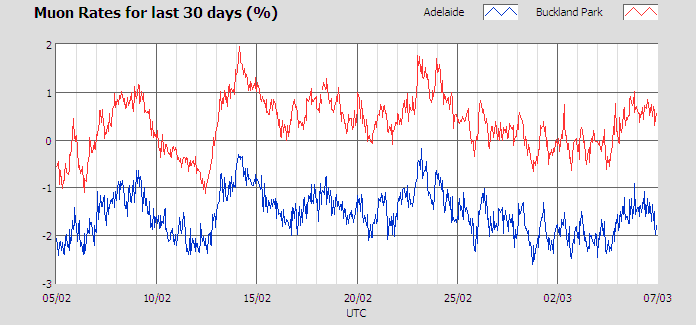
The University of Adelaide operates a one square metre muon detector on the Adelaide Campus, which records the number of detected cosmic ray muons every 15 minutes. The detector was originally designed to provide data for undergraduate teaching purposes including student project work. There is a larger system 40 km north of Adelaide at Buckland Park. This is made up of eight one square metre scintillator muon detectors, with four detectors being in the form of a square above the other four detectors. By taking coincidences between vertically placed detectors, or diagonally spaced detectors, nine directional 'beams' can be made and we measure the muon rate for each of those. We additionally record the total count rates, the second by second total rate, and the rates of small cosmic ray showers which trigger more than two detectors 'in coincidence'. The Adelaide and Buckland Park systems make up HEAMS. The original Adelaide system was intended for teaching undergraduate students about heliospheric processes, inclusing CME's and associated Forbush decreases. The Buckland Park system was then built out of scintillators and electronics previously used for the Buckland Park air shower array. It's construction and commissioning was originally done by Roger Clay and Neville Wild, with Abdullrahman Maghrabi working on it for his Master's project work in the late 1990's. Abdullrahman's continuing interest later led to some financial support from his home institution for the HEAMES upgrade. The original Adelaide system showed some progressive drifting to lower sensitivity over a period of about a decade. This was pointed out to us by colleagues at Moscow, and reported by them at the Rio International Cosmic Ray Conference. This drift was believed to be due to a progressive deterioration of one of the four scintillator slabs in use within one of the two Adelaide detectors. The interest of our international colleagues encouraged us to upgrade to HEAMS with the use of an FPGA to add many more monitored channels at Buckland Park. It is hoped that these data will complement scaler data from the Pierre Auger Observatory, which is located in Argentina at the same latitude and about 206 degrees shifted in longitude. The Adelaide detector is below three concrete floors in a building, which means that it has a slightly higher energy threshold than the Buckland Park system for vertically arriving muons. The diagonal beams for Buckland Park arrive at zenith angles of 60 degrees or more, and they have even higher thresholds due to the extra atmosphere which they must pass through. Cosmic ray muons make up something like half of the natural sea-level radiation background. They are produced high in our atmosphere from the interactions of primary cosmic ray particles with atmospheric gas nuclei. The muons then lose energy as they pass through the atmosphere to reach us. Some will lose so much energy that they fail to reach us and, as a result, there is a dependence of the muon rate on the atmospheric pressure. The primary cosmic rays reach the Earth after travelling through the solar wind. Not all of them are able to make that journey, especially when there are strong solar outbursts. As a result, the rate of detection of muons depends on the "solar weather" and, at times of solar flare activity, there may be significant changes to the muon rate known as "Forbush decreases". These are naturally more common at times of maximum solar activity which follow an eleven year cycle. Solar activity is currently building towards the next maximum, expected in the year 2000. The muon detector is located in the Physics Department of the University of Adelaide with about 300 g cm-2 of building material above it. Our atmosphere has a depth of about 1000 g cm-2 so, assuming that muons lose energy by ionisation at a rate of about 2 MeV(g cm-2)-1, the threshold energy (at production) for the muons we detect is a rather high 2.6 GeV. To get lower energies, neutron monitors are used since neutrons do not suffer ionisation energy loss in passing through our atmosphere. The Earth's magnetic field prevents low energy charged cosmic rays from reaching the atmosphere. There is a rigidity threshold for all place on the Earth due to this. For Adelaide it is about 3 GV. By coincidence then, for protons, this is about the same value as the threshold for muons to reach the detector. A map of rigidities over the Earth can be found through the Chicago The data show a strong pressure dependence but, when a correction is made for that, variations relate to solar (heliosphere) effects. DataBelow is a plot of the data from the last 30 days. The lines represents the count recorded every 15 minutes for the Adelaide and Buckland Park components of HEAMS, corrected for atmospheric pressure assuming a linear relationship of about -0.2% count rate for each millibar increase in pressure.
Other DetailsTeaching with the Muon Detector. Information on Cosmic Ray Related Undergraduate Experiments [140KB, pdf]. Details and images of the Muon Detector Data Collected since July 2003. Some other related links.
|
|
|||||||||||||||||||||||||||||||||||||||||||||||||||||||||||||||||||||||||||||||||||||||||||||