Departments of Physics
Mathematical
Physics
Mawson Institute
for Antarctic Research
BRAGG CENTENARY
1886 – 1986
UNIVERSITY OF
ADELAIDE
Some reflections
on
"PHYSICS AT
THE UNIVERSITY OF ADELAIDE"
Edited by E.H.
Medlin
CONTENTS
Introduction 1
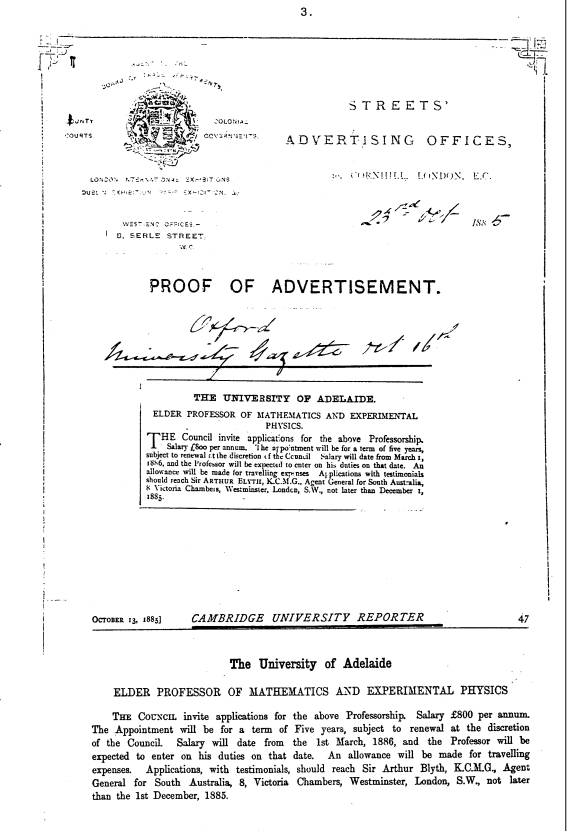
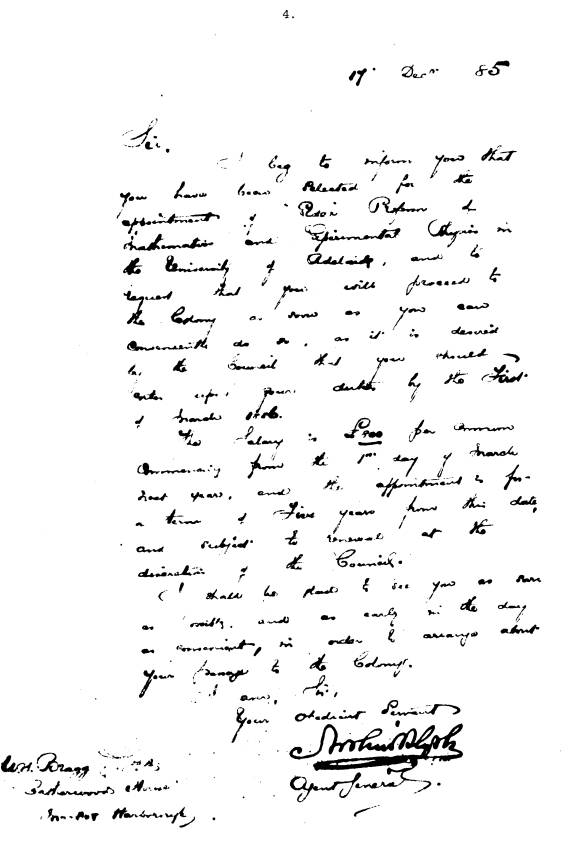
Advertisement and
offer of appointment 3
The Life and Work
of Sir William Bragg by
Sir Kerr Grant 5
The Appointment
of W.H., Bragg F.R.S., to the University
by Dr. John
Jenkin 38
List of Graduates 59
Prize winners 73
Holders of named
Offices 78
Academic staff 83
Introduction
Many people have
collaborated in the attempt to collect raw material for this 1986 Bragg
Centenary. It has not been a straightforward task even to attempt to collect
complete and accurate data over the 100 years since 1886. There are
inconsistencies between Acts, Statutes, decisions by the Council, Registrarial
practices and so on, not to mention the (wholly understandable) vagaries of
departmental approaches to their origins and histories.
Most of us engaged in this
exercise are (well-intentioned) amateurs and, as such, have felt privileged to
assemble the material for plundering in good time by the real professionals. We
have been awed by the professional expertise
by Rod Home, Susan Woodburn and Pamela
Runge but we have had to press on, regrettable errors and omissions no doubt
notwithstanding. We hope that we have prepared a reasonable base for serious
reflection and scholarship.
The graduate list presented
herein is that of the Bragg Centenary Commemoration Programme supplemented by
those past B.Sc. students who have responded to our public call to identify
themselves with one or the other of the three departments involved. With regard
to Prize and Scholarship winners we have deliberately restricted ourselves to
achievements whilst in Adelaide.
Certain biographical
material was available for some of the many graduates and staff who have
achieved distinction in other parts of the world. That material is
insufficiently complete to justify inclusion. For the time being, it is
regretted that names will have to speak for themselves.
The essential criterion
applied in the listing of academic staff has been that the positions and
incumbents should have been listed in the University Calendars. Records of
distinguished visitors are very incomplete and partial listing was judged to be
invidious; the same is true of the general staff many of whom served with
distinction over many years. It is to be hoped that this regrettable defect
will be corrected, and quickly.
2.
The Committee that
conceptualized these Celebrations, under the general stewardship of
W.G. Elford, was:‑
P. Berry‑Smith
A. Del Fabbro
A. Ewart
H.S. Green
R.B. Potts
S.G. Tomlin
E.H. Medlin
(Chairman)
Thanks are due
and acknowledgement is made to the following for their generous services:-
Peter Berry-Smith, Basil
Briggs, Don Creighton, Albert Del Fabbro, Graham Elford, Alan Ewart, Maxine
Ewart, David Fearnside, Oliver Fuller, Mary Genovese, Wayne Hocking, Rod Home,
John Jenkin, Keith Merry,
John Prescott, Pamela Runge, Peter Schebella, Arlene Shaw, Stan Tomlin,
Rosemary Vasey and Susan Woodburn. The
dedication of Alan and Maxine Ewart, of Albert Del Fabbro and of Arlene Shaw is
particularly acknowledged.
The Celebrations have been
strongly supported by "The University of Adelaide Foundation" and our
gratitude is expressed and hereby recorded.
Finally, the whole occasion
has been endorsed as an Official South Australia Jubilee 150 Event. The
discipline of physics is now practiced in three buildings. The main Physics
Building was the first gift of a building (1926) to the University by the State
Government and commemorates its Diamond Jubilee this year. The other two
buildings commemorate two of our greatest scholars, namely Sir William Bragg
and Sir Mark Oliphant. We are privileged to share our Celebrations not only
with the comet but also with the community, which we aim to serve, and
especially during this Official Event with our presentations from Professors
Stephen Bragg, Frank Close, Paul Davies, Freeman Dyson and Brian Matthews.
Harry Medlin. 1 April 1986.
5.
THE JOHN MURTAGH
MACROSSAN MEMORIAL LECTURE FOR 1950*
THE
LIFE AND WORK OF
SIR WILLIAM BRAGG
by
Sir Kerr Grant
Emeritus Professor of Physics
University of
Adelaide
*Reproduced by courtesy of the University of Queensland.
6.
INTRODUCTION
The celebrated autobiography
of Benvenuto Cellini begins with the words "it is the duty of all men who
during their life‑time have accomplished anything of merit to write an
account of their life with their own hand". In default of such a self‑recorded
history it may perhaps be said with equal justification that this obligation devolves upon the contemporaries or
successors of a famous man to see that the story of his life and deeds is fully
and faithfully recorded in order that posterity way know what manner of man he
was to whom it owes a debt of service or achievement. This public duty is, in
fact, one of those specifically laid down in the terms under which the John
Murtagh Macrossan Foundation was established, and it has been previously
honoured on many occasions in this series of lectures.
In selecting the "Life
and Work of Sir William Bragg" as another to be commemorated under this
Foundation, the Professorial Board of the University of Queensland has made no
unworthy choice; in honouring me with an invitation to undertake the task,
reason was doubtless found primarily in the fact of my succession to him in the
Chair of Physics in the University of Adelaide.
The association thus
entailed with his former colleagues on the staff of the University, his
relatives and friends in Adelaide, and old students who attended his classes
does indeed place me in a privileged position to obtain from them and from
other sources, first‑hand information concerning the man himself and the
details of his life while he lived among them; further, it was, no doubt,
assumed that a Professor of Physics might be expected to posses, at the least,
a general acquaintance with those aspects of Physical Science, to which, in the
main, Bragg's researches and discoveries belong.
I can only hope that such
advantages ass I may possess in these respects may serve in some degree to
outweigh the disadvantage of my inexperience in the art of literary
presentation in this field.
But whether or not the
choice of a biographer has been wisely made, it was at any rate a wise decision
not to postpone too long the interval between the death of the subject of the
biography and the collection and recording of the factual data which must form
the foundation for a story of his life.
The apocryphal elements in
the life‑histories of many famous men warn us how soon in the absence of
reliable temporary records, many things we would wish to know concerning their
lives are either irrecoverably lost, incrusted with the lore of legendary
fiction or shrouded in the mists of myth. How soon too, does the opportunity
pass for the biographer to secure from the relatives, friends and acquaintances
of one deceased, direct testimony concerning his personal characteristics, the
circumstances of his daily life and all the trivial yet nevertheless
significant actions and events without knowledge of which he can at best
prepare a mere factual record devoid of the human appeal and living semblance
of a "flesh‑and‑blood" portraiture.
Already, in the case of Sir
William Bragg, two only of his former colleagues on the staff of the University
of Adelaide ‑ Sir William, Mitchell and Sir Douglas Mawson survive, and
only two relatives by marriage ‑ Miss L.G. Todd and Mrs. Guy Fisher are
now resident in Adelaide.
7.
Sources of Information
His only, surviving son, William Lawrence (now Sir Lawrence) and his
only daughter Gwendolen (Mrs. Alban Caroe) are resident in England. Sir
Lawrence Bragg has been so kind as to send to me excerpts from an
autobiographical statement of his father concerning his early life prior to
coming to Australia.
Miss Lorna Todd has furnished me with a most interesting statement
setting forth her reminiscences of Bragg's associations with her father, Sir
Charles Todd and his family culminating in his marriage to her younger sister.
Sir William Mitchell also has told me much concerning his colleague during his
tenure of the Chair of Mathematics and Physics in Adelaide University. Sir John
Madsen, who was Lecturer of Electrical Engineering in Adelaide during the last
years of Bragg's term as Professor of Physics and who co‑operated with
him in research work, still recalls clearly the conversation in which Bragg told him of the new point of view at which he had arrived
regarding the nature of alpha‑rays, a point of view which subsequently
led to a triumphal march of successes in experimental research. Others, whose
acquaintance with him was of a more limited character such as that of student
to teacher ‑ have contributed items of personal recollection.
My own opportunities of a close personal acquaintance with Bragg were
unfortunately few, comprising only one brief meeting in Melbourne shortly prior
to his departure to England; subsequently, occasional meetings and
conversations during my visits to England in 1919, 1927 and 1931, and
occasional correspondence.
Of literary sources available to me the most valuable as a record of
his work and picture of his personality is the excellent obituary written by
Professor Andrade of London University for the Royal Society of London.
A full appreciation of his scientific achievements could, of course,
only be based upon a critical study and evaluation of ‑ the numerous
papers contributed by him to the proceedings of scientific journals, or as set
forth in the several books in which the contents of these were collected and
integrated. It is neither my intention nor my prerogative to attempt more in
these lectures towards such an appreciation than to endeavour to indicate the
salient points in method and the main results of his researches. Sir Lawrence
Bragg has informed me that it is his intention to write a full biography of his
father and an account of his scientific work when in a few years time his
retirement from office will afford him the leisure to undertake the task.
In the realm of popular exposition Bragg was an acknowledged master.
Several lecture‑courses which he gave at the Royal Institution are
published in book form. These also aid his biographer in his efforts to attain
the difficult goal of "presenting a life‑work in full and
significant delineation".
Heredity
William Henry Bragg was the son of Robert Henry Bragg who, at the early
age of 25, gave up a post in the British Merchant Navy to purchase and
cultivate a farm in the village of Westward near the town of Wigton in
Cumberland. His mother, Mary Wood, was the daughter of the Vicar of the parish.
There seems to be little evidence to permit of a decision on the
controversial and invidious question as to whether the son owed his outstanding
intelligence to his father or to his mother. Moreover, in the light of the
science genetics, the question is over‑simplified, the grand‑parents
and even
8.
remoter progenitors are claimants also to whatever congenital merit or
demerit is assigned to any one of their descendants.
Heredity, despite the
mathematical regularities which the work of Mendel and his successors have
revealed in its operation, can play strange tricks. The appearance in their off‑spring
of characteristics which neither parent is eager to claim as his (or her)
donation ‑ I have been told ‑ a not infrequent source of marital
altercation; the occasional Emergence of individuals of exceptional ability
from a line of undistinguished ancestry (such illustrious names as those of
Newton, Faraday and Einstein immediately occur to a physicist) may seem even
more inexplicable.
On the other hand there is
abundant evidence to show that, in common with other physical and mental
characteristics, exceptional ability can and does descend from generation to
generation. In England we have as illustrious instances of hereditary
scientific genius the families of Darwin, of Herschel and of Huxley. There is
already sufficient evidence to justify the addition of the name of Bragg in his
honourable gallery.
The possession of
exceptional scientific and mathematical ability is fully attested for two
generations in the achievements of father (W.H.) and son (W.L.); less well
known is the possession of distinctive artistic talent by the father (W.H.),
his second son Robert (killed at Gallipoli) and his daughter Gwendolen (now
Mrs. Alban Caroe). I learn from Miss Todd that the genes of genius have
persisted into a third generation. Sir Lawrence Bragg's eldest son has had a
distinguished scholastic career in mathematics at Rugby and at Cambridge,
where, in succession which is probably unique, he is a Scholar of Trinity. In
the second son the gene of artistic ability is again strongly dominant.
Childhood and Early Education
Both Bragg I s parents died
young ‑ his mother when he was only seven ‑ and the responsibility
of providing him with a home and education was willingly accepted by an uncle,
William Bragg, who lived in the town of Market Harborough in Leicestershire, and
had played a part in the re‑establishment of the local grammar school.
In some notes written by
himself at the age of 70 concerning his early life, which I owe to the courtesy
of Sir Lawrence, Bragg has given an interesting account of his experience at
this school. It was not a very large one. " I was one of the six
boys", he said "with which it opened. At the end of the first year I
was given a scholarship exempting me from payment of fees. At the prize-giving ‑
there were many more than six boys at that time ‑ my name was called out
and I went up to the desk to get the scholarship, not knowing what it was. I
was puzzled and disappointed to go back empty‑handed."
The precocity which is a
common if not an invariable indication of future genius, was not lacking in the
school‑boy Bragg. At the early age of eleven he entered for and passed in
the "Oxford Junior Locals", the youngest boy in England to get
through.
His home life during this
period, despite the care and affection bestowed upon him, was perhaps
unfortunate in respect of the narrow religious atmosphere which prevailed, with
its insistence on an unquestioning acceptance of prevalent orthodox beliefs.
9.
At the age of 13, having
probably reached the limit of the school's capacity to go further, his uncle
sent him to King William's College in the Isle of Man. Here he rapidly
developed a proficiency in his studies ‑ and especially in mathematics ‑
on the one hand and in school sports on the other.
This latter accomplishment
was fortunate, for he confesses to having been a shy and retiring boy ‑
though it seems likely that this may have been due mainly to the fact that he
was younger than his classmates ‑ and to excel in games was probably
then, as now, a school boy's surest passport to popularity with his fellows. He
rose, at any rate, to be Head of the school. In 1880 he entered for the
examination for Scholarships at Trinity College, Cambridge, and was awarded
one, but on advice of the authorities, delayed his entrance for a year.
It was in this year, at the
age of 18 ‑ a critical period in the emotional life of an adolescent ‑
that the school he attended was, in Andrade's words, "swept by a storm of
religious emotionalism" in which Bragg by reason of the revolt of his
reason and sympathy against the irrational and inhuman dogmas of Athanasian
theology, was involved so deeply as to recede rather than to progress in his
studies and failed at the next scholarship examination to equal his previous
performance. Nevertheless, he was awarded a minor scholarship and entered
Trinity College, Cambridge University in 1881
In this new environment
where ‑ unless the social and intellectual climate of Cambridge was very
different then from what it is today ‑ at atmosphere of spiritual freedom
and intellectual tolerance envelops the formalities of religious observance and
the dogmas of theology this brief unhappy interlude of religious melancholia
could not endure, and the young Bragg entered upon a new life full of interest
and enjoyment.
He now lived and worked as a
student in Trinity College he has told in his own words, written in 1927.
" I went up to
Cambridge in 1881, taking the rather unusual course of beginning work there in
the Long: I suppose I was in Cambridge six weeks or so, July and part of August.
But I forget the exact date. I had rooms in master's Court. I appreciated
thoroughly the beauty of the whole place; and I liked going to Routh's classes.
It was lonely, because I was doing the unusual thing: and I had no companions.
But it was good all the same. As a scholar of the College I went up every Long
afterwards: it was always a jolly time. Very few restrictions: just the regular
classes three times a week with Routh, and the preparation for them. After that
tennis in plenty: boating on the river above Cambridge, and the summer weather,
and Cambridge looking its best. I tried during that preliminary long to get
through an exam that would excuse me the Littlego: and I failed in Latin, which
seems to me now to be very odd, as I had studied Latin from the time I was
seven and given a lot of schooling time to it, and worked conscientiously too!
I had to take the Littlego, in November after all.
Cambridge gave me a good
time, of course: although I might have done mach better if I had known more or
been more easily sociable. I ought to have gone to lectures on other subjects
than mathematics, and taken an interest in other things. It simply did not
occur to me. I could not afford, or thought I could not afford, to join the
Union or the Boating Club: which cut of f a good many opportunities. I had none
of those experiences of discussion of the world and its problems with other
young men, which many men seem to look back upon with so much pleasure. I
worked at the mathematics all the morning, from about 5‑7 in the
afternoon and an hour or so every evening, and then bed fairly early. Every
10.
afternoon I played a game, generally tennis, or went for a walk: my
tennis was fairly good, so that I always found people ready to play."
There is an omission of a
sentence or two in this except which can be made good from Andrade's obituary;
it refers to the congratulations received from friends on his success in the
Tripos examination. One of these was A.N. Whitehead, later of world‑wide
reputation as a mathematician (he offered a derivation of the principle of
relativity alternative to Einstein's) and philosopher (he is now Professor of
Philosophy at Harvard) "who came and shook me by the hand saying 'may a
fourth wrangler congratulate a third."' He had been fourth the year
before.
After his crowning success,
Bragg continued his mathematical studies and sat for the more advanced
examination, Part III of the Tripos, as it then was. of the result of this he
says, humorously, "I believe that none of us did too well, but nearly all
got Firsts because the Senior Wrangler did not do any better than we did and
they could not give him a second."
APPOINTMENT
TO THE ADELAIDE CHAIR
Bragg, in his reminiscences,
tells the story of how he came to apply for and be appointed to a Professorship
in the University of Adelaide. In 1885 the Chair of Mathematics and Physics had
been rendered vacant by the resignation of Professor Horace Lamb, who was the
first occupant at the date when the University was established in 1874 and who
now wished to return to England, where he had been offered the Chair of Pure
Mathematics in the Owens College, Manchester. According to a practice still
customary, the vacancy was advertised in the English press. Bragg had seen the
advertisement but had not though of applying, believing that his youth (he was
only 23) and entire lack of teaching experience would make his chance of
appointment negligible. However, on his way to a lecture by J.J. Thomas
(afterwards famous for his discoveries in the realm of atomic physics) he was
joined by the lecturer, with whom he also had social acquaintance. The
conversation turn on the Adelaide Chair. As a result of Thomson's advice Bragg
telegraphed an application ‑ it was the last day of entry.
There were only a few applicants
and Bragg was one of the three on the “short list" selected for interview. The interviewers were
Professor Lamb, J.J. Thomson, and the Agent-General for South Australia, Sir
Arthur Blyth. They also called in, to assist them in making a final choice, an
Adelaide man who happened to be in London at the time. He was Mr. (afterwards
Sir) Charles Todd who certainly did not know then that he was helping to bring
to Australia not merely a professor but his own future son-in-law.
Another applicant much senior
to Bragg was a Senior Wrangler of great ability whose claim to preference was,
however, discounted by, his partiality for the contents of the bottle which, if
it sometimes cheers, too often inebriates. So the choice fell upon Bragg, to
whom it was first conveyed by a telegram from Australia that same evening,
worded "As new professor of Mathematics and Physics in Adelaide University
would you give some particulars of your career." Bragg's delight in an
appointment which offered him, in his own words, "an assured position, a
salary beyond all expectation (£800 a year), a new country with all the
adventure of going abroad to it, and a breakaway from being a subject, to be
now my own master" was tempered by the distress which the prospect of
losing him caused to his worthy and benevolent old uncle to whom he was
evidently as dear as a son, a distress, however, relieved by pride in "his
nephew the professor".
11.
Fifty years later Bragg
could still recall and record the enthusiasm and excitement of the preparations
for departure: the novel experiences of the voyage to Australia in the largest
vessel of the P. & 0. fleet ‑ the "Rome" of 4,500 tons ‑
and his efforts to learn something about physics (for his studies at Cambridge
had been confined to Mathematics alone) during the voyage by reading
Deschanel's Electricity and Magnetism!
Long years afterwards, when
I paid him a visit in London and congratulated him on his appointment as
Fullerian Professor of Chemistry in the Royal Institution, he said with humorous
enjoyment: "The joke of it is that I always seem to be appointed as
professor in subjects about which I know nothing." It was true, no doubt,
that when he went to Adelaide he knew little or nothing of the formal physics
of the text book; possibly true that when he took the Fullerian Chair of
Chemistry not much more of text‑book Chemistry. But these deficiencies of
academic knowledge had the advantage of leaving him with a clean sheet on which
to write his own self‑acquired knowledge on these subjects and, as one of
his most distinguished disciples (Dr. W.T. Astbury) says: "He had the most
amazing faculty of taking up a subject on which he had only the foggiest ideas
to begin with and quickly improving it out of all recognition."
From the first day of his arrival
Bragg thoroughly enjoyed his life in Australia. He was fortunate in that the
acquaintance already made in London with Charles Todd ‑ who was Director
of the Adelaide Observatory ‑ immediately opened to him the door of a
delightful domestic circle comprising in addition to the father and mother,
three daughters and two sons. Very soon he, with a new friend, the late Dr.
Alfred Lendon, became a regular Sunday afternoon and evening visitor at the
Observatory home. “We were a cheerful party there," writes Miss Lorna Todd
(who was eight years old at the time). "Fierce arguments over religious
and social subjects were the order of the day amongst the men. The
irresponsible and illogical chatter of my sisters" (thus irreverently did
this child of eight characterise the conversation of her older sisters)
"delighted him most. It was a revelation to a young man who had been
taught to weigh every word he uttered, and he blossomed under the cheerful and
inconsequent atmosphere."
A very natural and happy
sequel to this idyll of domesticity was the marriage in the year 1889 of
William Henry Bragg to Gwendoline, third daughter of Sir Charles and Lady Todd.
Of this marriage there was
issue to sons, the first, William Lawrence (now Sir Lawrence, Director of the
Cavendish Laboratory); the second, Robert, who was killed in the Gallipoli
misadventure of World War I, and one daughter Gwendolen (Gwendy) now Mrs. Alban
Caroe of London.
Bragg, from the very first,
was marked as a born teacher and lecturer. Professor Andrade says (quoting ‑
no doubt from hearsay ‑ some Adelaide source) that in his early days
"he was one of the least impressive of lecturers." If there is any
justification for all this disparagement it may rest either on his complete
inexperience in the art of lecturing or in his disdain of the use of rhetoric
in which one of his colleagues, himself a master of that "poison of
sincerity" was wont to appraise the quality of another's oratory.
Students who, at a later
date, attended his lectures have one and all agreed in crediting him with
exceptional powers of lucid exposition, so much so, indeed, that they accuse
him of having been able to invest his discourse on abstruse topics with an
altogether delusive simplicity. His interest and influence in educational matters
soon spread beyond the precincts of the University. The curriculum of the
secondary schools in South Australia, as more or less in all Australian States,
dominated then as it is now by the public
12.
examinations syllabus, and, in particular, by the subjects demanded for
matriculation, was still modeled on that of English public schools with their
almost exclusive emphasis on the ancient languages and mathematics. Any
scientific subject, if grudgingly permitted an hour or two a week of the timetable,
was taught largely as an exercise in memorisation of the text‑book with
little or no appeal to observation, lecture‑demonstration or laboratory exercises by the student.
Bragg was not long in
raising his voice in criticism of this defect and in pleading the claim of
science to be regarded as an educational medium of high practical value.
At the commemoration address
which he gave in December, 1889, he concedes, doubtfully, the claim that the
classical system of education "may perhaps develop in the younger
generation the capability of fulfilling duties in certain traditional
ways," but, he continues, "it does not so train their minds that,
having a knowledge of the tools that modern science provides and judgement as
to what may be done with them they may strike out for themselves new kinds of
Work and new methods of working."
In the same address and on
subsequent occasions he strongly advocated the introduction of practical work
in school physics. "Every year," he said, "I have answers from
book‑taught candidates which show a practical ignorance of physics."
To emphasise his views he relates an amusing story of a youth's answer to an
oral examination to the question:
"What is the use of a
compass?"
After much hesitation came
the answer:
"To find the latitude
and longitude."
on the examiner asking
"Could you do it?" the examinee promptly replied: No, Sir, but YOU
could."
So far as the schools went,
his exhortation, if heeded at all, led only to the casual and perfunctory
performance of an extremely elementary type of practical exercises in physics
in one or two of the larger schools. But, in his own University classes,
systematic practical courses were very soon established, he himself for many
years acting as instructor with little or no junior assistance.
His scientific interest
seems to have turned, immediately after the assumption of his duties, from
mathematics to physics. Indeed the mathematics required for the Cambridge
University examinations in those days was perhaps not of a type to inspire many
to pursue it further. From the first he found particular pleasure in
demonstrating, both to his students in the routine lecture‑courses, and
in public lectures and conversaziones, the more novel and spectacular miracle
of scientific discovery. In these latter his young wife's social talents proved
an invaluable asset.
Success in presenting the
results of scientific research to a popular audience, unacquainted for the most
part with the basic facts and principles of the special science in question,
demands from the lecturer not merely a thorough understanding of his subject
but the ability to translate the technical terminology of science into the
language of every‑day usage. In this art, Bragg was singularly gifted. In
the light of the nature of his subsequent achievements it is interesting to
note that in 1895 the subject of a course of extension
13.
lectures was "Radiation"; in 1896 "X‑rays";
in 1897 "Sound". Undoubtedly the task of preparing these lectures and
the experience gained in the technique of experimental demonstration must have
served to lay a solid foundation of knowledge and skill which stood him in good
stead in his future researches in the fields of radio‑activity and X‑rays.
Bragg also followed with
keen interest the news which reached Australia from time to time of the
remarkable discoveries and developments which were at this time (1895 and
onwards) taking place in Europe in these last‑named subjects and in
wireless telegraphy.
But he did more than merely
read about them and talk about them. He promptly set about reproducing them by
his own efforts with the very slight amount of technical assistance and meagre
stock of instruments and apparatus which his laboratory possessed. Especially
was his interest aroused by the discovery of X‑rays by Professor Rontgen
of the University of Wurzburg in 1895. Rontgen published his discovery in
December, 1895; news of it reached Australia in a brief cable in January, 1896.
In common with Professors of Physics in other Australian Universities, Bragg
was immediately stirred to find means to produce this new kind of
"invisible light".
X‑rays are produced by
the impact of an electron stream on any solid object and to realise this all
that is essential is an evacuated glass bulb into which are hermetically sealed
two metallic electrode, and a source of high tension electricity. The type of
vacuum‑tube used by Rontgen when he made his immortal discovery, was
first designed and constructed by Sir Wm. Crookes and employed by him in his
researches on the passage of electricity through rarefied air; the high‑tension
electricity was supplied by a Ruhmkorff induction‑coil. The meagre
equipment of the physics laboratory in those days did not include a Crookes
tube and to have imported one would have meant a delay of several months.
Fortunately Bragg's laboratory assistant, Mr. A.L. Rogers, was skilled in the
art of glass‑working and by Bragg's direction at once proceeded with the
attempt to construct a small tube. In this he was ultimately successful, but
before the first tube was satisfactorily completed a citizen of Adelaide, Mr.
S. Barbour, returned from a visit to England bringing with him two Crookes
tubes purchased from a British firm. With the co‑operation of Professor
Bragg remarkably good radiographs were taken with these tubes.
Subsequently Mr. Rogers made
and evacuated many tubes which were successfully employed in medical
radiography.
Professor Bragg's eldest
son, William Lawrence (now Sir Lawrence) was a child of five at the time of
these experiments in which, nevertheless, he was on one occasion a participant.
In his foreword to the publication of Messrs. Watson and Sons' book entitled
"Salute to the X‑ray pioneers of Australia", Sir Lawrence
writes: "I well remember my father's first experiments with X‑ray
tubes, although I was only six years old at the time. I think I must have been
amongst the first to be employed as a patient. I had smashed my elbow badly by
a fall and was taken to a cellar in the University for the exposure. The
flickering greenish light, crackling and smell of ozone were sufficiently
terrifying to impress the incident deeply in a child's mind. When I think,
however, of the early experiments, the interest which they aroused in medical
men in Australia is not their chief significance to me! I see them as fore‑runners
of my father's interest in the ionisation of gases leading to his experiments
with X‑rays from radium and finally the experiments on the diffraction of
X‑rays by matter which we carried out together."
14.
The letter "X"
which Rontgen chose to designate this new type of radiation, had reference of
course to his confessed ignorance of their true nature. (His tentative
hypothesis: "Ought not the new rays to be ascribed to longitudinal
vibrations in the ether?" was fallacious.) It was not until 1912 that the
experiments of von Laue in Germany, confirmed and extended in the next year by
the Braggs, father and son, definitely proved them to be essentially identical
in character with ordinary light. But among the apparatus which Bragg left
behind him in the Physics laboratory was a large prism made of pure sulphur. On
the testimony of Sir Lawrence Bragg, quoted in the publication just referred
to, this was made with the special object of testing whether a beam of X‑rays
would be refracted in passing through this prism. If this recollection is
correct it shows that the problem of elucidating the nature of X‑rays was
already occupying the elder Bragg's attention many years before its final
solution. (I am personally somewhat doubtful of the correctness of this
opinion, recalling the answer given to my question by Professor R.W. Chapman
who as a lecturer under Bragg was in a position to have first‑hand
knowledge that the prism was used for experiments on the refraction of electric
(Hertzian) waves.)
In the same year in which
Rontgen discovered X‑rays a young Italian, Guglielmo Marconi, was
experimenting in his home town of Bologna on the transmission of signals by
means of wireless telegraphy. Coming to England (his mother was Irish) in 1896
he found encouragement, financial support and technical assistance from the
British General Post Office, and we all know of the remarkable developments in
wireless communication which followed. In 1898 Professor Bragg was granted a
year's leave of absence to visit England with a commission to inquire into
matters of educational interest. His contacts with many eminent men of science
must have created an interest in this new method of communication, for soon
after his return he began experimenting in wireless transmission, first within
the University and then from a transmitting station in the Observatory grounds
to Henley Beach ‑ a distance of about five miles. I quote from Miss Lorna
Todd's lively account of this event: "I think I am right," she says,
"in saying that the first wireless pole to be erected in Australia was in
the Observatory grounds. A receiving pole was put up on the sand‑hills at
Henley Beach. My brother‑in‑law did much experimental work there.
One afternoon I remember that my father asked me to pack tea and drive down
with him to Henley Beach, saying he would send a 'wireless' to say that we were
coming. I felt a very 'doubting Thomas' as I packed a specially nice tea and
tied paper around the blackened picnic billy‑can (there were no thermos
flasks in those days). However, when we got within sight of the tall pole on
the sand‑hill there was my brother‑in‑law waving his arms and
his cap, as thrilled as any schoolboy that the message had come through. It
seemed a miracle. Both he and my father were almost boyish in the delight and
the fun of the discoveries then being made so rapidly in science."
FIRST ORIGINAL RESEARCH WORK IN ADELAIDE
It has been a matter of
remark by some who have discussed or commented upon Bragg's scientific career
that his entry into the arena of scientific research should have been so long
delayed.
It was not, in fact, until
he had attained the age of 46 and had occupied the Chair of mathematics and
Physics in the University for 18 years that he published anything of a quality
entitling it to be considered as an important contribution to existing
knowledge.
15.
This long interval during which his genius for experimental research
lay latent, is indeed an exception, though by no means a solitary one, to the
general rule that creative imagination and scientific activity are at their
highest in the spring‑time or early summer of life.
In Bragg's case there are plausible grounds of explanation for a
seasonal retardation.
As already stated, his natural interests were those of the physicist,
rather than of the "pure" mathematician, yet his whole academic
experience previous to his election to the Adelaide Chair had lain exclusively
in the former discipline. Thus before he could even glimpse the horizon which
bounded the great sea of existing physical science at that date ‑ a
horizon more‑over which was expanding so rapidly that it continually
receded from the voyager pursuing it ‑ he had an immense leeway to make
up.
It is, of course in that unknown land beyond the horizon that lies the
realm of scientific discovery, the realm of "research".
But that word had 'not, half a century or earlier ago, even in
scientific circles ‑and certainly not in the politics of University
finance ‑ attained the portentous significance which to‑day
entitled it to vie in blessedness with "Mesopotamia" of sacred
utterance.
Research had not yet acquired the status of a professional business.
Rather was it then regarded as a natural and unforced by‑product of
academic employment and intellectual interest; subordinate, nevertheless, to
the performance of the professor's contractual obligation to train his students
in the discipline of his special science, and to serve the general public as an
authority and consultant on whom reliance could be placed for trustworthy
information or wise counsel in all matters relating to his particular province
of expert knowledge. It was in such a light, doubtless, that Bragg would view
the responsibilities of his post.
His teaching duties at the outset were not onerous ‑ there were
in his first year only two students in the laboratory ‑ but he did not
hesitate to enlarge them whenever he saw occasion and opportunity.
For the benefit of those who could not attend during the day ‑
mainly teachers in secondary schools ‑ he instituted night‑lectures
and practical work, which he conducted.
Sir William Mitchell has told me of the surprise and pleasure which he
felt when, on his arrival to occupy the chair of English in 1894, he found that
a branch of the British Teachers' Guild
in which he had been
interested in Scotland had already been established by Bragg in Adelaide. The
high esteem in which he was held by the teaching profession and the gratitude
and affection which they felt towards him were publicly expressed in tributes
paid to him at a Teachers' Conference held in July, 1908, shortly after his
decision to accept the invitation from Leeds University had been announced.
It need not be denied that other and distracting human influences
competed strongly with the "divine curiosity" which is the stimulus
to the task of intellectual pursuits. Bragg was no indoor recluse; he was
athletic in body as he was active in mind. He had a love for all healthy
outdoor sports and pastimes and indulged his liking in actual participation. By
his own account (already quoted) he played tennis well and no doubt, found in
it pleasant opportunities of social recreation.
16.
He took up golf and became
one of several devotees among his colleagues (Mitchell and Henderson were fellow‑practitioners
of that Royal and Ancient game) and become so proficient that in the year 1907
he was beaten in the championship contest only on the last two holes of the
course by Henderson. He introduced the Canadian game of lacrosse to South
Australia and was for several years captain of the North Adelaide Lacrosse
team.
To these athletic
proclivites he added artistic talents of no man order. He sketched and painted
in water colours with the hand and eye of a true artist. His wife shared with
him this delightful talent ‑ her teacher, Mr. H.P. Gill, would speak of
her as a "first‑class artist ruined by marriage". During
holidays husband and wife would sometimes sketch or paint, in company, a scene
that took their fancy.
Gifted with a good musical
ear, he not only enjoyed music but was himself a competent performer on the
flute, an accomplishment which, on the testimony of Professor Andrade, he still
practiced in his later London years.
Possessor of a fine presence
and of all the social graces, he was a popular guest at social functions and
entertainments whether public or private.
Fortunate in a happy
marriage, blessed with and devoted to a family of two sons and a daughter, it
might well be thought that he would have found his life in Adelaide so full and
satisfying as to exclude all thought or wish of change or adventure either in
the world of reality or the world of ideas.
But underneath all the
pleasant preoccupation and lighter interests of his life there smoldered the
urge to creative intellectual effort, nourished by the news of one great
discovery after another in physics, and awaiting only the moment of inspiration
to break out in action. Neither was this period of latent activity wholly
devoid of all contribution to science.
In 1891 he contributed a
paper to the Proceedings of the A. & N.Z.A.A.S. entitled "The elastic
medium method of treating electrostatic theorems" and, as a sequel to
this, in the following year another on "The energy of the electrostatic
field", published in the Transactions of the Royal Society of South
Australia. This latter he amplified and presented again at the Brisbane meting
of the Association in 1895.
These papers are all in the
true Faraday‑Maxwell tradition, in which the mathematical theory of
electric and magnetic fields is based on analogy with the state of an elastic
medium under stress.
They were essays in
mathematical physics which put known results in a new light, ingenious
variations on well‑established theory, but they contained no result of
importance previously unknown, and they neither reported nor suggested new
lines of experimental research.
The occasion initiatory to
such suggestion came with the duty of preparing the presidential address to
Section A of the A. & N.Z.A.A.S. at the Dunedin meeting of the Association
in 1904.
It is a recognised duty of
sectional presidents to present to their section a resume of important recent
advances in some branch of their special science. This was a time when new and
surprising discoveries were revolutionising basic ideas in regard to the nature
of matter, of electricity and of radiation and the mutual relations of these
entities to one another.
17.
Rontgen in 1895 had
discovered X‑rays; J.J. Thomson, in 1897, had experimentally proved the
existence of a universal type of electrical sub‑atom or corpuscle (now
called the electron); Max Planck of Berlin had shown that light is radiated
from atoms only in wave‑pulses carrying energy quanta proportionate in
amount to the frequency of the waves. Einstein, in the same year in which he
published his epoch‑making paper proving the relative character of
space-extension and of time‑duration had also suggested an atomic aspect
in the nature of light as a explanation of its power to eject electrons from
surfaces on which it fell. Niels Bohr of Copenhagen had successfully applied
Planck's quantum theory to solve the riddle of atomic spectra; the Curies, man
and wife, following upon Henri Becquerel's discovery of the radio‑activity
of the metal uranium, had isolated a new element, radium, a million times more
active. Rutherford had analysed the radiation from radium and its products of
disintegration and shown that it contained three entirely distinct kinds of
rays ‑ which he called the alpha (a), beta (a) and gamma (y) rays.
Into this last, as yet only
partially explored territory of the science of radioactivity now entered Bragg.
It came about in this way.
He chose as the topic of his
presidential address, "Some recent advances in the theory of
ionisation".
Ionisation is a phenomenon
which, as he states, "furnishes one of the principal methods by which the
strange new properties of radioactive substances are made manifest and
studied".
Neither air nor any other
gas in its normal condition conducts the electric current. But, when irradiated
by a beam of ultra‑violet light, or of X-rays, or of any of the three
kinds of radiation emitted by radioactive substances, or when traversed by fast‑moving
electrons, a small fraction of the molecules of a gas normally uncharged or
neutral may acquire either a positive or a negative charge by losing or gaining
one or more electrons. These electrically charged molecules are termed
"ions", the gas is said to be "ionised" or in a state of
"ionisation", and if a voltage difference is applied between two rods
or plates of metal immersed in the gas, the ions drift under the influence of
the electric force towards one or the other, thus effecting the transfer of
electricity which constitutes an electric current.
Already in 1904 a vast
amount of experimental work had been carried out by scientists in investigating
the nature and properties of ions, the laws of the ionisation‑current and
the properties of the various kinds of ionising agencies, in particular, the so‑called
alpha, beta and gamma rays of radium. and other radioactive substances
Bragg made a critical
examination of the information thus available on the penetrating and ionising
powers of these three kinds of radiation (alternatively, of the absorption
which they undergo in passing through matter) . He came to the conclusion that
there was a radical difference in these respects between the alpha rays and the
other two, concluding that whereas the main reason for the reduction in
intensity and ultimate extinction of a beam of beta‑rays in passing
through matter lay in the scattering of its moving electrons due to the
repulsive forces exerted upon them by the fixed electrons of the atoms through
which they passed, the alpha rays, by reason of their being nearly 2000 times
as massive as an electron, suffered little or no such deviation from this cause
and thus pursued a straight path until their initial velocity and energy were
exhausted by the work done in ionising ‑ or at least "exciting"
‑ atoms through which they passed.
18.
If this conclusion proved to
be correct, it indicated, said Bragg, the following practical applications:‑
(1) A means of identifying any species of
radioactive element ‑ provided it was
an alpha‑ray emitter ‑ by
observation of the range of its rays in air;
(2) a method of ascertaining
what and how many different alpha‑ray emitters were contained in a sample
of any radioactive material;
(3) a method of comparing
atoms of different kinds in regard to their "stopping power" for
alpha‑rays.
His conclusion as to a limited
but definite range for alpha‑rays was supported by an experiment
described by Madame Curie.
A think film of the
radioactive element polonium was placed on a metal plate. Parallel to this and
at an adjustable distance were fixed two other plates an inch or two apart, the
space between serving as an ionisation‑chamber. The plate nearest to the
radioactive source had a hole in it through which rays could pass.
It was found that ionisation
resulting from entry of rays through this hole took place only when the
distance from hole to polonium film was less than 4cm., indicating that the
alpha‑rays from polonium had a maximum range in air of that order.
On his return to Adelaide,
Bragg promptly made preparation for an experimental attack on this problem. With
the aid of a grant of X500 from a generous friend of the University he was able
to purchase a small quantity of radium bromide and the necessary instrumental
equipment. The Ionisation‑chamber he himself designed and had constructed
in his small workshop by a highly skilled mechanic, Mr. A.L. Rogers. In
principle it was similar to that employed by Marie Curie, but it incorporated
two vital improvements. In the first place, the actual ionisation‑chamber
was made very shallow, and the plate with the hole in it was replaced by a
sheet of thin metal gauze which afforded easy access of the rays to the
chamber. This enabled the effect of the rays to be measured at successively
varying distances from their source. Secondly, by mans of stops placed
vertically above the radium‑‑covered plate it was ensured that only
the rays which travelled perpendicular to the plate could reach the
ionization-chamber, so that the same number of rays, if any, entered the
chamber whatever its distance from the source.
Just as important as the
provision of the instrumental equipment was the fortuitous and fortunate
discovery and employment as an assistant of a young countryman named Kleeman.
This young man while
employed as a blacksmith in the country town of Tanunda, had brought himself
under Bragg's favourable notice by soliciting his help in the solution of some
mathematical problems. Correspondence resulted in an offer to Mr. Kleeman to
come to Adelaide and, while pursuing his studies, to pay his way by acting as
an observer in the experimental work on alpha‑rays.
He turned out to be well‑suited
for this tedious employment; precise, careful and tireless in taking, day after
day, the many hundreds of readings of the electrometer required to determine
the "ionisation‑curves" which showed the relation between the
distance of the shallow‑chamber from the source and origin of the rays,
and the ionisation within it which measured their effects.
19.
The results of these
experiments vindicated Bragg's expectation to the full.
As the distance of the
chamber from the radium or other radioactive source was increased ‑
starting from a distance of about I inch ‑ the ionisation increased with
it up to a very definite limit, after which it abruptly diminished to a zero
value. If the source of the rays was radium without admixture of any of the
other radioactive products of its disintegration, the maximum distance or range
of the rays was 3 1/2 cm. If, however, these products, namely radon (formerly
termed "radium emanation"), radium A, radium B and radium C were
present, the complete ionisation curve showed unmistakably the emission of
alpha-rays from four of these and indicated ranges of 4.1 for radon, 4.7 for
radium A and 7.0 for radium CF (radium B emits beta‑rays only).
These results not only
demonstrated the correctness of Bragg's views; they furnished at the same time
a convincing confirmation of the disintegration theory of radioactive
transformations which had been put forward by Rutherford and Soddy only four
years earlier, during their brilliant partnership in radioactive research at
McGill University. Realising this, Bragg immediately sent a letter to
Rutherford ‑ who was still at Montreal ‑ informing him of the
results of his experiments, and, as he subsequently avowed, "eagerly
awaited his reply."
When it came, warmly
praising this new method of attacking the many still unsolved problems of
radioactive phenomena, Bragg doubtless felt assured that any doubts he might
have had as to the importance of his discoveries, could be cast aside and, with
such assurance, from that time went confidently forward not only to extend his
researches on alpha‑rays but to embark on a fresh voyage in another sea
as yet imperfectly explored: the nature of X‑rays.
Parenthetically, it may be
stated here that this first correspondence with Rutherford was not his earliest
contact.
When Rutherford, at the age
of 19, having been awarded that 1851 Exhibition, was on his way from New
Zealand to England ‑ where he was to become a research student in the
Cavendish Laboratory (then under the direction of Sir J.J. Thomson) his ship
called at Adelaide and he took the opportunity to pay a hurried visit to the
University and call upon the Professor of Physics. He found him in a
photographic dark‑room trying to make a Hertzian oscillator work ‑presumably
it was intended for use in the experiments on wireless waves already referred
to. Rutherford had brought with him the "magnetic coherer" for the
reception of Hertzian ‑ or "wireless" ‑ waves which he
had invented while still a student in Christchurch. "Thus," says
Professor Eve, in recording this incident, "there occurred a fourfold
coincidence: Bragg, Rutherford, oscillator and detector."
EARLY WORK IN ADELAIDE ON X‑RAYS
They say that the tame
tiger, having once tasted human blood, becomes thereafter a dangerous man‑eater.
Bragg, in his experimental research on the alpha‑rays, having once tasted
the joy of discovery, similarly realised his true vocation, and from then on
followed the gleam of his "one true light" to the end of his days.
As an initiation to
experimental research the work on alpha‑rays was well chosen. Here was a
clear‑cut problem to which experiment could and did yield a definite
solution.
20.
Once solved, however, and
obviously related questions such as the stopping‑power of the different
species of atoms for the rays cleared up, he was content to leave it to others
to apply the method to f ill in blank spaces and to elaborate refinements while
he himself turned his attention to the more extensive field of the mysterious X‑rays.
As already stated, Rontgen
himself could do no more than offer a suggestion as to their possible
character. A strong similarity to light was shown in the fact that X‑rays
travel in perfectly straight lines from point to point, in their power to
ionise air or other gas, to affect the photographic plate and to cause certain
minerals to emit fluorescent light. Yet an essential identity in their nature
seemed to be excluded by reason the failure of all attempts to reflect them
from the surface of a mirror or to bend their path by passing though a prism.
Even the possession of a
wave‑like character was put strongly in doubt by the apparent absence of
two effects which are common to all kinds of waves, viz., the
"interference" of one beam with another identical beam to produce a
partial nullification, and the power of all waves to bend in some degree around
an obstacle placed in their path, known as "diffraction". On the
other hand, if a corpuscular character were attributed to them, their pursuance
of a straight path, undeviated by the influence of the strongest electric or
magnetic fields, showed that they carry no electric charge, whether positive
like alpha‑rays, or negative like the beta.
Since in all the above
respects ‑ save only in far higher powers of penetration ‑ the
gamma rays of radioactive substances were identical, they too, were taken to be
X‑rays. The view generally held as to the nature of X‑rays when
Bragg commenced his researches was the "ether‑pulse" theory
proposed by Sir George Stokes, Lucasian professor of mathematics in the
University of Cambridge. According to this, the violent impact of the cathode
rays on a solid object would result in an electrical wave‑pulse, much as
the impact of a bullet on a target gives rise to a short sharp pulse of sound.
Such a pulse, it was argued, would not possess the ability of a train of waves
to exhibit interference or diffraction effects, nor to undergo reflection or
refraction, but would still travel in straight lines with the speed of light
and, it was claimed, possess the power to eject electrons from atoms on which
it impinged.
It was in this last claim,
especially, that Bragg from the first suspected a weakness which he set out to
test by a series of experiments.
The experience gained in his
work on alpha‑rays stood him in good stead, for although there was no
question of identity between these and X‑rays, the same method of
observation, namely measurement of ionisation produced by the rays in a gas,
was applicable to both, and the essential equipment for such observation was
ready to hand.
Also, Bragg was again
fortunate in securing the valuable assistance of a capable collaborator in the
person of John Madsen, a Sydney graduate who had been appointed to take charge
of classes in electrical engineering under Bragg. Their experiments were
directed towards the elucidation of the relations between the gamma‑rays
and the properties of the electrons ejected by them from atom on which they
impinged. Reports of similar experiments made on X‑rays by European experiments
were already available in scientific literature.
The experimental evidence
obtained by Bragg and Madsen confirmed Bragg in his doubts respecting the
validity of the ether‑pulse theory. It pointed with
21.
strong probability to a close equality of the energy of the ejected
electrons with that of the gamma‑rays which expelled them, and to a
continuance of their motion in the same direction of travel, hence, Bragg
argued, to a direct transference of the energy of the one ray to the other.
Such a transfer of energy is easily understood on a corpuscular theory of X‑rays
‑ requiring nothing more to explain it than the mechanical laws of
colliding bodies ‑ but extremely difficult ‑to reconcile with any
theory of an ever‑expanding wave which, obviously, must disperse its
energy over a wider and wider surface as it travels on, whereas the speed of
ejection of electrons was found to be the same whatever the distance of the
sheet of metal from the radium emitting the gamma‑rays. Neither, as his
experiments proved, did the nature of the metal, whether aluminium, or copper,
for example, affect this speed in the least, a sufficient proof that the energy
of the electrons was derived from that of the gamma‑rays alone and not
from a store of energy within atoms through which they passed.
Bragg clearly realised the need for explaining the enormous differences
in penetrating power of the gamma and the beta‑rays, and the indifference
of X‑rays to the action of electric or magnetic forces. His explanation
was simple, and in the existing state of knowledge, highly plausible.
It was based upon what he termed the conception of a "neutral
pair". When a high‑speed negatively charged electron penetrated an
atom, it was assumed that it could pick up from the atom another particle
charged with an equal amount of positive electricity which would, of course,
neutralise its own negative charge, thus becoming electrically neutral and
consequently relatively immune to the influence of both electrical and magnetic
fields whether within atoms or without.
By the converse process, just as easy to imagine, of losing this
positive partner in penetrating another atom, it would be possible for the X‑ray
to be reconverted to an electron, which on the assumption of negligible mass in
the positive particle removed, would possess the same or nearly the same energy
and speed as the original electron which created the X‑ray.
Another consequence of the neutral‑pair theory, on which Bragg
laid stress was, as he believed, confirmed in the indirect nude of ionisation
by X‑rays. Naturally, if, due to the neutral character of an X‑ray
and consequent lack or weakness of its external field of force, at atom can
exert little or no influence upon a ray passing through it, the X‑ray in
turn would exert little or no effect upon the atom.
Only when ‑the positive part had become detached and the ray
reconverted to a moving electron would its disruptive power come into play.
Hence ionisation and the production of cathode‑rays from X‑rays
must go hand‑in‑hand. This deduction is certainly well verified in
the case of the most penetrating X‑rays and all the better, of course, in
that of gamma‑rays whose properties ‑ and especially their
penetrating power ‑ correspond to X‑rays produced by several
million volts.
But with the extension in range of penetrating power to include very
"soft" X‑rays, this argument loses all validity and the
behaviour of X‑rays is seen to fall into line with a general principle
governing the exchange of energy between rays and atoms, illustrated also in
the fact, already cited, that the ionising power of alpha‑rays is at its
maximum just at the end of their path.
Bragg's ingenious neutral‑pair theory did not pass unchallenged.
22.
Dr. Charles Barkla of Liverpool attacked it in the columns of
"Nature", citing in refutation many experimental observations made
bry himself on the behaviour of X‑rays, and claiming these as being
entirely consistent with the ether‑pulse theory and inconsistent with a
corpuscular.
Bragg replied with equal vigour, stressing, naturally, the results on
gamma‑rays obtained in the Adelaide experiments.
Since future developments have shown that both theories are untenable
it does not seem worthwhile today to assess the merits and demerits of the case
either for the prosecution or the defence, but it is satisfactory to be able to
report that both disputants have been subsequently awarded the Nobel Prize for
their Aork in the very f ield on which they fought and that the award to one,
at least, was in part due to the confirmation of his discoveries by the other.
In January, 1909, the Australasian Association for the Advancement of
Science met it Brisbane and Bragg was its President. He chose as the title of
his Presidential Address: "The Lessons of Radioactivity" and in it he
gave a masterly and eloquent exposition of the state of knowledge in this new
branch of science at that time. In evidence of his possession of a power of
poetic imagination, I will quote one passage from this fine address verbatim.
After emphasising the independence of radioactivity of all physical conditions,
he goes on to say: "It is clear that we are dealing (in radioactivity)
with the most fundamental characteristics of atoms, with the building material
and not with the structure; with the inner nature of the atom and not its
outside, and it is this which differentiates radioactivity from the older
sciences. You will remember how Jules Verne in one of his bold flights of
imagination drives the submarine boat far down into the depths of the sea. The
unrest of the surface, its winds and its waves, are soon left behind; the boat
passes through the teeming life below, down into the regions where only a few
strange and lonely creatures can stand the enormous pressure, and driving still
further, reaches at last black depths, where there is a vast and awful
simplicity. Here 'where no man hath come since the making of the world' the
silent crew gaze upon the huge cliffs which are the buttresses of the
continents above. It is with the same feeling of awe that we examine the
fundamental facts and lessons of the new science."
It was inevitable, as Andrade says, that with his reputation as a
physicist of the first rank now established, Bragg should receive offers from
other centres of learning. An of fer in 1906 to become the f irst Professor of
Theoretical Physics in McGill University ‑ one may suspect a
Rutherfordian influence in this ‑ was nipped in the bud by a f ire which
destroyed a great part of the University and upset its finances. But in 1908
came a second call to the Cavendish Professorship of Physics in the University
of Leeds.
Bragg, eager to prosecute his research work with better facilities than
were available to him in Adelaide ‑ he told his colleague Mitchell that
he anticipated that chemical analyses which took months to complete in Adelaide
would be done in less weeks in Leeds ‑ accepted, and left Adelaide with
his family for England in February of the year 1909.
They travelled on the ill‑fated ship "Waratah" ‑
it was the return trip of her first voyage. On her second the
"Waratah" disappeared without leaving a trace between Ourban and Cape
Town.
In a letter which Bragg had written to a friend (Sir Charles Todd) in
Adelaide after arriving in England, he expressed very grave concern regarding
the sea‑worthiness of the ship, based in all probability, on the long
time which was taken in recovering from a roll. It is a general principle of
oscillatory motion
23.
of all kinds that such a slow recovery ‑ in technical terms, a
long period of oscillation ‑ is an indication of an approach to
instability. At the official enquiry into the loss of the "Waratah"
the evidence to this effect given by Bragg helped to elucidate the cause of the
disaster.
During the first two years of his stay at Leeds his published
scientific papers dealt mainly with the same problem of the relation of X‑rays
to the secondary electrons ejected by them, or the converse effect.
No doubt the process of settling in with the work of preparing new courses
of lectures, new practical courses, perhaps certain unexpected frustrations,
limited the amount of time and energy available for taking up researches in new
fields.
The situation in regard to the nature of X‑rays ‑ whether
corpuscular or undulatory ‑ seemed to have reached a deadlock.
Bragg's "neutral pair" ‑ a forecast of the actual
"neutron" now known to exist ‑ was satisfactory as an
explanation of the extraordinary power of the rays to penetrate matter ‑
far exceeded indeed by that of the real neutron ‑ and, as Bragg was the
first to maintain, of their inability to ionise gases directly and only by mans
of the secondary electrons they create. Cn the other hand, the electro‑magnetic
wave or pulse‑theory offered a more plausible explanation of the polarisation
of the rays which, precisely as with light‑waves, took place when the
rays were scattered from matter through which they passed. An experimental
proof that their velocity was identical with that of light would have been
decisive for the wave‑theory, but the claim made by a German scientist to
have proved this equality was rejected by Bragg as unwarranted. The crucial
tests for a wave‑character, as already remarked, lie in the effects known
as "diffraction" and "interference". The situation was, in
fact, a striking parallel to that which existed in regard to the nature of
light in the time of Newton, 300 years ago.
Newton upheld the corpuscular view of the ancient Greeks on the very
same grounds as Bragg for X‑rays, namely the sharpness of their shadows
and lack of evidence as to their capacity for interference or diffraction. His
Dutch contemporary, Huyghens, on the other hand, espoused the wave‑theory.
Only after Thomas Young in England and Fresnel in France had devised
experiments which convincingly demonstrated the existence of these effects was
the corpuscular theory abandoned in favour of a wave‑theory.
Subsequent refinements and elaborations of such experiments has built
up a vast body of precise information concerning light‑waves and their
properties and led to extensions of the realm of optics to include both waves
too long and waves too short to affect the sense of sight ‑ the
"infra‑red" and "ultra‑violet" regions.
It was, at least, a reasonable ty‑pothesis that waves of the same
(electromagnetic) nature might exist of still shorter wave‑length than
the shortest known ultra‑violet.
On the other hand, even to convinced adherents of the wuve‑theory
of Xrays, there seemed to be no prospect of determining the wave‑lengths
or obtaining a spectrum of the waves by means of an interference or diffraction
effect, since estimates based on Stokes pulse‑theory and on the failure
of all experiments to find such an effect indicated a value of the weve‑length
1000 times less than that of light. Thus, 17 years after the date of nontgen's
discovery the true
24.
nature of the rays remained undecided. But in 1912 a discovery was made
which not only solved this mystery but inaugurated a new era in the Department
of Physics of the University of Munich, in this branch of science when Max von
Laue, a Privat‑dozent was inpsired by a brilliant idea.
LAUE’S DISCOVERY; W.L.
BRAGG’S INTERPRETATIONS; JOINT WORK OF
W.H.B. AND W.L.B.
Laue's special interest had been in the electromagnetic wave‑theory
of light. He had been entrusted with the task of writing an article on wave‑optics
for the Encyclopaedia of mathematical Science and in doing so had devoted
special attention to the theory of the diffraction‑grating. He was also
well acquainted with the space‑lattice theory of crystal ‑structure,
a theory which explains the geometrical characteristics of crystal‑form
in terms of the arrangement of its atoms or molecules in a pattern which
repeats itself throughout the whole volume of the crystal. Thus in a crystal of
the cubic or regular system the elementary unit of pattern might take the form
of a cube with an atom at each corner, a repetition of which in all directions
could result in a crystal having its faces perpendicular to the edges of the
cube. Assuming such a structure a simple calculation based upon a knowledge of
the density of any crystalline solid and the weight of its molecules gives the
average spacing of these as something of the order of one hundred millionth of
a centimetre.
Now, although Pontgen himself and others after him had failed to obtain
conclusive evidence of the diffraction of X‑rays (e.g., in spreading out
as light does after passage through a fine slit) yet others believed that
photographs of a narrow beam of rays passing through a fine slit did indicate
such diffraction. This was strongly confirmed when Koch of Munich devised a
photometer which far surpassed the human eye in its resolving power. His
measurements on photographs such as that just mentioned indicated a wave‑length
of one thousand millionth of a centimetre, that is about one‑tenth of the
spacing of the atoms in a crystal, a relationship comparable to that existing
between wave‑lengths of light in the visible range and the spacing of
lines on a diffraction‑grating.
To Privat‑dozent Laue, equipped with these elements of knowledge
basic to a solution of the problem but as yet held in separate compartments of
his mind, there came one evening a student, P.P. Ewald, seeking assistance in
his endeavours to solve a problem in wave‑propagation concerned with the
effect of a three‑dimensional space‑lattice on electromagnetic
waves passing through it.
Laue confesses that he was unable to help Ewald to solve his problem.
But the discussion effected the necessary conjunction of hitherto separated
conceptions. He says "The idea came to me to put the question: how would
waves behave which are short in comparison with the spacings (of atoms) in a
spacelattice? My optical sense furnished an immediate answer. Diffraction
spectra must result." Despite adverse comment by his seniors on the staff
he obtained permission to put this opinion to the test of experiment. Two young
assistants were employed to set up a simple arrangement for this purpose. A
fine pencil of X‑rarys, limited by passage through pin‑holes in
lead sheets, traversed a thin plate of a copper‑sulphate crystal and fell
upon a photographic plate. After a few failures, due to erroneous placing of
the crystal, the anticipated result was obtained. Surrounding the central spot
due to the direct ray were several faint replicas which could only be due to
diffraction effects. The evidence was conclusive. At one stroke both the wave‑theory
of X‑rays and the existence of the crystalline space‑lattice had
found convincing confirmation.
25.
Further experiments were then made ‑ all critics silent now ‑
with refinement in the details of the apparatus and on several crystals of a
simpler type, including zinc sulphide, which belongs to the regular or cubic
system. Beautifully symmetrical patterns of spots were obtained, the position
of which on the plate could be correlated with three whole numbers (replacing
the single number in the equation connecting wave‑length and direction of
diffracted beam in the theory of the one‑dimensional grating) each set
specifying a set of atoms in the crystal which collaborated in their scattering
effects in a certain direction.
For complete correlation, however, of theory and results, an assumption
had to be made as to the nature of the elementary unit of pattern in the spacelattice.
Von Laue's assumption of a cube with an atom at each corner was
erroneous and to get even an imperfect agreement between his calculations and
actual measurement necessitated an arbitrary restriction of the wave‑length
of the rays to certain specific values.
It was at this stage, that William Lawrence Bragg took up the running.
He was at that date (1912) a research student in the Cavendish Laboratory at
Cambridge and, as he states, "an ardent supporter of my father's views
respecting the corpuscular nature of X‑rays." He goes on to say:
"During the summer of 1912 we had discussions on the possibility of
explaining Laue's pattern (of spots) by some other assumption than that of
diffraction of waves, and I actually made some unsuccessful experiments to see
if I could get evidence of "X‑ray corpuscles" shooting down the
avenues between the rows of atoms in the crystal. On returning to Cambridge to
ponder over Laue's paper, however, I became convinced of the correctness of his
deduction that the effect was one of wavediffraction ‑ but also
convinced that his analysis of the way it took place was not correct."
He then proceeds to explain how from a certain secondary feature of the
photographs (merely, in fact, the change in shape of the spots with position on
the photographic plate) he was led to substitute the idea of a reflection of
the rays by planes more or less densely packed with atoms for the scattering of
waves from individual atoms on which Laue based his explanation. Also, he found
it necessary to replace Laue's simple elementary cube by one in which an atom
was situated not only at each corner but in the centre of each face (an
arrangement which had been proposed on other grounds by Professor Pope of
Cambridge).
Repeating now the calculation with the necessary modifications he found
complete agreement with the observed pattem and thereby decisive proof of the
essential correctness of Laue's theory. (Thus, nobly, do the rival galdiators
in the arena of scientific research come to the help of an opponent who
stumbles!)
There followed immediately upon his initial success similar solutions
of the X‑ray diffraction spectra of several other simple kinds of
crystalline salts. The first day of success in the X‑ray method of
analysing crystal structure had dawned, to be followed, in perennial
succession, by thousands of others.
The younger Bragg, in these initial stages, had also at first regarded
the space‑lattice of the crystal as a regular arrangement in space of
individual atoms and used the same method of mathematical analysis as Laue to
obtain a picture of that arrangement. But what might have seemed to anyone else
an unimportant minor feature of the photographs (as already mentioned it was a
change in the shape of the diffraction images with increasing distance of the
image from the crystal) led him to an alternative and most illuminating
26.
viewpoint. It was to regard the atoms as lying in sets of parallel
planes, in analogy to the way in which the vines in a vineyard may be seen as arranged
in parallel rows. And just as by changing the direction of observation in the
latter case different sets of rows appear in view, so, in a crystal, a
multitude of sets of planes, each set packed more or less densely with atoms,
intersect it in varied orientation.
When a beam of X‑rays penetrates the crystal a swarm of secondary
wavelets starts out f rom each and every atom in an atomic plane each time a
wave passes over them the aggregate of these forming a new wave‑front.
Alone, such a secondary wave oould be feeble far below the possibility of
detection. But if, as may result from a particular relation between the spacing
of the planes, the wave‑length and direction of travel of the rays, the
reflected waves from successive layers follow one another crest upon crest and
trough upon trough ‑ to use a metaphor drawn from water‑waves ‑
then their cumulative effect could well be expected to amount to a reflection
comparable in strength to the reflection of light from the most perfect mirror.
on this being pointed out to him by the distinguished physicist C.T.R. Wilson
(inventor of the fog‑chamber method of detecting tracks of alpha and
other oorpuscular rays) Bragg (jnr.) immediately made the experiment of
directing a pencil of X‑rays on to a thin sheet of mica and placing a
photographic plate in a position to receive both incident and reflected ray.
When the angle of incidence was rightly adjusted, an exposure of a few
minutes only sufficed to show the existence of the predicted effect whereas to
obtain Laue diffraction‑pictures of comparable intensity an exposure of
several hours was required. Here, then, was obviously a new and powerful tool
of X‑ray analysis, and one moreover which could be made to serve a double
purpose. Firstly, from the relation between wave‑length and direction of
travel of the waves and spacing of planes, a knowledge of wave‑length
would enable a determination of the spacing; secondly, if the spacing is known
it is only necessary to measure the angle at which reflection occurs to find
the wavelength.*
The elder Bragg (to whose work on X‑rays after this long
digression we now return) immediately reoognised the truth and appreciated the
possibilities revealed by Laue's discovery and his own son's interpretation of
it, without, however, wholly renouncing his previous arguments in favour of a
corpuscular theory. His acceptance of the wave‑theory was hailed by
Arnold Sommerfield in these wards, written in 1913 in the course of an
appreciation of Laue's discovery: "One particularly admirable success of
these crystal diffraction photographs is the service they have done in
convincing the most renown adherent of a corpuscular theory ‑ W.H. Bragg ‑
and bringing him over into the camp of the followers of the wave‑theory."
It was true that Bragg, confronted with the compelling evidence of
these new phenomena, could not but accept the wave‑theory. But, as
remarked above, he did so with a reservation. In November of 1912 he expressed
his views on the matter as follows: "Dr. Tutton suggests that the new
experiment may possibly distinguish between the wave and the corpuscular
theories of the X‑rays. This is no doubt true in one sense. If the
experiment helps to prove X‑rays and light to be of the same nature then
such a theory as that of the 'neutral pair' is
*The relationship of the spacing of the atomic planes in the crystal to
the wavelength of the X‑rays and the angle at which they impinge on the
planes is expressible by a simple equation known as "Bragg's Law".

27.
quite inadequate to bear the burden of explaining the facts of all
radiation. On the other hand, the properties of X‑rays point clearly to a
corpuscular theory and certain properties of light can be similarly
interpreted. The problem then becomes, it seems to me, not to decide between
the two theories of X‑rays but to find, as I have said elsewhere, one
theory which possesses the capacity of both."
Here Bragg enunciates clearly the outstanding paradox of modern
physics, the possession by the same physical entity of two apparently
irreconcilable characters: wave and corpuscle. It would seem probable that he
was not fully aware of the developments which had been taking place in Germany ‑
paralleling his own independent line of thought ‑ following upon the
discovery in 1900 of the discontinuous nature of temperature‑radiation by
Planck, and particularly of Einstein's attribution of a corpuscular aspect to
ordinary light ‑ shared with its wave‑character ‑ according
to which the frequency of the waves fixes the energy of the corpuscles, and
which have culminated in the mathematical theory of wave‑mechanics. Be
that as it may, he immediately appreciated and prepared at once to apply the
reflection of X‑rays by crystals in experimental investigations. His
interest at the outset ‑ as Sir Lawrence has informed me ‑ was
directed, not so much towards the determination of crystal structure ‑
which perhaps he regarded as his son's pre‑emptive right ‑ but to
the reciprocal problem of defining the quality of X‑rays in terms not, as
formerly, by their power to penetrate or to be absorbed by matter but of their
wave‑characteristics, namely, wave‑length or frequency and
intensity.
To this end he devised a beautiful instrument, the X‑ray
spectrometer (the counterpart of the optical spectrometer used in the analysis
of light in the visible, infra‑red or ultra‑violet regions) which
can be employed to weasure not only wave‑lengths like the optical
instrument but also intensity of X‑ray beam. The manner of using it is as
follows: A beam of the radiation to be examined is defined in direction by
passage through narrow slits in sheet‑metal, falls then upon a plate of a
perfect crystal ‑ rock salt, calcite or other ‑ which can be
rotated in such a way as to throw a reflected beam into an ionisation chamber.
The angle made by the atomic reflecting planes in the crystal with the incident
beam then gives the wave‑length; the value of the ionisation current the
intensity.
Sir Lawrence Bragg writes about this instrument as follows:‑
"The X‑ray spectrometer opened up a new world. It proved to
be a far more powerful mthod of analysing crystal structure than the Laue
photographs which I had used. One could examine the various faces of the
crystal in succession and by noting the angles at which and the intensity with which
they reflected the Xrays one could deduce the way in which the atom were
arranged in sheets parallel to these faces. The intersections of these sheets
pinned down the positions of the atoms in space. On the other hand, a suitable
crystal face could be used to determine the wave‑lengths of the
characteristic X‑rays coming from different elements as sources. A 'pure'
beam of monochromatic X‑rays could be selected by reflection from a
crystal and its absorption in various substances measured. It was like
discovering an alluvial gold field with nuggets lying all around waiting to be
picked up. At this stage my father and I joined forces and worked furiously all
through the summer of 1913 using the X‑ray spectrometer. Although the
description of this instrument was published in our joint names, I had no share
in its design.
"The capital I brought to the family firm was my conception of
reflection and the application in general of the optical principles of
diffraction and my success in analysing the first crystals by the Laue method.
28.
It was a glorious time when we worked far into every night with new
worlds unfolding before us in the silent laboratory. My father was at first far
more interested, in X‑rays than in crystals, and left the determination of
crystal structure to me with the exception of a paper on diamonds which showed
the power of the instrument he had devised. He measured the wave‑lengths
of the X‑ray spectra given by the elements, platinum, osmium, radium,
palladium, rhodium, copper and nickel. He identified them with Barkla's K and L
radiations."
Moseley's famous experiment of a year later in which he determined the
wave‑lengths of the X‑rays characteristic of a series of chemical
elements was a direct extension of these earlier experiments of W.H. Bragg, the
main difference in his technique being the substitution of a photographic plate
for the ionisation chamber. The elder Bragg's one incursion into crystal
analysis ‑which his son was pursuing concurrently with equal vigour and
success ‑ solved the problem of the arrangement of atoms in the diamond,
a crystal, it need hardly be said, unique in many of its physical and optical
properties. The dimension of the unit cell of its space‑lattice ‑
built up of tetrahedra with a carbon atom at each corner of each tetrahedron
and one at the centre ‑ is defined by one single length, viz., the
distance from every carbon atom to anyone of its four neighbours. This distance
is 1.54 Angstrom units.
It is not difficult to appreciate how the remarkable properties of
diamond ‑ its extreme hardness and elasticity, its infusibility and
insolubility (which have, up to now, frustrated attempts to make artificial
diamonds) its high refracting power for light, find a physical basis in such a
structure. The tetrahedral character assigned by chemists to the carbon atom
which is one of the key‑stones of structural organic chemistry is visibly
apparent in this model. Another feature, oomiion to carbon compounds of the
aromatic class, of which benzene is the simplest exemplar (equally put in
evidence in this crystal model) is the existence of a linked meshwork of rings
in each of which the atoms lie alternately either slightly above or slightly
below a median plan.
The other crystalline form of pure carbon known as graphite differs
most remarkably from diamond in many ways ‑ among others in its opacity
to light, and in its power of conducting electricity like a metal. The
explanation of this difference is to be seen it is space‑lattice in which
the benzene‑ring layers are now separated much more widely, so that
rigidity, as between them, is lost and the crystal flakes easily along these
layers, behaviour which explains well its property as a lubricant.
WORLD‑WAR 1. WORK ON
SUBMARINE DETECTION
This period of intense and fruitful co‑operation of father and
son was interrupted by the outbreak of the first World War.
To combat enemy submarine attacks on British shipping, the Admiralty
had created a Board of Invention and Research for the purpose of obtaining
scientific advice on mthods which might be devised for countering this menace.
Bragg, an original member of this Board, was appointed "Director of
Research on methods of detecting underwater sound," the objective being to
locate enemy submarines either by the self‑emitted sound of its screw‑propeller
or engines or (as proved to be far more effective) by the echo from the hull of
the submarine of a pulse of sound‑waves generated by some form of
transmitter carried on a destroyer.
(Water, even when so turbid that a beam of light is transmitted only a
few feet, is an excellent medium for sound‑propagation.)
29.
Experimental work was carried on, in the f irst place at a naval base
on the Firth of Fbrth; afterwards, when this proved unsatisfactory, at Harwich.
Ernest Rutherford was also an active collaborator in this work.
A small team of physicists and technicians worked under Bragg's
direction on the problems of devising sound generators for creating an intense
bean of high‑frequency sound waves on the one hand and receivers suitable
for detecting the echo reflected from the hull of the submarine, on the other.
For the former, a modified form of the piezo‑electric vibrator
devised by Professor Langevin of Paris, was employed; for the latter,
underwater microphones or hydrophones. Success was finally achieved in
constructing these in such a way as to indicate nor merely the arrival of the
underwater sound from a distant source but in indicating the direction from
which it came.
While Bragg the father was engaged on this work, Bragg the son was
employed upon the parallel problem of locating the position of the eneny's
heavy guns by somewhat similar mans, namely the precise times of arrival of the
soundwave which accompanied the firing of the gun at several different stations
behind the British lines. Here again, a special type of microphone (Tucker hot‑wire
microphone) was devised which discriminated in favour of the explosive wave
arriving from the distant gun as against local noises.
During his stay at Lees a tempting offer had come to Bragg in the form
of an invitation to become the Principal of the new University of British
Columbia. In some uncertainty of mind as to whether or not he should accept, he
sought the advice of his friend Rutherford.
Rutherford's reply to the inquiry is so characteristic of his outlook
that I quote a couple of sentences. "I think," he says, "that if
I were tired of physical work (does he not mean 'work in physics'?) and had not
an idea left to work on, I should consider it an admirable position to occupy
one's declining years, but I quite agree with you that it would be very
difficult to leave the Physical ;‑brld (world of research in physics?) at
such an interesting time when there is so much to do and so many interesting
problems in sight."
With such a hint that, in Rutherford's opinion, administrative jobs are
suitable occupations for scientific men only when approaching senility or when
vacuity in ideas renders them incapable of further productive work it is not
surprising that Bragg declined the position.
But, when in 1915 he was invited to become Quain professor of physics
in University College of London University, he accepted, and as soon as release
from war‑service cam with the ending of the war, resumed his work on
crystal analysis. Many other physicists and crystallographers, both in England
and elsewhere, impressed with the power of this new weapon ‑ so
conclusively demonstrated by the Braggs ‑ began to make use of
it in the same f ield of research.
Many modifications in the method of crystal analysis and many
extensions of its application, resulted from their work. of these, the most
important was due to Bragg himself, when in 1924 he showed that by
making a bold yet plausible assumption the principles and technique of the
X‑ray analysis of crystal structure could be applied to the determining
of the structure, not only of inorganic but also of organic crystals ‑
or, at least, of that large class known as aromatic compounds.
30.
The assumption is that the group of six carbon atoms linked together to
form a hexagon known as the "benzene‑ring" (benzene itself
consisting of such a ring plus six hydrogen atoms) may be regarded as a
physical ent1ty of definite size and form irrespective of the crystal in which
it occurs. Thus naphthalene is to be looked upon not as a molecule containing
10 carbon and eight hydrogen atoms but as two benzene rings having one side ‑
or two carbon atoms ‑ in common. Bragg demonstrated the value of this
hypothesis by the experimental determination of the form and dimensions of the
unit‑cell, the infinite repetition of which builds up the crystal ‑
of a number of benzene and naphthalene derivatives and it has since been
successfully applied by others to compounds of such extreme complexity as the
proteins.
DIRECTOR OF THE ROYAL
INSTITUTION
The Royal Institution of Great Britain, most famous of all scientific
foundations, of which it has been well said "that it combines the
characteristics of an academy, a college, a research institution and a
club" was founded in the year 1799 by that extraordinary individual Count
Rumford (born plain Benjamin Thompson, at the little town of Rumford, in the
State of Massachusetts).
Exiled from his native land because of his active partisanship of the
British cause in the American War of Independence, knighted by King George III
for his services in military administration, created a Count of the Holy Roman
Empire by Karl Theodor, Elector of the State of Bavaria, in recognisition of
the social and military reforms which he effected; soldier, administrator,
scientist, inventor and social reformer; Rumford founded the Institution
"for the promotion of science and the diffusion and extension of useful
knowledge."
Well has it served those worthy aims. From within its laboratories in
Albermarle Street, Piccadilly, under the direction of a succession of famous
scientists, there has come a succession of famous discoveries. In its lecturetheatre
these same men and many others of scientific fame have expounded the most
recent advances in their special field of knowledge.
Its first director, Humphrey Davy ‑ famous for adding sodium,
potassium, chlorine and iodine to the list of chemical elements and for his
invention of the miner's saftey‑lamp ‑ by his enthusiasm and
eloquence, drew to his audience not only the few engaged in serious scientific
pursuits, but also the many to whom is discosurse merely offered intellectual
entertainment. His successor, Michael Faraday, greatest of experimental
scientists, rose to that dignity and fame from the humble level of Davy's
laboratory assistant; as an expositor of science he rivalled his former master.
Daring Faraday's regime the finances of the Institution, hitherto
always precarious, were greatly improved by a benefaction by John Fuller, a
wealthy ‑and, it is said eccentric ‑ Member of Parliament. This
enabled the managers to create two "Fullerian" Professorships, one in
Chemistry, the other in Physiology; to these a third, in Natural Philosophy was
subsequently added. Faraday was the first "Fullerian" Professor of
Chemistry.
John Tyndall, who followed Faraday, made important contributions to our
knowledge of Radiant Heat, of Light and of Sound. He, like his predecessors,
combined the faculty of speaking well with that of writing well. His books on
Sound, Light and Heat still repay reading by students of Physics.
31.
Next in succession came Sir James Dewar, well‑known for his
success in liquefying hydrogen gas for the first time and for invention of the
Dewar vacuum flask, better known by its commercial title of
"Thermos". Dewar died in 1923 after holding office for 46 years.
The task of choosing a successor was probably not a difficult one.
Bragg was clearly marked as the right man. He had all the essential qualities
demanded of the occupant of this distinguished office in full measure: the
ability to originate, prosecute or direct fundamental research; the gift of
simple yet inspiring oratory; a personality richly endowed with dignity of
bearing, sincerity of speech and charm of manner.
He was elected to the combined offices of Director of the Royal
Institution, Resident Professor and Fullerian Professor of Chemistry. To these
was added a new responsibility ‑ Director of the Davy‑Faraday
Research Laboratories, the construction, equipment and maintenance of which was
made possible by an endowment which the Institution received from Dr. Wdwig
Mond. This fund also permits the financing of a limited number of independent
research workers.
Bragg brought with him for inclusion in this band of coworkers, two
members of his University College staff, Messrs. Muller and Shearer, both
already experienced in the technique of X‑ray crystal analysis. These
two, especially, gave valuable assistance in the design and construction of new
and more powerful equipment, which included, for example, two high‑power
X‑ray generating tubes, one of 5 k.w., the other of 50 k.w.
These and other improvements permitted a reduction in the time required
for the observations to a fraction of what it had previously been.
An active school of research in X‑ray crystal analysis soon came
into being. In its members are included such well‑known names in British
science as J.D. Bernal, W.T. Astbury, Kathleen Lonsdale, and many others who
have made important contributions to this new branch of science.
While the steady flow of publications describing the results of these
researches amply fulfilled the primary purpose of Count Rumford's foundation,
the "promotion of science", it did not supplant or prevent the
fulfilment of its secondary objective, "the diffusion and extension of
knowledge." Increase in membership and in the numbers attending lectures
necessitated extensive alterations and additions to the Lecture Theatre,
Library and reading room of the Institution. The Friday evening discourses
initiated in Faraday's time received fresh accession of popularity largely
because of the attraction exerted by Bragg's own lectures and demonstrations.
when conversaziones were held, to which
large numbers were invited, lady Bragg was, as formerly in Adelaide days,
an active assistant to her husband in explaining exhibits and experiments to
visitors.
on this wifely occupation her sister (Miss Todd, makes the following
comment: "He and I would listed with great enjoyment to my sister
explaining experiments to her friends and he would smile at me with delight and
understanding." I once said to her, "How can you dare to do this,
especially with Will listening, when you really don't know a thing about
it?" "Well, darling," she would reply, "they understand
what I tell them far better than when will explains."
31.
Next in succession came Sir James Dewar, well‑known for his
success in liquefying hydrogen gas for the first time and for invention of the
Dewar vacuum flask, better known by its commercial title of
"Thermos". Dewar died in 1923 after holding office for 46 years.
The task of choosing a successor was probably not a difficult one.
Bragg was clearly marked as the right man. He had all the essential qualities
demanded of the occupant of this distinguished office in full measure: the
ability to originate, prosecute or direct fundamental research; the gift of
simple yet inspiring oratory; a personality richly endowed with dignity of
bearing, sincerity of speech and charm of manner.
He was elected to the combined offices of Director of the Royal
Institution, Resident Professor and Fullerian Professor of Chemistry. To these
was added a new responsibility ‑ Director of the Davy‑Faraday
Research Laboratories, the construction, equipment and maintenance of which was
made possible by an endowment which the Institution received from Dr. Ludwig
Mond. This fund also permits the financing of a limited number of independent
research workers.
Bragg brought with him for inclusion in this band of coworkers, two
members of his University College staff, Messrs. Muller and Shearer, both
already experienced in the technique of X‑ray crystal analysis. These
two, especially, gave valuable assistance in the design and construction of new
and more powerful equipment, which included, for example, two high‑power
X‑ray generating tubes, one of 5 k.w., the other of 50 k.w.
These and other improvements permitted a reduction in the time required
for the observations to a fraction of what it had previously been.
An active school of research in X‑ray crystal analysis soon came
into being. In its members are included such well‑known names in British
science as J.D. Bernal, W.T. Astbury, Kathleen Lonsdale, and many others who
have made important contributions to this new branch of science.
While the steady flow of publications describing the results of these
researches amply fulfilled the primary purpose of Count Rumford's foundation,
the "promotion of science", it did not supplant or prevent the
fulfillment of its secondary objective, "the diffusion and extension of
knowledge." Increase in membership and in the numbers attending lectures
necessitated extensive alterations and additions to the Lecture Theatre,
Library and reading room of the Institution. The Friday evening discourses
initiated in Faraday's time received fresh accession of popularity largely
because of the attraction exerted by Bragg's own lectures and demonstrations.
when conversaziones were held, to which
large numbers were invited, lady Bragg was, as formerly in Adelaide days,
an active assistant to her husband in explaining exhibits and experiments to
visitors.
On this wifely occupation her sister (Miss Todd, makes the following
comment: "He and I would listed with great enjoyment to my sister
explaining experiments to her friends and he would smile at me with delight and
understanding." I once said to her, "How can you dare to do this,
especially with Will listening, when you really don't know a thing about
it?" "Well, darling," she would reply, "they understand
what I tell them far better than when will explains."
32.
This very human gift for entertaining and interesting people was a
great help to my brother‑in‑law all through his career. They were a
much‑loved pair in the university town of Leeds and, when at the Royal
Institution in London, my sister made an excellent hostess. She still, at the
Friday night receptions, would explain the experiments, and I used to think
that the more inexact she was, the more the group round her would enjoy
themselves."
Bragg's first successful course of "Christmas Lectures to
Children" in the 'World of Sound" was followed by several others:
"Old Trades and New Knowledge" ‑ designed to demonstrate
"the way in which new knowledge is continually changing the old
crafts"; "Concerning the Nature of Things" (a modern version of
"De rerum Natural' written by the Roman poet Sureties 2000 years ago,
devoted not to his object of "freeing mankind from fear of the
supernatural" but merely to an explanation of their physical properties in
terms of their atomic structure; and the "Universe of Light," the
theme and scope of which is well indicated in its opening sentence "Light
brings us news of the Universe."
When the Second World War broke out in 1939, Bragg at the age of 76,
was not too old to serve the nation as Chairman of the Advisory Committee to
the British Government on Food Policy.
A letter which he wrote to the London Times shows no diminution of his
power of clear and vigorous expression. His last public activity would appear
to have been the organisation of a series of broadcasts by the British
Broadcasting Corporation in collaboration with the Science Committee of the
British Council ‑of which Bragg was Chairman ‑ entitled
"Science lifts the veil". I quote from the preface to the published
edition of these tasks:‑
"The late Sir William Bragg .. was deeply interested in the
series. He believed enthusiastically in the great role that broadcasting must
have in the stimulation of public interest in and the understanding of science.
He proposed the theme for the series, sketched the topics and gave the opening
talk himself . He introduced ten of the speakers, including his own son, Sir
Lawrence Bragg, and his last public words were spoken in his discussion with
Professor J.D. Bernal on 'The Problem of the origin of Life.'"
This most interesting discussion is too long to quote in its entirety.
But in order to put these last words spoken by Bragg in public on record here,
as well as for their intrinsic interest, I reproduce the last few questions
asked and the answers given.
The discussion has turned upon the structure of protein molecules ‑
a problem Bernal had been foremost in attacking by the method of X‑ray
analysis ‑and especially of the nature of a virus, probably the lowest
thing to which the quality of life can be assigned.
Bragg asks: But if one protein or virus must always come from another
how did the first one get there? How did it all start?
Bernal answers: That's what we have to find out. One big step towards
it is getting the structure of virus and protein molecules. it's really the
problem of the original life.
Bragg: That is just it. What do you mean by life? All the time you have
been talking of a virus as alive at one moment and being a crystal at another.
How can that be?
(It is now Bernal’s turn to put the question) . He asks: Well! What do
32.
This very human gift for entertaining and interesting people was a
great help to my brother‑in‑law all through his career. They were a
much‑loved pair in the university town of Leeds and, when at the Royal
Institution in London, my sister made an excellent hostess. She still, at the
Friday night receptions, would explain the experiments, and I used to think
that the more inexact she was, the more the group round her would enjoy
themselves."
Bragg's first successful course of "Christmas Lectures to
Children" in the 'World of Sound" was followed by several others:
"Old Trades and New Knowledge" ‑ designed to demonstrate
"the way in which new knowledge is continually changing the old
crafts"; "Concerning the Nature of Things" (a modern version of
"De rerum Natural' written by the Roman poet Lucretius 2000 years ago,
devoted not to his object of "freeing mankind from fear of the
supernatural" but merely to an explanation of their physical properties in
terms of their atomic structure; and the "Universe of Light," the
theme and scope of which is well indicated in its opening sentence "Light
brings us news of the Universe."
When the Second World War broke out in 1939, Bragg at the age of 76,
was not too old to serve the nation as Chairman of the Advisory Committee to
the British Government on Food Policy.
A letter which he wrote to the London Times shows no diminution of his
power of clear and vigorous expression. His last public activity would appear
to have been the organisation of a series of broadcasts by the British
Broadcasting Corporation in collaboration with the Science Committee of the
British Council ‑of which Bragg was Chairman ‑ entitled
"Science lifts the veil". I quote from the preface to the published
edition of these tasks:‑
"The late Sir William Bragg .. was deeply interested in the
series. He believed enthusiastically in the great role that broadcasting must
have in the stimulation of public interest in and the understanding of science.
He proposed the theme for the series, sketched the topics and gave the opening
talk himself . He introduced ten of the speakers, including his own son, Sir
Lawrence Bragg, and his last public words were spoken in his discussion with
Professor J.D. Bernal on 'The Problem of the origin of Life.'"
This most interesting discussion is too long to quote in its entirety.
But in order to put these last words spoken by Bragg in public on record here,
as well as for their intrinsic interest, I reproduce the last few questions
asked and the answers given.
The discussion has turned upon the structure of protein molecules ‑
a problem Bernal had been foremost in attacking by the method of X‑ray
analysis ‑and especially of the nature of a virus, probably the lowest
thing to which the quality of life can be assigned.
Bragg asks: But if one protein or virus must always come from another
how did the first one get there? How did it all start?
Bernal answers: That's what we have to find out. One big step towards
it is getting the structure of virus and protein molecules. it's really the
problem of the original life.
Bragg: That is just it. What do you mean by life? All the time you have
been talking of a virus as alive at one moment and being a crystal at another.
How can that be?
(It is now Bernal Is turn to put the question) . He asks: Well! What do
33.
you mean by "life"?
Bragg replies: When I was young it seemed quite simple. A thing was
alive if it moved and grew and reproduced its like. Crystals did not move or
reproduce. They did grow; not like a living thing by taking outside materials
into themselves but simply by adding more on the outside like piling stones on
a pyramid. Now your viruses don't move. They can't grow by taking material
inside themselves because they have not got any insides, but they do seem to
reproduce. Are they alive or (are they) not?
Bernal: I would prefer not to say.
Bragg: Why not?
Bernal: Because my colleague Dr. Pirie who had done so much of his work
on viruses and has written a cutting essay on the meaninglessness of the term
"life" would never let me hear the end of it.
Bragg: But you must have some idea of your own.
Bernal: I have; but it's no question of definition.
BRAGG 'S RELIGION
Brief reference has already been made to a painful episode in Bragg's
early life due to a revolt of conscience against those clauses in the Apostles
creed which condemn all unbelievers to an eternity of existence in everlasting
fire. A quotation from his autobiographical notes shows how deeply his mind was
shaken in the struggle to free itself from the chains of beliefs, fastened upon
him in early childhood. "It really was a terrible year," he says.
"For many years the Bible was a repelling book which I shrank from reading."
This early experience lends a special interest to the discussion of his
views on religion when matured by experience and based upon his independent
judgment.
In 1941 he was invited by the University of Durham to deliver one of
the annual Riddell Memorial Lectures ‑ a foundation which honours the
memory of the Scottish religious poet, Henry Scott Riddell.
The title he gave to his address was "Science and Faith"; its
keynote is an endeavour so to interpret the meanings of these two words as to
make compatible one with the other.
Defining "Science" in the first place as a "collection
of observables of
T
Nature" he proceeds to elaborate this definition by pointing out
that to make the vast body of knowledge included in it comprehensible, the
scientist must "endeavour to find (in it) correlations, rules and laws. He
must reduce his observations to order, because he then finds indications of the
most hopeful lines of further advance.
"He could not grasp what he has already got unless he did what he
could to codify it. He therefore makes hypotheses." (Here, by the way, is
apparent contradiction to Newton's much quoted declaration "Hypotheses non
fingo".) "But it is to be observed," he goes on to say,
"that all such hypotheses are tentative and are to be amended as knowledge
grows." He is insistent also that a clear distinction must be made between
"science", so defined, and "the applications of
34.
science" and that the reproaches made against science for the evil
uses of some of its applications are misdirected.
Again and again he returns to emphasise the provisional character of
scientific hypotheses and takes pains to illustrate this character by reference
to the amendment which Einstein made in Newton's Law of Gravitation and to the
remarkable alternations which have taken place in our views as to the nature of
light.
Seeking now a definition of "Faith" he quotes St. Paul:
"Faith is the substance of things hoped for, the evidence of things not
seen." But while giving praise to this as "a sentence obviously full
of earnestness and meaning" he acknowledges that it may mean different
things to different people, for he goes on to say "When we look into the
definition we find that we way not take it word for word without stripping it
of all meaning." My own interpretation," he adds, "is that St.
Paul's faith was a hypothesis so firmly held and trusted that he would and did
stake his life upon it. But he is describing a hypothesis which, like any
other, exists to be tried by experiment. That need not trouble any follower of
the rule of Christ because Christianity is again and again defined as an
experimental religion."
we see here that his aim is to justify Faith in the realm of religion
on the same ground as he would justify it in the context of science, viz., in
justification by results. It is at least a generous attempt to find a basis for
the reconciliation of the two great modes of interpreting human thought and
existence. But does it not ignore the existence of the deeper philosophical
antithesis in their outlook, the scientific seeking always to make a picture of
the world from which subjective and anthropomorphic aspects have been
eliminated; the religious based on a presumption of intelligibility, meaning
and purpose in the world which is relative to man's existence and nature.
Irreconcilably opposed as these view‑points may appear to be ‑
and the history of the conflict of science and religion bears tragic testimony
to the violence of human feeling engendered by this antagonism ‑ we can
all agree with Bragg that in the community of civilised educated humanity
today, there is on either side a trend towards a less dogmatic assertion of
doctrines which previously have been held as incontrovertible and absolute.
Bragg relates as an illustration of such a change in dogmatic theology
the following experience of his childhood days.
"When I was a very small boy the maid in our house took my cousin
and myself one Sunday to a service in the Independent Chapel of our town. We
were a Church household and my grandmother, who was in charge of us, was much
disturbed. in the evening she set us down to be questioned. She went through
the item of the Apostles Creed. Did we believe in the Communion of the Saints?
Did we believe in the forgiveness of sins? Did we believe in the Resurrection
of the Body? And so on. Quite overawed we meekly answered "yes" to
each question in turn. Finally, my grandmother closed the prayer‑book,
saying that she thought we must be all right. We had come to no ham."
"Surely '11 is his comment, "such an incident would be far
more unusual now."
. Religion," says Professor Andrade in his obituary, "was a
strong influence in Bragg's life." In a particular sense of this word like
Faith, of marry meanings ‑ the greater Oxford dictionary gives fifteen of
the first and six of the second ‑ this is doubtless true. Although Bragg
has nowhere to my
35.
knowledge explicitly defined that sense we get some clues to it both
from his comments of his early experiences and from other writings or utterances.
In the concluding paragraph of his "World of Sound" he
contrasts Religion with Science; :in all our lives, in all we work and strive
for it is of first importance to know as much as we can about what we are
doing, to learn from the experience of others and, not stopping at that to find
out more for ourselves so that our work may be the best of which we are
capable. That is what Science stands for. It is only half the battle, I know.
There is also the great driving force which we know under the name of religion.
From religion comes a man's purpose, from science his power to achieve it.
Sometimes people ask if religion and science are not opposed to one another.
They are: in the sense that thumb and fingers are opposed to one another. It is
an opposition by means of which anything can be grasped."
Here, again, the identification of religion with the motivating agent
in human activity is broad enough to include not only the thousand and one
"religions" which mankind professes today but a multitude of other
spiritual agencies, not usually so classified.
It need not be doubted, however, that Bragg had Christianity chiefly in
mind: a Christianity devoid both of theological dogma and of submission to any
specific authority of man, church or book ‑ he declined, much though it
hurt him to refuse the request of a friend, to read the lessons at the open air
services held by the Vicar of Leeds, saying "it would be a vindication in
public of something he could not believe because it could not be proved."
As to what is specifically implied in Christianity his own Words are
these: "If a man is drawn towards honour and courage and endurance;
justice, mercy and charity let him follow the way of Christ and find out for
himself that it leads him the way he should go."
HONOR AND OBITUARY
The scientific importance of Bragg's work was recognised in the
bestowal of many honours and awards by scientific societies and foundations.
Election to fellowship of the Royal Society of London followed soon upon his
earliest researches on alpha rays and X‑rays; he became a member of its
Council in 1911, vice‑president during the years 1920, 1921 and again
during 1923, 1924, 1925. He held the Presidency from 1935 to 1940. The
Society's Rumford Medal was awarded to him in 1916 for his contributions to the
science of radiation, and the Copley Medal in 1930. He was President of the
British Association in 1928.
In 19.15 the Nobel prize for Physics ‑ an award of the monetary
value of about 110,000 made without respect to nationality, sex, or creed ‑
was shared with his son in recognition of their joint creation of the new
sciences of X‑ray spectrometry and crystal analysis.
Knighthood in 1928 came in recognition of his service to the National
cause as well as his scientific eminence. The supreme Civil honour of the order
of Merit was bestowed in 1931. Concerning this last Miss Todd relates the
following incident. A train traveller reading of the award in his morning paper
remarked to his companion: "I see that Sir William Bragg has got an
O.M." To which the other rejoined: "Oh! Really. Does he drive it
himself?"
36.
of many personal tributes paid to him during his life and after his
death I will reproduce two only here.
The first is in the form of two elegant verses taken from the dedication
of Professor Andrade's little book on "Engines" (the record of a
course of Christmas lectures to juveniles at the Royal Institution):
"You by a twofold excellence Raised to deserved eminence Not only
Nature can compel Her enigmatic oracle To breathe to you but can convey't Clear
to the uninitiate Three times yourself at Christmas tide Have charmed us, as
the children's guide In ice and snow's fantastic frond And close compacted
diamond Have shown the wonders that abound And wandered through the 'World of
Sound And have most curiously displayed How Science guides the hand of
Trade."
I quote one other tribute from the distinguished American physicist,
Dr. Albert Hull, late Assistant‑Director of the G.E. Co’s. Research
Laboratory, and personal friend of the writer. He writes to me as follows:‑
"I am very glad to learn that you are writing the life of Sir
William Bragg for whom I have a great affection. Your memory about his lecture
in Schenectady is accurate. I recorded it in a paper which I wrote some time
ago of which I am enclosing a copy and should be very much pleased to have you
quote it or use it in any way you wish. "The reference to Bragg is in a
paper by Hull entitled "Outlook for the Physicist in industry'; it runs:
'In 1914 Sir William Bragg came to our laboratory and described in his
delightful manner his pioneer work on X‑ray Crystal Analysis. At the end
of his lecture I inquired whether he had determined the structure of iron which
was of interest for the light it might throw on magnetism. He said 'No, We have
tried it but we haven't succeeded.' The next day I began working on X‑ray
crystal analysis. To a physicist the statement 'I have tried and failed' is a
stronger challenge than any amount of advice. "
Bragg died peacefully after a very short illness on March 12, 1942.
Although his physical strength had been declining for some time previously he
remained mentally active and sufficiently interested to take part in a
discussion on a point relating to the reflection of X‑rays by crystals only
a few months before he died.
A Memorial Service held in Westminster Abbey was attended by a great
concourse comprising not only personal friends and associates but
representatives of the King, Government Departments and all the leading
Scientific Societies. The service was conducted by the Archbishop of Canterbury
and the Dean of Westminster. His body by the wish of the family was interred in
the grounds of the Church at the village of Chiddingford in Surrey where he had
a country cottage.
Long before he died Bragg's work had won world‑wide renown. He
belongs for all time to the company of those whose fame raises them far above
all distinctions of nationality, race or creed. Yet perhaps it is still
permissible for us in Australia to feel a special pride in the fact that his
experimental
37.
genius first bore fruit on Australian soil.
The plea so often urged that our geographical remoteness from the
centres of creative science in the older continents of Europe and America is a
handicap to young men who aim at a career in scientific research work finds no
more support from his judgment than from his performance.
On the contrary ‑ as he once told me ‑ he looked upon his
own stay in Australia as a factor in his subsequent success and wished that
many other of England's young scientists could enjoy the same advantage.
His first experimental result (that all alpha‑rays coming from
the same radioactive element have a definite range) may seem unimportant in
comparison with the extensive and important developments which have resulted
from the discovery that a crystal reflects X‑rays according to a definite
law. Yet it too may be regarded as the starting point of a chain of discoveries
culminating in one of portentous significance for the future of mankind.
For it was on this fact that Rutherford was able to discriminate
between rays emanating from the radioactove sources and such as resulted from
internal atomic energy released by their impact; from this first artificially
induced atomic explosion a sequence of others culminated with the discovery of
the nuclear fission of uranium, the motive agency in the atomic bomb.
Logically, therefore, the origin of the present international world
situation may be followed back to the day when in a small basement‑room
of the University of Adelaide, William Henry Bragg first obtained the evidence
that rays from radium travelled through air into which they emerged just
"thus far and no further."
38.
THE APPOINTMENT OF W.H. BRAGG, F.R.S. TO THE
UNIVERSITY OF ADELAIDE*
by John G. Jenkin
Department of Physics, La Trobe University, Bundoora, Victoria 3083,
Australia
*Reprinted from
Notes and Records of the Royal Society of London, Vol. 40, No‑1,
1985, pp.75‑99. by courtesy of the Royal Society of London.
39.
INTRODUCTION
Two of the more important figures in 20th century science have been
William Henry Bragg (1) and his elder son William Lawrence Bragg (2). Less
fully studied and understood are the formative years of W.H. Bragg's academic
and research career, which were spent in Australia, where, in addition, W.L.
Bragg was born, raised and educated. W.H. Bragg was appointed Elder Professor
of Mathematics and Experimental Physics in the University of Adelaide late in
1885; at the age of 23 years and very soon after he graduated from the
Cambridge Mathematical Tripos. It may be conceded that such a young man needed
time to mature and to learn the ways of the academic world, but nevertheless it
seems curious that his first 17 years in Australia should have involved little
more than wide social popularity, a passion for golf and painting in water‑colours,
'bicycle tours and picnics during the long lazy summer vacations by the sea' ,
a flirtation with X‑rays, and generally 'a pleasant and useful life as a
popular teacher and good friend in the Adelaide community (3).
In her illuminating and charming portrait of her father, Bragg's only
daughter, Mrs. G.M. Caroe, notes three unusual features of her father's life
and career, two in the form of questions: ‘Why did he come to research so
late?’; the uniqueness of father and son sharing work which brought them a
joint Nobel Prize; and 'How did a man so retiring, so completely without
personal ambition, become such a public figure?'(4).
Previous assessments of the early Adelaide years invite re‑examination,
and are shown in the present essay to be inadequate; the notable features
enumerated by Mrs. Caroe deserve further exploration. In addition, the study of
Australian science, then largely confined to the three universities at Sydney,
Melbourne and Adelaide, offers additional perspectives on Australian history,
on scientific life at the periphery of the English colonial empire, and on the
world‑wide impact of Cambridge science. The events surrounding both
Horace Lamb's tenure of, and resignation from the Adelaide Mathematics
Professorship and W.H. Bragg's succession to the augmented chair, as well as
Bragg's exceedingly strenuous first,two years there, all illuminate these
themes.
ADELAIDE UNIVERSITY
The colony of South Australia was founded late in 1836, when the first
boat‑loads of new settlers arrived from England ‑ religious and
political dissenters who sought escape from the established religion and class
structure of their homeland. It was an agricultural economy from the beginning,
but in the 1840s copper was discovered north of Adelaide, and mine owners
joined the pastoralists, politicians and businessmen in Adelaide's newly
emerging gentry and ruling classes. By the 1870s the transcontinental telegraph
line had connected the eastern capitals of Australia, through Adelaide, with
Darwin and Europe; Adelaide had 30,000 inhabitants, piped water and gas
lighting, and attractive public buildings built from the warm local stone (5).
The University of Adelaide was founded in unusual circumstances. In
February 1872 the Baptist, Congregational and Presbyterian Churches decided to
establish Union College, primarily to train young men for the Christian
ministry. The College soon found it necessary to seek funds to expand its
facilities and activities, and the copper magnate Walter Watson Hughes agreed
to give £20,000. This princely contribution caused the officers of the College
to rethink their plans. In what has been described as 'a splendid act of self‑abnegation'
they decided to offer the funds for the establishment of a university. The
province was less than forty years old; it was imaginative as well as
disinterested to
4o.
think in terms of a university for Adelaide (6). Meetings, discussions
and negotiations went ahead under a University Association, and after a lengthy
parliamentary debate the required legislation received the Governor's assent on
6 November 1874. On the same day the pastoralist Thomas Elder gave a further
£20,000. Hughes's deed of gift specified that his money was to be used to endow
two professorships, one in classics and comparative philology and literature,
the other in English language and literature, and mental and mral philosophy.
The new Council decided to use Elder's gift to appoint two further professors,
in pure and applied mathematics and in natural science, the latter including
geology and chemistry.
Like the existing universities in Sydney and Melbourne, Adelaide was
anxious to recruit the best possible people to its foundation chairs, which
characteristically required a broad range of scholarship. It was March 1876
before teaching could begin.
HORACE LAMB
The foundation Professor of Pure and Applied Mathematics was Horace
Lamb, Second Wrangler in the Cambridge Mathematical Tripos of 1872 and Fellow
and Lecturer in Mathematics of Trinity College, Cambridge. Lamb had married in
1875 and had therefore been required to resign his college fellowship (7). One
of his earlier schoolmasters, by then a clergyman in South Australia, persuaded
him to apply for the Adelaide post, to which he was duly appointed. Nothing
could be taken for granted in setting up a new institution so far from 'ham'
(8); on 20 March 1876 Lamb wrote to the Registrar of the University to report
that 'there will be little choice in the matter of chalk as Williams [a local
stationer] has no such thing in his shops' (9).
Lamb's formal responsibilities were confined to pure and applied
mathematics, but from the beginning and purely of his own volition he instituted
and gave courses in natural philosophy at all three levels of the B.A. and
B.Sc. degrees (10). Furthermore, in so far as the limitations of apparatus and
space would allow, Lamb also held regular laboratory classes for the natural
philosophy students.
Initially conditions were difficult, as the embryonic university moved
from one set of inadequate, rented quarters to another. In September of his
second year Lamb wrote to George Stokes, offering himself (unsuccessfully) for
the Sydney mathematics chair, Stokes being on the selection committee (11).
Furthermore, when the University reviewed the duties and salaries of its
professors early in 1879, the Vice‑Chancellor reported to the University
Council that 'Professor Lamb agreed with the proposal made to him with this
exception ‑that he should not be required to accept the title and duties
of Professor of Natural Philosophy in addition to that of Professor of
Mathematics if his salary was to be the same as those of Professors Tate and
Kelly, as his work would then be much increased' (12).
Despite these difficulties, however, Lamb became a beloved teacher,
popular public lecturer and respected member of Adelaide society (13); he
carried a large teaching and examining load, saw six of his children born there,
and wrote and published the first edition of his famous hyrodynamics text (14).
41.
In December 1883 Lamb wrote to the Registrar as follows (15):
'Sir,
I wish respectfully to ask the Council whether they would be disposed
to grant me a year's leave of absence at the end of the next academical year
[late 1884]. I shall then have been nine years in the service of the
University, during which time I have undertaken duties which do not fall
strictly within the scope of my professorship. I think I may fairly urge in
support of my request that the change would give me opportunities, of rendering
myself more capable of discharging these as well as my other duties with
efficiency and advantage to the University.
I am…..’
This may now sound a rather straightforward request, but it contained
the seeds of a long and sometimes distressing debate. First, there were no
formal provisions for leave of absence. Second, Lamb was very reluctant
personally to arrange for his teaching to be continued during his absence, despite
two requests from the Council to do so (16). Third, the Council did not
acknowledge the relevance of Lamb's other 'duties' (his physics teaching) to
his application (17), although they did discuss the question with him as a
separate matter; and finally they appear to have had a suspicion that the
reasons for the request were? altogether or ... mainly of a personal and
private character' (18).
Correspondence travelled back and forth between Lamb and the Council,
but by January 1885 still no decision had been made. In February Lamb wrote a
long letter to the Registrar regarding his physics teaching, at the end of
which he begged leave 'to suggest that the Council should formally establish a
separate Lectureship on Experimental Physics'. As I have no wish to create any
unnecessary difficulties', he continued, 'I am willing ... to accept this for
the present, as an honorary appointment, from year to year' (19). The Council
agreed, and finally also acceded to Lamb's request for leave of absence,
although by the time of his departure in mid‑1885 there was little doubt
as to his underlying motive. With the aid of his old Trinity College colleague,
Henry Taylor, Lamb had earlier applied for the chair of pure mathematics at
Owens College, Manchester, the Council of which, on 19 June, has resolved to
elect him 'subject to the receipt of satisfactory testimonials from Adelaide
and to the result of an interview to be held with him on his return from
Adelaide' (20).
Despite their protracted nature, these difficult negotiations left no
permanent scars and Lamb and the University parted amicably (21). Indeed, Lamb
subsequently acted for the University in the United Kingdom on numerous
occasions, notably in the selection of his successor and as the University
Library's buying agent for many years (22).
As far as the University Council was concerned the principal impediment
to granting Lamb's request was the difficulty of providing for his teaching to
be continued during his absence. It finally agreed only after Professor Rennie
(chemistry) had expressed his willingness to undertake Lamb's duties (23), and
subject to the passage of the following addition to Statute 2 ‑ of the Professors and Lectures (24):
'2A. The Council way at its discretion grant to any Professor or
Lecturer or any officer of the University leave of absence for any time not
exceeding one year on such Professor or Lecturer or other officer providing a
substitute, to be approved by the Council, to act in his stead during such
leave of absence.'
42.
Thus was a study‑leave provision written into the University's
legislation, the first such provision in Australia (25). It remains a generous
but essential feature of Australian academic life.
As subsequent events were to show, the University also determined that
if, as it suspected, a replacement for Lamb would soon be required, then it
would seek a professor for a combined chair of mathematics and physics.
W.H. BRAGG'S BOYHOOD AND
YOUTH
William Bragg's early life was extremely tough and testing. He did not
remember his mother well, for she died in 1869 when he was barely seven years
old (26). His father lived on but is almost totally absent from Bragg's later
autobiographical notes. W.H.B. (27) grew into manhood with almost no remembered
parental love or guidance. His boyhood was totally dominated, as was the rest
of the Bragg family, by his Uncle William, with whom he went to live at Market
Harborough in Leicestershire later in 1869. Here 'there were no parties for
children; we never went to other people's houses, and no children came to ours.
I think my uncle was too "particular" ... He used to lecture us
terribly, talking by the hour, and I suspect he was not to be shaken in his
opinions by any one' (28).
School offered some outlet. The old grammar school had been reopened,
also in 1869, in ‘a quaint structure raised on wooden pillars’. The new master,
Wood, 'was an able man, I believe, ... and I got on quickly enough' (29). In
1873, at the age of eleven, W.H.B. went up for the Oxford Junior Local Examinations
at Leicester and was the youngest boy in England to get through, although he
failed in Church history and Greek. An aptitude for mathematics and modern
languages rather than the subjects of the old classical syllabus was already
becoming apparent (30).
The few organized school ball‑games were 'a great delight', and
there were some happy times with his cousin Fanny, who also lived with Uncle
William. otherwise, whatever enjoyment, satisfaction and contentment the young
W.H.B. found in life were discovered primarily within himself. He was already a
solitary child: "I liked peace and was content to be alone with books or
jobs of any sort' (31). But he was not, I suggest, without personal ambition;
~his tough childhood had made him self‑reliant, quietly self‑confident
and self‑content. These characteristics would sustain him for the rest of
his life, and they would be immediately advantageous at King William's Gollege,
on the Isle of Man, where he spent his youth.
'In 1875 my father came to Harborough and demanded me; he wanted to
send me to school at King William's College ...’, where his brother‑in‑law
was a master. 'I think he became alarmed lest he should lose me altogether'
(32). There are but few accounts of the college in the second half of the 19th
century (33), and these do not paint an attractive picture. King William's had
improved from the unhappy state described by Wilson, but it was no better than
many other English public schools, where the conditions, as viewed by the
present author from a considerable distance in position and time, can only be
described as barbaric. The physical conditions could be extremely harsh, the
social and psychological conditions no better. Cruelty among the boys,
including the fagging system, was extraordinary, engendered no doubt to a
significant degree by the fearful beatings that masters meted out to their
pupils. If sexual imbalance and repression were endemic, then the sexual
inhibitions of the masters were certainly unhelpful. And the fanatical
religious revivals that swept numerous schools surely added to the unrest and
confusion which the boys must have felt.
43.
Regarding the 'religious storm' that swept the college in his final
year, W.H.B. much later devoted two emotion‑filled pages of his brief
autobiography to this time, and it clearly affected him profoundly. The
headmaster did not then resolve his difficulties; nor later, it seems, did the
escablished church. W.H.B. finally settled for a scientific‑intellectual
humanism of his own making (34).
W.H.B. survived and eventually prospered in this environment by
adhering strictly to the rules of the college, by applying himself diligently
to his studies, by enjoying to the full the sporting, social and recreational
opportunities that the school increasingly provided, and by submerging almost
totally the emotions he had already learnt to hide. As he said of the school
religious revival: 'the storm passed in time, by sheer exhaustion, and the
fortunate distraction of other things, work and play' (35).
W.H.B. found much satisfaction in his school work, especially the
mathematics with the Rev. D.D. Jenkins, 'a good fellow, keen, and a good
teacher' (36). The ultimate academic goal for school and boys alike was a
scholarship to one of the Oxford or Cambridge‑ colleges (37). W.H.B.'s
surviving school reports testify to his exceptional mathematical ability and
achievements (38). In 1880 he won, as His Excellency the Lieut. ‑Governor'
s Prize for Mathematics in the Sixth Form, the two volumes of Maxwell's Treatise on Electricity and Magnetism;
a formidable gift indeed (39). His scientific interests also extended
beyong mathematics; in 1879 he won the college's Byrom Geology Prize (40).
Outside the classroom, W.H.B. was a praepositor (prefect) in the years
1879 to 1881, and Head of the School in 1880‑81. He was secretary of the
Chess Association, an active member of the Literary and Debating Society, a
fair cricketer, wanting 'freedcm and spirit in his play' (41), and a tennis and
fives player. But it was the annual theatricals with the Histrionics Society
that W.H.B. enjoyed most. It was 'great fun, the best event of the year', he
remembered. 'We made scenery, collected costumes, rehearsed at times when we
might have been doing lessons, and generally broke away from the ordinary run'
(42). He was Bassanio in the Merchant of
Venice and Claudio in much Ado About
Nothing, but it was in farce, behind a theatrical mask, that W.H.B. let
himself go as at no other time. The Barrovian
reporter was lyrical about his perfon‑nance: 'the whole life of the
piece was Bragg, as Susan, the maid of all work. From his first word
"Lawks" to the end he kept the audience in continual fits of
laughter' (43).
In the Easter week of 1880 examinations were held at Trinity College,
Cambridge, for election to College Scholarships and Exhibitions. The Cambridge University Reporter of 13
April announced that Bragg had been awarded a Minor Scholarship, valued at 175
per year. The King William's College headmaster, Joshua Hughes‑Games,
described it as 'the highest honour open to a school‑boy; and he has won
one at an unusually early age, and against unusually strong competition' (44).
Three other entrants had beaten him to the more lucrative Foundation
Scholarships.
Because of his youth (17 years old) and on the advice of both Trinity
College (45) and Hughes‑Gaines (46), W.H.B. returned to King William's
College for a further year. He participated successfully and enjoyably in
almost every available school activity, but his academic work stagnated, so that
when he went up again to try for an improved Trinity scholarship he did not do
as well as in 1880. The 'effective cause for my stagnation was the wave of
religious experience that swept over the upper classes of the school during
that year' , he remembered (47).
44.
CAMBRIDGE
Bragg recalled
that 'I went up to Cambridge in 1881, taking the rather unusual course of
beginning work there in the Long [vacation]' (48). Three Australians entered Trinity College that year, two of whom
W.H.B. was to become particularly aware of: William Sheppard, born in Sydney
and educated in Brisbane (49), and Sydney Talbot Smith from Adelaide, whom he
met on the lacrosse field. W.H.B.'s tutor was H.M. Taylor, a friend of Horace
Lamb. He was allocated rooms in Whewell Court (50). In that first long vacation
W.H.B. 'tried to get through an exam that would excuse me the Littlego, and I
failed in Latin' (51); he had to take it in November after all. He passed Part
I in the Second Class and Part II in the First; further proof, if any were
needed, that mathematics was his strength (52). During this period 'it was
lonely ... and I had no companions'. Furthermore, 'I could not afford, or
thought I could not afford, to join the Union or the Boating Club' (53). His
carefulness and reserve held him back.
When classes
began he was accepted by Routh, who is remembered as the greatest of all the
Cambridge Mathematical Tripos tutors. W.H.B.'s acceptance is indicative of his
own awareness of the Cambridge scene and of Routh's early appreciation of his
abilities. In the College examinations of 1882 W.H.B, was awarded a freshmen
mathematics prize and his minor Scholarship was coverted into a Foundation
Scholarship (54). His success gave him 'a standing in the College. I had the
right then to join the Trinity Tennis Club without election, and to wear the
strawberry and cream blazer; which was a source of pride. I sat in the
scholars' seat in chapel…' (55). In 1883 he again won a College mathematics
prize.
The next year,
1884, brought the examinations for Parts I and II of the Mathematical Tripos.
The details are less important, but it should be noted more generally that the
Tripos of the 1880s not only encompassed such Newtonian subjects as statics,
dynamics, hydrostatics, optics, gravitational theory and astronomy, but also
heat and electricity and magnetism. It had, in fact, a very applied mathematics
flavour, providing a wide general education in the subject and fitting its
graduates for a range of subsequent studies (56). By the time of the examinations
W.H.B. was anxious and weary, but all this was forgotten in the elation with
which he greeted the result ‑ 3rd Wrangler: 'I was fairly lifted up into
a new world. I had a new confidence; I was extraordinarily happy.' He could
still feel the joy of it 43 years later (57).
During the autumn
of' 1884 W.H.B. worked for Part III of the Tripos, as it then was. When he
later applied for the Adelaide Chair, the first reference he supplied was from
Mr. Glazebrook, and its contents are most interesting in the present discussion
(58):
'Cavendish Laboratory,
Cambridge, Dec. 1, 1885.
Mr. W.H. Bragg of
Trinity College attended several courses of my lectures while preparing for the
Mathematical Tripos and since that time he has worked under my suggestions at the
Cavendish Laboratory while studying practical physics. In his preparation for
the third part of the Mathematical Tripos I supervised his reading as
University Lecturer in the branch he was taking up. I have also examined him in
various College Examinations. I have thus had ample opportunity of becoming
acquainted with Mr. Bragg's powers and I have no hesitation in recommending him
most strongly to the Electors for the Professorship of Mathematics and Physics
45.
at Adelaide as
being extremely well qualified to discharge the duties of the post and likely
in every way to give satisfaction.
R.T. Glazebook, M.A., F.R.S.
Fellow and Assistant Tutor of Trinity College, Demonstrator of Physics and
University Lecturer in Mathematics.'
The branch of
mathematics for which Glazebrook was particularly responsible was entitled
'Advanced Physics' in the Cambridge
University Reporter, and involved the subjects of
waves and sound, higher geometrical optics and the theory of light. This short,
simple letter clearly throws considerable new light on the progress of W.H.B.'s
career. We may note particularly both the waves and sound topic, a precursor to
similar lectures to physics and music students in Adelaide, to later studies of
the acoustic problems of the new Elder Hall at the University of Adelaide (59),
and subsequently to extensive asdic and soundranging experiments by W.H.B. and
W.L.B. during the appalling conflict of 1914‑18 (60); and also the theory
of light, something W.H.B. must have remembered when, during his own research
work in Adelaide suggesting the material nature of X‑rays and y‑ray
(61), others stressed their similarity to light. Bragg's interests had already
swung towards what we now call physics.
With the
conclusion of the Part III examinations and the award of his First in the
winter of 1884/85, W.H.B. was confronted with the question of his future. In
more normal circumstances a Fellowship at Trinity College would have beckoned,
but in 1884 his 'chances did not look well, because in 1883 the 2nd, 3rd, 4th
and 5th wranglers were all Trinity men, and in my year the lst (Sheppard), 2nd
(Workman), 3rd (myself) and 5th (Cassie) were all Trinity men'. Had he had
independent means, he could have contemplated leisurely study 'amongst books
and people in Cambridge' (62). He was offered a commission by a publisher to
solve all the problems in Smith's Conics;
but
he 'had other things to do' (63). These 'things' involved work in the Cavendish
Laboratory. It had been 'Maxwell's view of the function of the laboratory that
it should be a place to which men who had taken the Mathematical Tripos could
come, and, after a short training in making accurate measurements, begin a
piece of original research' (64). This scheme continued during Lord Rayleigh's
professorship and in the early years of J.J. Thomson's tenure of the Cavendish
chair, to which he had been appointed in December 1884. Thomson was himself a
notable product of the scheme (65).
As we have seen,
W.H.B. had a genuine interest in the physical sciences. He was an ideal
candidate for the conversion course from mathematician to experimental
scientist; indeed, he had already embarked upon it. He studied in the Cavendish
for nearly the whole of 1885. All of this makes his later statement, ‘I had
never done any [physics], nor worked at the Cavendish except for a couple of
terms' (66), hard to understand. Appointed to a joint mathematics and physics
chair in Adelaide, Bragg for a number of years referred to himself as Professor
of Mathematics only, despite his increasing personal dedication to physics
(67). The primacy of the Mathematical Tripos and of mathematics in his own
education no doubt shaped his view, as too his modesty (68), although his old
Trinity and Adelaide colleague Sydney Talbot Smith saw it a little differently:
'Well, we know how clever men can delight to exaggerate their own shortcomings.
As Bragg always humorously told the story, he just bought some books on
physics, studied them on the voyage, and ... was only about two jumps ahead of
his students' (69).
46.
His acquaintance
with J.J. Thomson was also central to W.H.B.'s future. In 1882 Thomson had been
elected to an Assistant Lectureship in mathematics at Trinity College, where he
also resided, in the Great Court; the paths of the two young men must have
crossed often. We know J.J. played the card game whist, and got his exercise by
taking walks on a very regular basis. He was also a sports enthusiast (70).
W.H.B. was a whist player, and had played the game with his brother Jack when
Jack was seriously ill at King William's College. W.H.B. also recalled that, at
Cambridge, 'every afternoon I played a game ... or went for a walk' (71). In
1885 W.H.B. too had rooms in the Great Court at Trinity, a reflection of his
new status. These occasions are conjectural, but there is one other certain
avenue of intimate contact between W.H.B. and J.J. in addition to that at the
Cavendish; namely tennis. W.H.B. later recalled, "I knew him [J.J.] pretty
well at that time [the end of 1885]; he and Carey Wilberforce and I used to
play tennis regularly together (72).
If, throughout
much of his time at Cambridge, W.H.B. knew little of matters outside his own
line of work and was 'very much shut in on myself, unventuresome, shy and
ignorant', then in the year after his graduation university life was 'spacious
and beautiful', Cambridge ' a lovely place ' and Trinity 'something to be very
proud to belong to' (73).
APPOINTMENT TO ADELAIDE
Horace Lamb's
appointment as Professor of Pure Mathematics in the Owens College, Manchester,
was formally confirmed on Friday, 2 October 1885 (74). According to a plan
previously drafted between Lamb, the University of Adelaide and the Agent‑General
for South Australia in London, Sir Arthur Blyth, arrangements for the
appointment of a successor were implemented immediately. On Monday, 5
October, Blyth wrote to J.J. Thomson at Cambridge, asking him 'to aid the
University in the selection of a successor to Professor Lamb', and 'to name the
newspapers in which you think the advertisement should appear' (75). Thomson
agreed, and with Lamb and Blyth formed the Board of Selection, with full
authority to make the appointment without further reference to Adelaide. Such
an untrammeled procedure was not universal in Australian universities at the time,
but it is a vivid
illustration of the reliance they placed upon Oxbridge professors and graduates
for many decades. There was one notable Australian applicant for the position,
William Sutherland, M.A. (Melbourne), B.Sc. (London), who later because an
outstanding theoretical chemical physicist (76); he had to send his application
to London (77).
The conditions, as set out
in the advertisement, were as follows (78):
'The University
of Adelaide
Elder Professor of
Mathematics and Experimental Physics.
The Council
invite applications for the above Professorship. Salary £800 per annum. The
appointment will be for a term of five years, subject to renewal at the
discretion of the Council. Salary will date from lst March, 1886 and the
Professor will be expected to enter on his duties on that date. An allowance
will be made for travelling expenses. Applications, with testimonials, should
reach Sir Arthur Blyth ... not later than lst December 1885.'
The circumstances
surrounding W.H.B.'s last‑minute application for the position are well
known. Walking along King's Parade one morning to attend a lecture by Thomson
at the Cavendish, Bragg was joined by the lecturer, who asked if Sheppard, the
Senior Wrangler in his year, was going in for the post; a

47.
logical question as Sheppard
was an Australian. W.H.B. thought not; and he then 'asked J.J. whether I might
have any chance, and he said that he thought I might'. W.H.B. was astonished at
the whole episode: 'it had never occurred to me that anyone so young might be
eligible'. Also the 'salary seemed too big for such untried people' (79). His
naivety very nearly cost him the appointment that was to shape the course of
his future life.
'The total number
of candidates is twenty three', the Agent‑General reported to the
Registrar of the University of Adelaide, 'but one of these has sent in an
informal application which cannot be entertained' (80). J.E.A. Steggall, Second
Wrangler in 1878 and First Smith's Prizeman, was the applicant concerned. He
would surely have been a strong candidate, but he declined to pursue his
provisional application (81). Even without Steggall the field was an impressive
one: 15 Cambridge graduates, of whom 14 were Wranglers and two Smith's
Prizemen, two Oxford graduates, two London, one Trinity College, Dublin, and
two whose background I have been unable to trace. Thomson and Lamb met Blyth to
discuss the applications and decided to draw up a short list for interview in
London. It consisted of J.F. Adair, 7th Wrangler in 1878, W.H. Bragg, and C.
Graham, 3rd Wrangler in 1878 and Second Smith's Prizeman. We may wonder why the
only Senior Wrangler and First Smith's Prizeman on the list was not invited to
attend. The reason is probably contained in the following extract from W.H.B.'s
autobiographical notes (82):
'By the way, I
forgot to say ... that the electors could have sent out a Senior Wrangler of
great ability, but he was not safe with the bottle. They thought, however, that
they had better consult an Adelaide man who happened to be in London, and he
was in favour of the young man who so far had kept off the drink. The Adelaide
man was my future father‑in‑law [Sir Charles Todd].'
Lamb reported to
the Chancellor of the University of Adelaide that 'By far the ablest man in the
list was excluded ... on personal grounds' (83). When the electors met in
London on Thursday, 17 December, Adair was absent owing to illness and the
interviews were short. The Board had two additional references for W.H.B.; his
College tutor, Taylor, thought him 'a sound and careful mathematician', and
Routh certified that 'he has great mathematical talent'. That evening, at
Market Harborough, a telegram broke the exciting news. In the dark of nightfall
Uncle William broke down and wept.
The next day Lamb
hastened to give the Adelaide Chancellor 'some account of the manner in which
we have discharged our stewardship' (84). He reported:
'…..Yesterday
the interviews were held and ‑ after some slight hesitation between two
of the candidates ‑ we unanimously recommend ... Mr. Bragg of Trinity
College, Cambridge... It is evident that his math abilities are of the highest,
and he has also worked at Physics in the Cavendish Laboratory under my
coadjutor in the appointment, who says that his work is very good. I was up at
Cambridge a week before our last meeting and ... Mr. Bragg bears a high
reputation in every way... As far as I can judge, the only possible source of
misgiving as to the propriety of our choice is Mr. Bragg's youth, he is only
23. Personally, I do not think much of this. I cannot but remember that I was
myself not much older when I went to Adelaide .....
48.
I can testify
also that Prof. J.J. Thomson took great care and trouble in this matter, and
showed the greatest anxiety to come to a fair decision.
With kind regards
I am my dear Chief Justice Yours very sincerely, Horace Lamb.
'P.S. The most
curious incident in the award was a letter from Lord Carnarvon (Viceroy of
Ireland) arguing that there might be a danger that 'justice to Ireland' would
not be done unless some Irish Mathn of repute were put on the Board
to look after the interests of Irish candidates. Sir A. Blyth sent a very
dignified reply.'
Two years later
J.J. Thomson confided to his old friend Richard Threlfall, by then Professor of
Physics at Sydney University, regarding a further application from Adair for a
Demonstratorship (85):
'I do not think
he has a very extensive knowledge of the book‑work of Physics but he is a
good Mathematician (in fact he very nearly got Bragg's appointment) ... he is a
gentleman, but an Irish one, and this is my chief doubt as Sir Arthur Blyth
told me Irishmen were very unpopular in Australia.'
Graham too was an
Irishman, as was Thomas Lyle, another applicant for the Adelaide Chair. Lyle
had the added apparent disadvantage of having completed his studies at Trinity
College, Dublin, although he was soon to follow Bragg to Australia as Professor
of Natural Philosophy at the University of Melbourne. It is perhaps not
surprising that late in 1885 the Earl of Carnarvon and Lord Lieutenant of
Ireland had written to the Agent‑General for South Australia supporting
claims by Trinity College, Dublin, that 'Irish Candidates for Educational posts
have been frequently overlooked by the Colonial authorities ... in mathematics
especially ... as these appointments are practically in the hands of Cambridge
men' (86). Blyth replied that his instructions from Adelaide did not permit him
to accede to the request, but promised to forward the correspondence to
Adelaide for further consideration. He also pointed out that Irish candidates
had been successful in previous professional appointments. Blyth was sensitive
to local prejudices. South Australians were predominantly English and Welsh and
very strongly non‑conformist. There was a lower proportion of both Irish
immigrants and Roman Catholics in Adelaide than in other Australian capital
cities, and those Irish men and women who had emigrated were predominantly
working class and unskilled, sometimes uncouth and generally disliked (87).
The choice of
W.H.B. was a bold one, and we may wonder if it was an equally daring decision
of W.H.B. to accept; but the answer is probably no. Australia was a well‑known
and integral part of the British Empire, and service in the colonies was a well‑trodden
path for capable Englishmen. The Cambridge colleges of the time had a
surprisingly large number of Australian undergraduates drawn principally from
the newly emerging upper class. Sheppard and Talbot Smith have already been
mentioned, and many of the prominent Adelaide families were also represented:
Barker, Barr‑Smith, O'Halloran‑Giles, Fowler, Robin, Ibbotson and
Murray (88). Although W.H.B. apparently knew none of them well, even he cannot
have failed to recognize an Australian presence in Cambridge. In addition, the
position was a professorship, where he could be his own master, with a
'magnificent' salary, and all the adventure of going abroad to a new country.
As for the dual nature of the appointment, it was common for the young
Australian universities to ask their professors to cover more than one
discipline, and joint lectureships in mathematics and physics were widespread
49.
until the 1920s.
W.H.B. probably viewed the duality of the Adelaide chair with much less
trepidation than has previously been suggested; the mathematics surely held no
terrors, and he was clearly far better prepared for the physics than was
earlier understood. Only the extent of the demand on his time and physical
stamina lay menacingly hidden.
Preparations for
W.H.B.'s departure proceeded apace: 'the next three weeks was a grand time'
(89). During 1885 his father had died, an event quite unrecorded in his
autobiographical notes; and the day before he sailed his aunt and Uncle William
came to London with the news that his brother Jack had just died. At the King
William College 1882 Prize Day, Jack had been singled out for special attention
for having obtained full marks for all the sixth‑form mathematics papers
set (90), but his very promising career had finally succumbed to a constantly
recurring illness. Many years later, in 1915, W.H.B. would lose another gifted
young man tragically close to his heart (91). Yet neither of the present
tragedies could dull his elation: 'next day [14 January 18861 they saw me off
at Tilbury, and there I was away on the great adventure, thrilled by it' (92).
FIRST TWO YEARS IN ADELAIDE
The
boat trip to Australia on the Rome was an exciting, relaxing and
fascinating journey for the young professor. He read some of Deschanel's Electricity and magnetism on the way
(93). The long journey provided a useful transition from the cold and damp of
the northern mid‑winter to the torrid southern summer in the heat and
openness of the Adelaide plain. W. H. B. was landed by tender at Glenelg,
where, only 50 years before, the first settlers of the new Colony had also come
ashore. Next day Dr. Alfred Lendon called for W.H.B. and took him on his rounds
in his horse‑drawn Victoria. That first day was one of the most important
of W.H.B.'s 23 years in Australia, the people he met symbolic of his new life.
First there was Lendon himself, who became a close personal friend and with
whom W.H.B. boarded during his early years in Adelaide. He was to become one of
Adelaide's leading medical identities and to hold numerous medical and academic
posts (94). He would be best man at W. H. B.'s wedding three years later, and
W.H.B. would be godfather to Lendon's elder son.
During that first
day they also called at Dr. Way's and were refreshed with green figs; 'lovely I
thought' (95). The Hon. Samuel Way Ll.D. was the Chief Justice of South
Australia and Chancellor of the University. His home, Montefiore in North
Adelaide, was one of the city's best‑known houses; it had a magnificent
garden and large hothouses, and Way used it extensively for entertaining, for
which it was renowned. It also contained Way's outstanding personal library of
more than 14,000 volumes and his magnificent art collection. Way was a staunch
Methodist. He represented better than anyone else in the colony the academic
and social milieu into which W.H.B. was soon to be accepted (96).
Finally
the two newly acquainted young bachelors trotted down the hill, across the
Morphett Street Bridge over the River Torrens lake, and soon arrived at the
neat clump of observatory Buildings in the West Parklands. The ample twostoreyed
home of Charles Todd, Government Astronomer, Postmaster‑General and
Superintendent of Telegraphs, looked out over West Terrace. Here they had been
invited for supper, and here W.H.B. met the Todd family for the first time.
Charles Todd was famous throughout the country as the architect and builder of
the Trans‑continental Overland Telegraph Line, one of the epic
achievements of Australian history (97). He was genial and friendly, possessed
of an overbountiful fund of humour which reveled in puns, spoonerisms and
riddles. He was
50.
an accomplished astronomer
and physical scientist, one of the very few in the colony. W.H.B. would find
pleasure in his company and conversation; together they would pioneer radio in
Australia in the 1890s (98). Alice Todd, his wife, impressed W.H.B. at once
(99). She too has a memorial associated with the overland Telegraph; for during
construction in 1871, the sub‑overseer W.W. Mills had discovered a large
spring of water in his section of the line and had named it Alice Springs, in
honour of the Superintendent's wife.
What W.H.B. does
not immediately mention, but what we can surely guess caught his eye, were the
other members of the Todd family. The two sons Charles Edward and Hedley
Lawrence were in their middle twenties, beginning medical and business careers
respectively. In later years W.H.B. would be consulted by Dr. Charles on the
medical uses of the new X‑rays, and by Hedley on the electrification of
the city. But most of all there were the four daughters: Lizzie, Maude, Gwen
(16 years old) and Lorna. Their irresponsible chatter delighted W.H.B. most. It
was a revelation to a young man taught to weigh every word he uttered and,
until that day, almost totally deprived of female companionship and affection.
They nicknamed him 'The Fressor', and he blossomed under the cheerful and
inconsequential atmosphere they created (100).
W.H.B. and the
third daughter, Gwendoline, courted, married and built their subsequent lives
together, and their relationship will repay further study, for this particular
family was to be quite unique in all the history of science. W.H.B. supplied
the solidity and the direction of their lives. Gwendoline the social and family
environment. He depended on her for all the womanly qualities that his earlier
life had lacked. The large, emotional plaque that he placed in the entrance
hall of The Royal Institution after his wife died is evocative testimony to his
affection and gratitude. Its text speaks of Davy and Faraday but its symbols
are a child surrounded by birds in flight. She gave him their children, and she
lifted his spirits to the sky (101). William Bragg had arrived in Adelaide.
When W.H.B.
entered the University he found an institution still struggling to establish
itself. A recent account by Blainey of the University of Melbourne also applied
to Adelaide at this time (102):
'The basic
weakness of the university was neither shortage of money nor conservatism of
thought, but rather a shortage of students who wanted to study and who could
afford to study. The university capped the pyramid of education, but the base
of that pyramid was weak.'
W.H.B. was
responsible for all the pure and applied mathematics and all the physics and
practical physics teaching, and for much of the secondary‑school public
examining in these subjects as well. There is no precise information on his
university teaching load in 1886; fortunately, in that first year there were no
third‑year mathematics students. As for examinations, by the end of his
first year Bragg had set and marked 29 major examination papers: 7 in March
just after his arrival (2 university supplementary mathematics papers and 5
Matriculation exams), 10 mathematics and physics papers for B.A. and B.Sc.
students at the end of the academic year in November, and 3 exams for the South
Australian Scholarship and 9 papers for the Junior and Matriculation public
examinations in December. One can readily picture the long evening hours W.H.B.
spent pouring over Horace Lamb's syllabuses and previous examination papers in
an endeavour to acquaint himself with the requirements of such a wide range of
courses (103).
In addition there
were 48 evening lectures to be given to a class of ten students in advanced mathematics;
men and women who were employed during the day and who sought to further their
education in the evenings. Adelaide had but one
51.
government secondary school
at this time, the Advanced School for Girls. Secondary education was otherwise
the sole preserve of private and denominational establishments and therefore
available only to those families that could afford the fees; and in South
Australia the 1880s were a time of depression and widespread unemployment. As
if all this were not enough, W.H.B. also gave lectures to second‑year
music students on acoustics, a course in which he took particular delight. It
was no doubt based on his studies with Glazebrook and he filled his lectures
with demonstrations and analogies. Of all the lectures he gave in Adelaide that
first year, he kept only these notes; they are still among his papers in the
archives of The Royal Institution (104).
During 1886
W.H.B. wrote to the Council of the University on three occasions: first to ask
for lengths of rubber tubing for the Physical Laboratory, second to point out
that 'in the mathematical lecture room there are no desks or tables on which
students may take notes during lecture[s] ', and third to request the purchase
of 17 books for the Library (105). Later that same year he had returned only 6
of the 47 texts he had earlier borrowed from that same library; preparation for
lectures and other very basic matters of teaching filled his days. In October
he was elected Dean (and Chairman) of the Professorial Board.
Nor were
recreational activities neglected. The game of lacrosse was introduced in South
Australia in 1885, and in the winter of 1886 W.H.B. joined his old Cambridge
team‑mate, Talbot Smith in the Adelaide team. The Adelaide Observer newspaper reported that W.H.B. rapidly
established himself as 'without doubt, the finest all‑round player we
have' (106). In future years he would be the central figure in the expansion of
the competition (107). In the summer there were games of tennis on the
university court and elsewhere (108).
In October of his
first year in Adelaide, Professor Bragg took the male lead in a comic drama in
two acts entitled 'The Jacobite' (109). It was presented in the Torrens Park
Theatre, a magnificent auditorium built by Robert and Joanna Barr‑Smith
at their massive home at Mitcham, in the Adelaide foothills. Barr Smith had
large pastoral holdings, and his company, Elder Smith & Co., pioneered much
of the pastoral settlement of South Australia. His philanthropy became
legendary, the University not the least of his beneficiaries. Mr. & Mrs.
Barr‑Smith were lavish and charming hosts, and the theatre, with its
intricate plaster work, oval windows, fully equipped stage and seating for 200
people, became the venue for countless entertainments (110). W.H.B.'s
participation in at least one of these is a reminder of his love of
theatricals, and indication of his immediate acceptance into the highest level
of Adelaide society, and a crucial pointer to his future fame. Seventeen years
later BarrSmith would provide the money with which W.H.B. purchased his first
radium sample and thereby began his extraordinary research career (111).
In January 1887,
during the long summer vacation, W.H.B. visited Melbourne and Sydney; young,
moneyed and energetic, he was keen to explore his vast new homeland. He
travelled 500 miles by train to Melbourne, where he was able to use Routh's
letter of introduction to Professor Nanson (112), and then by boat to Sydney,
where Richard Threlfall welcomed him (113). Two months earlier, and after
several years of discussion, a preliminary meeting of an Australasian
Association for the Advancement of Science (A.A.A.S.) had been held in Sydney,
of which W.H.B. was no doubt anxious to hear a first‑hand report. In the
years ahead, the regular meetings of the A.A.A.S. would provide him with
invaluable opportunities for professional and personal development (114).
52.
His first year in
Adelaide may have been full of activity, but the second year, 1887, was the one
in which W.H.B. experienced the full impact of his new responsibilities. In
July he recorded the details of his weekly teaching commitments (see Table 1)
(115). There were 28 weeks in the academic year and W.H.B. therefore spent 672
contact hours with his students in that year, 168 of them in the evenings. Even
by the standards of the day this was an extraordinary teaching load, made all
the more remarkable by the fact that he did not have a single academic
colleague to assist with student difficulties or the 21 university examinations
involved, and only one part‑time laboratory assistant to help build,
prepare and supervise the lecture demonstrations and laboratory experiments. It
is said that W.H.B. was an unimpressive lecturer to start with, being too
careful and too mathematical (116). That he later became renowned as a lecturer
without peer may owe something to the level of practice he had in Adelaide
during his early years there.
This incredible
commitment in no way reduced that to his other duties. In March W.H.B. set and
marked five mathematics, one natural philosophy and one English history
Matriculation examination, and in November another five ‑mathematics and
two physics public examination papers (117). On 27 July 1887, W.H.B. wrote to
the Council of the University (118):
TABLE 1
W.H. Bragg's teaching
commitments, at the University of Adelaide
for the academic
year 1887 (note 115)
Hours
per week
B.A.
lst year mathematics 2
physics 2
2nd year mathematics 2
3rd year mathematics 2
B.Sc.
lst year same as lst year B.A.
2nd year mathematics (extra) 1
physics 2
practical physics 2
3rd year physics 2
practical physics 2
Mus.B.
Acoustics 1
Evening classes
mathematics 2
physics 2
practical physics 2
total 24
Additional in
1888
honours in 3rd year mathematics 2
'I beg respectfully to call
your attention to the large increase in the duties which devolve upon me as
Professor of Mathematics, and to my need of assistance to enable me to fulfill
them satisfactorily... Next year at least one new class must be started in accordance
with the University regulations.
'These lectures are so many
that I cannot make them fit in with the
53.
lectures of the other professors... [and] not only is there no time to
get all these lectures in, but the strain of so much teaching is very heavy: to
do so at all well is beyond the strength of one man....
'I would rather suggest that when it is possible an assistant lecturer
in mathematics be appointed
The matter was referred to the Education Committee, which recommended
in August that, 'for the sake of the students as well as Professor Bragg, it is
desirable that help should be given him next year if the funds will permit'
(119). In December W.H.B. wrote to the Chancellor urging that the
recommendation be carried out. He proposed that a salary of £300 a year be
offered, £100 f ram the Evening Class Fund and £100 from the University chest;
' the other £100 I will provide myself for the first two years, if the Council
will then relieve me of that duty' (120). It was a generous and astute offer.
There were six excellent applicants when the position was advertised
shortly afterwards. The Education Committee discussed them fully in January,
'and ultimately Professor Bragg, who
was about to start for
Tasmania, was desired en route to see
one candidate in Melbourne, and one in Tasmania; and to report which of the two
he considered the better fitted for the lectureship, the Committee to recommend
the gentleman so selected to the Council for appointment' (121). W.H.B. Was
going to Tasmania to join Gwen and Charlie Todd, who had gone over for a
holiday; and from Hobart he wrote to the Registrar of the University to report
(122):
'I have chosen Chapman as assistant lecturer: he knew a great deal more
than the other man, was energetic and strong in appearance, whilst the other
was of the scholastic, weak‑eyed type. I think Chapman will do very well.
By the way he is an oarsman [and] has rowed 6 for Trinity against Ormond. Will
you please send him a Calendar as soon as it comes out?'
Robert Chapman, M.A. and B.C.E. from, the University of Melbourne, thus
began a lifelong commitment to tertiary education in South Australia (123). We
may wonder about some of these stated selection criteria, as we earlier
questioned some aspects of the procedures associated with W.H.B.'s own
appointment, but in each case the result was quite exceptional; Bragg and
Chapman were to become two of the University of Adelaide's most dedicated
servants and most illustrious scholars.
W.H.B. had his assistant. Furthermore, when he proposed to Gwen in
Tasmania she accepted, subject to approval. Charlie telegraphed their parents
and the answer came back: 'say everything kind to both' (124). For W.H.B. going
to Australia had indeed become 'like sunshine and fresh invigorating air' (125).
ACKNOWLEDGEMENTS
The research, of which this paper is the first substantial result, has
benefited from the generous assistance of many people whom I am unable to
mention individually but to whom. I wish to express my gratitude. These include
library and other institutional staff as well as individual people in Adelaide,
London, Cambridge, Castletown (Isle of Man), Market Harborough and Melbourne. I
am indebted to the various institutions noted throughout the paper for
permission to use and to quote from material in their care. Most particularly I
wish to thank the Bragg and Adrian families for their generous assistance,
Professor Rod. Home for much guidance and encouragement, Mrs. Margaret Gibbs
for painstaking research work, and the Australian Research Grants Scheme for
financial assistance.
54.
An earlier version of this paper was presented at a meting entitled
'The Lives and Works of William and Lawrence Bragg', arranged by The Royal
Institution Centre for the History of Science and Technology, and held at The
Royal Institution on 13 January 1984.
NOTES
(1) E.N. daC. Andrade,
'William Henry Bragg 1862‑1942' , Obit.
Not. Fell. R. Soc. Lond. 4 (1942‑4), p. 289.
(2) Sir David Phillips,
'William Lawrence Bragg', Biog. Mem.
Fell. R. Soc. Lond. 25 (1979), 75‑143.
(3) Andrade, op. cit. p. 280.
(4) G.M. Caroe, William Henry Bragg 1862‑1942: Man and Scientist (Cambridge
University Press, 1978), pp. 2‑3.
(5) The most widely respected historian of
the early years of South Australia is D. Pike, Paradise of Dissent (London, Longmans, 1975); a shorter and more
general work is R.M. Gibbs, A History of
South Australia (Adelaide, Southern Heritage, 1984).
(6) W.G.K. Duncan & R.A. Leonard, The University of Adelaide 1874‑1974 (Adelaide,
Rigby, 1973), Chapter 1.
(7) R.T. Glazebrook, 'Sir
Horace Lamb, 1849‑1934' , Obit.
Not. Fell. R. Soc. Lond. 1 (1935),
375‑392.
(8) Many Australian families
for generations referred to the United Kingdom as 'home'.
(9) University of Adelaide
Archives (U.A.A.), series 169 (1876) Letter Lamb to Barlow (Registrar),
20 March.
(10) U.A.A. series 169 (1885). Draft letter Lamb
to Registrar, 20 February, in which Lamb notes that 'the teaching of
Experimental Physics was undertaken by me proprio
motu, without any suggestion from the Council'. Following patterns set at the University of London, Adelaide,
from the beginning, sought powers to award science degrees and to confer
degrees on women. After some delay, Royal Letters Patent were granted in 1881
giving the University everything it sought and making it a pioneer in
both respects: Duncan &
Leonard, op. cit. p.14.
(11) University Library Cambridge, Stokes'
correspondence (add. MS 7656). Letter Lamb to Stokes,
13 September 1876 M12).
(12) U.A.A. series 18 (1879). Council Minutes, vol. II, p. 89 (March
meeting).
(13) R.B. Potts, 'Lamb, Sir Horace (1849‑1934)',
Australian Dictionary of Biography, vol.
5 (Melbourne University Press, 1974), p.55.
(14) H. Lamb, Treatise on the Mathematical Theory of the Motion of Fluids (Cambridge
University Press, 1897).
(15) U.A.A., series 169
(1883). Letter Lamb to Registrar, 19 December.
(16) U.A.A., series 1 (1884). Letter Book no. 8.
Letters Tyas (Registrar) to Lamb, 11 January and 21 April. The University was
acutely short of funds during this period and Lamb was apparently unwilling to
pay the necessary costs himself.
(17) U.A.A., series 169
(1885). Letter (draft) Lamb to
Registrar, 20 February.
(18) U.A.A., series 169
(1884). Letter Lamb to Registrar, 28 March, denying this motive.
(19) Note 17, p. 6.
(20) University of Manchester: minutes of meeting of Council of Owens
College, 19 June 1885.
55.
(21) In
his letter of resignation addressed to the Chancellor of the University of
Adelaide from The Owens College, Manchester (6 October 1885), Lamb says: 'In
thus severing my official connection with the Adelaide University ... I do so
with many feelings of regret, and I shall always cherish most pleasant memories
of the years spent in its service' (U.A.A., series 169, 1885).
(22) There are numerous
references in U.A.A. regarding Lamb's work for the University Library.
(23) U.A.A., series 1
(1886), Letter Book no. 10. Letter Tyas (Registrar) to Lamb, 29 March. Rennie
received remuneration for his additional services for the quarter ending 31
December 1885; Lamb's successor was required to arrive in time for the start of
the next academic year (March 1886).
(24) Adelaide University
Calendar (1886), p.62.
(25) Similar but less
generous provisions were introduced at the University of Sydney in 1895 and at
the University of Melbourne in 1898.
(26) The
few memories that remained Bragg lovingly recalled later: W.H. Bragg, untitled
autobiographical notes (ca 1927, with additions ca 1937): The Royal Institution Archives (R.I.A.), Bragg papers,
14E/l, p.4. These notes are concerned almost exclusively with Bragg's boyhood,
youth and arrival in Australia.
(27) It
is necessary to use some form of unambiguous abbreviations to distinguish
between William Henry Bragg and William Lawrence Bragg. With their consent, I
have chosen to use those adopted by the family over many years; namely W.H.B.
and W.L.B.; cf. Caroe, op. cit.
(28) W.H.B. autobiography, op. cit. p.10.
(29) Ibid. p.9.
(30) Ibid. The certificate that W.H.B. received remains in the Bragg
family papers, now in the care of Lady Adrian, Pembroke College, Cambridge.
(31) Ibid. p.12.
(32) Ibid. p.13
(33) J.M.
Wilson, James M. Wilson: An Autobiography (London, Sidgwick
& Jackson, 1932);
J.
Gathorne‑Hardy, The Public School Phenomenon 597‑1977 (Harmondsworth,
Penguin, 1979); W.H.B. autobiography, op.cit. It should be added that
King William's College is now a vastly different institution from that depicted
in these works.
(34) The
present paper is not the place to expand upon and document the conclusions.
However, even a brief reading of the references given in (33) gives credance to
these views.
(35) W.H.B. autobiography, op. cit. p.18.
(36) Ibid. p.14.
(37) The
early entrance hall of the College is lined with dark wooden honour boards
which record in Old English script the names and distinctions of previous
scholars at Oxford, Cambridge and the military acadamies. The College magazine,
The Barrovian (named after one of the
school's founders, Bishop Barrow), included regular accounts of Oxford and
Cambridge life.
(38) Most of W.H.B.'s
Terminal Reports from King William’s College are preserved in his personal
papers, now in the care of Lady Adrian, Pembroke College, Cambridge.
(39) The Barrovian no. 3
(second series) p. 126 (September 1880).
(40) H.S. Christopher, King
William's College Register 1833‑1904 (Glasgow, Maclehose, 1905), p.
348.
(41) The Barrovian no. 3
(second series), p. 126 (September 1880).
(42) W.H.B. autobiography, op‑cit. p.14.
(43) The Barrovian no. 1,
second series (April 1880) p.13.
(44) Letter Joshua Hughes‑Games
to R.J. Bragg (W.H.B.'s father), 14 May 1880, in Bragg family papers, op.cit.
(45) W.H.B. autobiography, op‑cit. p.15.
56.
(46) Note 44.
(47) W.H.B. autobiography, op.cit. p.16.
(48) Ibid. p.18.
(49) Trinity
College Admission Book 1850‑, Trinity College Library, Cambridge.
W.W.R. Ball & J.A. Venn, Admissions
to Trinity College, Cambridge (London, Macmillan, 1913), p.647.
(50) Trinity College Room Rents 1871‑1897
(Trinity College Library, Cambridge).
(51) W.H.B. autobiography, op.cit. p.19.
(52) Part I of the Previous Examination involved
biblical and Latin and Greek studies, Part II Euclid and some arithmetic and
elementary algebra: Cambridge University
Reporter, 19 November 1881, p. 151, and 16 December 1881, pp. 206‑212.
(53) Note 51.
(54) Cambridge University Reporter, 25 April 1882, pp. 497‑498.
(55) Note 51.
(56) D.B. Wilson, 'Experimentalists among the
mathematicians: physics in the Cambridge Natural Science Tripos, 1851‑1900'.
Hist. Stud. Phys. Sci. 12, 2 (1982),
325‑371.
(57) W.H.B. autobiography, op.cit. p.20.
(58) U.A.A., series 200, docket No.5/1886. This
docket contains Bragg's letter of application for the Adelaide post, his three
references from Routh, Glazebook and Taylor, and a list of applicants.
(59) See, for example, minutes of the Board of
Musical Studies and related correspondence, University of Adelaide archives,
series 129,
(60) See, for example, W.D. Hackmann,
'Underwater acoustics and the Royal Navy, 1893‑19301m Ann. Sci. 36 (1979), 255‑276; W.L.
Bragg, A.H. Dowson & H.H. Hefmning, Artillery
Survey in the First World War (London, Field Survey Association, 1971),
chapter 4.
(61) R.H. Stuewer, 'William H. Bragg's
corpuscular theory of X‑rays and ‑rays', Br. J. Hist. Sci. 5, 19 (1971), 258‑281; B.R. Wheaton, The Tiger and the Shark: Empirical Roots of
Wave‑particle Dualism (Cambridge University Press, 1983).
(62) W.H.B. autobiography, op.cit. p.22.
(63) Ibid. p.20.
(64) J.J. Thomson, Recollections and Reflections (London,
Bell, 1936), p.95.
(65) Ibid.
(66) W.H.B. autobiography, op‑cit. p.30.
(67) In correspondence and in
the annual Adelaide University Calendar until
1899.
(68) Caroe, op‑cit.
(69) S. Talbot Smith 'Memories
of Sir Wm. Bragg' , The Mail (newspaper)
(Adelaide, 4 April 1942), p.7.
(70) Lord Rayleigh, The Life of Sir J.J. Thomson O.M. (Cambridge
University Press, 1942).
(71) W.H.B. autobiography, op‑cit. pp. 24, 19.
(72) Ibid.
p.21. 'Carey' Wilberforce would appear to be L.R. Wilberforce, Trinity
College and Cavendish physics student during Bragg's years there, and later
Professor Physics at Liverpool; se J.A. Venn, Alumni Cantabrigienses, vol.
VI, pt. II (Cambridge
University Press, 1940).
(73) W.H.B. autobiography, op.cit. p.21.
(74) U.A.A., series 169 (1885). Letter Agent‑General
to Tyas (Registrar), 29 September enclosing Letter Lamb to Agent‑General
regarding Manchester appointment. Lamb sent a telegraph to Tyas on 3 October
1885, confirming his appointment and resignation.
(75) Ibid. Letter Agent‑General to Thomson, 5 October.
(76) W.A. Osborne, William Sutherland: A Biography (Melbourne, Lothian, 1920).
57.
(77) U.A.A., series 169
(1885). Letter Sutherland to Registrar, 3 October.
(78) See, for example, Cambridge University Reporter (13 October 1885), p.47. The advertisement also appeared in The Times, Nature, Oxford University
Gazette, The Athenaeun; The Academy ‑ U.A.A., series 169 (1885); copy of letter Agent‑General to
London advertising agent, 7 October.
(79) W.H.B. autobiography, op.cit. pp. 21‑22.
(80) U.A.A., series 200,
docket no. 3/1886. Letter Agent‑General to Tyas (Registrar), 4 December.
(81) South Australian Archives, State Library of
S.A., Adelaide, series GRG 55/7. Letter Agent‑General to Steggall, 5
December 1885.
(82) W.H.B. autobiography, op.cit. p.30.
(83) U.A.A., series 280, envelope 162 (various
dates). Personal letter Lamb on Hon. S.J. Way, 18 December 1885.
(84) Ibid.
(85) University Library Cambridge, J.J. Thomson
correspondence (add. MS 7654). Letter Thomson to Threlfall, 7 August 1887
(T19).
(86) U.A.A., series 200, docket no. 2/1886.
Letter Agent‑General to Tyas (Registrar), with 3 enclosures,
2 December.
(87) See, for example, C. Nance, 'The Irish in
South Australia during the colony's first four decades', J. Hist. Soc. S. Aust. no. 5 (1978), 6673;
D.L. Hilliard, 'The city of churches: some aspects of religion in Adelaide
about 1900', ibid. no. 8 (1981), 3‑30.
(88) D. van Dissel, The Adelaide gentry 1880‑1915 (University
of Melbourne, M.A. Thesis, 1973).
(89) W.H.B. autobiography, op‑cit. p.23.
(90) The Barrovian no. 11, second series (October 1882) p.291.
(91) His own second son,
Robert Charles Bragg, during World War I.
(92) W.H.B. autobiography, op.cit. p.24.
(93) Ibid. p.29‑30.
(94) Unattributed obituary, 'Alfred Austin
Lendon, M.D.' Proc. S. Aust. Brch. R.
geogr. Soc. Aust. 36 (1934/5), 20‑21.
(95) W.H.B. autobiography, op.cit. p.31.
(96) H.T. Burgess (ed.), The Cyclopedia of South Australia, Vol.I. (Adelaide, Cyclopedia
Co., 1907), pp. 245‑247.
(97) F. Clune, Overland Telegraph (Sydney, Angus and
Robertson, 1955).
(98) J.R. Ross, A History of Radio in South Australia 1897‑1977
(Adelaide, author, 1978).
(99) W.H.B. autobiography, op.cit. p.31.
(100) Caroe, op.cit. pp.33‑34.
(101) The plaque was designed and executed by
Ernest Gillick, A.R.A.; it was exhibited at the Royal Academy in 1934 (1934 R.A.
Exhibition Catalogue), and in 1935 Gillick was awarded the Silver Medal of the
Royal Society of British Sculptors for this work (private communication). The
interpretation given here of the allegorical representation is mine; no record
of the sculptor's interpretation appears to have survived.
(102) G. Blaney, A Centenary History of the University of Melbourne (Melbourne
University Press, 1957), p.24.
(103) Details such as these have
been gleaned primarily from the annual Adelaide
University Calendar.
(104) R.I.A. Bragg papers, 31A.
(105) U.A.A., series 200, docket
nos. 171/1886F 447/1886, 506/1186 respectively.
(106) The Adelaide Observer, 30 April 1887, p.18.
(107) J.G. Jenkin, 'William
Bragg and lacrosse in Adelaide', Aust.
Physicist 17, 5 (1980), 75‑78.
(108) J.G. Jenkin, "William
Bragg in Adelaide: tennis too', Aust.
Physcist, 18, 4 (1981), 69‑70.
58.
(109) South Australian Collections, State Library
of S.A., Adelaide, Box SC46, Programme for Torrens Park Theatre, 21 October
1886.
(110) J. Brown & B. Mullins,
Town Life in Pioneer South Australia (Adelaide,
Rigby, 1980). pp. 174‑186.
(111) W.H. Bragg, Studies in Radioactivity (London,
Macmillan 1912), p.5.
(112) Letter Routh to Bragg, 22 December 1885, in
Bragg family papers, now in the care of Lady Adrian, Pembroke College,
Cambridge. E.J. Nanson was Professor of mathematics there.
(113) South
Australian Register (newspaper), Adelaide, 4 January 1887, p.5; letter
Bragg to wife, 5 January 1890, in Bragg family papers, op.cit.
(114) For the foundation of A.A.A.S. see H.C.
Russel, President's Address, Rep.
Australas. Ass. Advmt. Sci. (Sydney, A.A.A.S., 1888), pp.1‑21; for
the importance of A.A.A.S. to Bragg see R.W. Home. 'The problem of intellectual
isolation in scientific life: W.H. Bragg and the Australian scientific
community 1886‑1909', Hist. Records
Aust. Sci. 6, 1 (1984), 19‑30.
(115) U.A.A., series 200, docket
no. 290/1887. Letter: Bragg to University Council, 27 July.
(116) Caroe, op.cit. p.31.
(117) Note 103.
During 1886‑7 there were major changes in the public examination
system and the university was also in dispute with Professor Boulger, its usual
English History examiner. The final two papers in
this subject under the old
regulations were set by Professor Rennie (Chemistry) and Professor Bragg.
(118) Note 115.
(119) U.A.A., Report of the
Education Committee no. 12/1887, 19 August.
(120) U.A.A., series 200, docket
no. 511/1887. Letter Bragg to Chancellor, 9 December.
(121) U.A.A. Report of the
Education Committee No. 1/1888, 17 January.
(122) U.A.A., series 200, docket no. 60/1888.
Letter Bragg to Tyas (Registrar) , 1 February. Trinity and Ormond are two of
the colleges attached to the University of Melbourne.
(123) Unattributed obituary, 'The late Sir Robert
Chapman Kt.Bach', InstnEngrs‑ Aust.
14 (1942), 101‑103. This article refers to Chapman as having had 'a
few months experience…on railway construction in Victoria', the only evidence I
have found of a widely told story that Bragg first spoke to Chapman regarding
the Adelaide post on the Ballarat railway station.
(124) Caroe, op‑cit.
p.34.
(125) W.H.B. autobiography, op‑cit., p.31.
59.
ADELAIDE
GRADUATES IN MATHEMATICAL PHYSICS
--------------------------------------------------------------------------------------------------------------------------------------
SURNAME OTHER NAMES DEGREES CONF
--------------------------------------------------------------------------------------------------------------------------------------
ABBOTT WILLIAM PETER B.SC(HONS) 1979
AHMED NUBASHAR PH.D 1978
AITCHISON CORDON JAMES B.SC(HONS) M.SC PH.D 1940 1945 1957
ALDERSEY ALGERNON LUMLEY HAYDON B.Sc 1950
ALLAN PHILLIP THOMAS B.SC(HONS) 1976
ALLEN JAMES BERNARD B.Sc 1891
ALLEN WILLIAM DOUGLAS B.SC(HONS) 1935
AMIES BRIAN WALTER B.SC(HONS) 1973
ANDERSON SYLVIA HILDA B.Sc M.Sc 1950 1954
ANDREWS MURRAY WILLIAM B.SC(HONS) 1950
ANGLEY RONALD JAMES B.SC(HONS) M.SC 1952 1954
ANGWIN HUGH THOMAS MOFFITT B.Sc 1910
ANTCLIFFE GAULT ANDERSON B.SC(HONS) PH.D 1961 1966
ARGALL PHILIP STEPHEN B.SC(HONS) 1985
ASENSTORFER JOHN ANTHONY B.SC(HONS) 1980
ATRENS ANDREJS B.SC(HONS) 1970
AUSTIN WAYNE DEAN B.SC(HONS) 1979
AYLMORE LANCE ARTHUR GRAHAM B.SC(HONS) PH.D 1957 1961
BACK PHILLIP JAMES B.SC(HONS) 1973
BAGOT CHARLES HERVEY B.SC(HONS) M.SC 1958 1961
BAHR JOHN LESLIE B.SC(HOHS)
PH.D 1966
1970
BAILES MATTHEW B.SC(HONS) 1985
BALL SUSAN MARGARET B.SC(HONS) PH.D 1976 1982
BARNDEN LEIGHTON REGINALD B.SC(HONS) PH.D 1966 1972
BARTLETT BRIAN MERVYN B.Sc 1949
BARTUSEK KAREL B.SC(HONS) PH.D 1964 1971
BASEDOW ROBERT WILLIAM B.SC(HONS) 1971
BASTIAN ALAN CHARLTON M.SC 19618
BAYLY L41LLIAPI REY14OLDS B.SC 1898
BEARE THOMAS HUDSON B.A 1887
BEATTIE ALLAN GEOFFREY B.SC(HONS) 1975
BEBEE DAVID JOHN B.SC(HONS) 1973
BEDNARZ BERNARD B.SC(HONS) PH.D 1973 1978
BENNET ARTHUR DAVID B.SC(HONS) 1972
BERESFORD ANTHONY CHARLES B.SC(HONS) PH.D 1966 1974
BEVAN ARTHUR REGINALD M.Sc 1960
BIBBO GIOVANNI PH.D 1978
BIRKS LAWRENCE B.SC 1894
BLACKBURN TREVOR ROBERT B.SC(HONS) 1965
BLAKE ALASTAIR JOSEPH B.SC(HONS) PH.D 1963 1967
BLESING ROBERT GRAHAM B.SC(HONS) PH.D 1967 1974
BLIGHT JOHN MALCOLM B.SC 1950
BOAS ISAAC HERBERT B.SC 1899
BOHM ROBERT ROMAN B.SC(HONS) PH.D 1969 1975
BOSHER VICTOR JAMES MARCEL B.SC(HONS) M.SC 1948 1949
BOSWELL RODERICK WILLIAM B.SC(HONS) 1966
BOSWORTH RICHARD CHARLES LESLIE B.SC(HONS) M.SC D.SC 1910 1931 1930
BOUNDY WILLIAM STEVENSON B.SC M.SC 1950 1969
BOWER ANTHONY RICHARD DAVID B.SC(HONS) 1969
BOYD ASHLEY JAMES B.SC(HONS) 1961
BRAGG WILLIAM HENRY M.A 1888
BRENNAN MAXWELL HOWARD PH.D 1964
BRIDGES GARETH EDWARD B.SC(HONS) 1983
BRIDGES ROBERT DEAN B.SC(HONS) 1972
BRIGGS BASIL HUGH PH.D 1963
BRIMBLE GORDON STUART B.SC(HONS) 1975
BRISSENDEN ROGER JAMES VERGE B.SC(HONS) 1985
BROMWICH DAVID WILLIAM B.SC(HONS) l975
BROSE HENRY HERMAN LEOPOLD B.SC D.SC 1910 1931
60.
ADELAIDE GRADUATES IN
PHYSICS - MAWSON INSTITUTE
----------------------------------------------------------------------------------------------------------------------------------
SURNAME OTHER NAMES DEGREES CONF
----------------------------------------------------------------------------------------------------------------------------------
BROWN ROGER NORMAN B.SC(HONS)
PH.D 1953
1959
BROWN MARY HOME B.SC 1902
BROWN JAMES WATSON B.SC 1892
BROWN DENIS HACKETT B.
SC(HONS) M.SC 1961
1964
BROWN NICHOLAS B.SC(HONS)
PH.D 1968
1973
BROWN MALCOLM STEWART M.SC 1970
BRUCE TIMOTHY EDMUND GREGORY B.SC (HONS) 1985
BUNNEY BRONTE ROWLAND B.SC(HONS) 1952
BURDON ROY STANLEY B.SC(HONS)
D.SC 1916
1935
BURFORD PETER JAMES B.SC(HONS) 1967
BURLEY SIMON PETER B.SC(HONS)
PH.D 1960
1965
BURNELL REGINALD GEORGE B.A 1905
BUSELLI GIACHINO B.SC(HONS)
PH.D 1967
1972
BUTEMENT WILLIAM ALAN STEWART D.SC 1961
BUTLER STUART THOMAS B.SC(HONS) M.SC 1947 1948
BUTTERFIELD ANTHONY WILLIAM B.SC(HONS) PH. D 1965 1970
BYRNE PAUL KEVIN B.SC(HONS) 1973
CAMERON ROBERT ANDREW B.SC(HONS) 1980
CAMERON MICHAEL THOMAS B.SC(HONS) 1979
CAMPBELL JOHN ARTHUR B.SC M.SC 1961 1964
CAMPBELL ROBERT DEAN B.SC(HONS) PH.D 1963 1969
CAMPBELL ALLEN PETER B.SC(HONS) 1962
CAMPBELL LAURENCE B.SC(HONS) 1975
CANNY NICHOLAS JOSEPH B.SC(HONS) 1949
CARRICK IAN GALBRAITH B.SC(HONS) 1972
CARVER JOHN HENRY PH.D 1965
CASSIDY ROBYN ANNE B.SC(HONS) 1979
CATCHPOOLE JOHN ROGER B.SC(HONS) M.SC 1953 1964
CATFORD WILTON NEIL B.SC(HONS) 1977
CAVENETT BRIAN CLIFFORD B.SC(HONS) PH.D 1961 1965
CAWTHRON EDWARD ROBERT B.SC(HONS) 1964
CHAMBERLAIN MALCOLM TREVOR B.SC(HONS) 1970
CHAPMAN ROBERT WILLIAM M. A 1889
CHAPPLE ALFRED B.SC 1894
CHAPPLE PHOEBE B.SC 1898
CHAPPLE FREDERICK JOHN B.SC 1891
CHARTRES BRUCE AYLWIN B.SC(HONS) M.SC 1951 1953
CIAMPA DOMINIC B.SC(HONS) 1985
CLANCY MICHAEL CHARLES B.SC(HONS) PH.D 1967 1972
CLARK EDWARD VINCENT B.SC 1895
CLENDINNEN IAN JEFFREY B.SC(HONS) 1952
CLOSE RONALD WILKINSON B.SC(HONS) 1929
COCKS TERRY DOUGLAS B.SC(HONS) 1971
COLMAN PETER MALCOLM B.SC(HONS) PH.D 1966 1970
COLVILLE JOHN STUART B.SC(HONS)
M.SC 1950
1956
COMLEY CHARLES HERBERT B.SC 1910
COOKE WILLIAM ERNEST M.A 1889
CORANI CLAIRE B.SC(HONS) 1983
CORBIN HUGH BURTON B. SC 1892
COTTRELL PETER LEDSAM B.SC(HONS) 1974
COVENTRY CAMERON HILDER B.SC 1900
COWLEY JOHN MAXWELL B.SC(HONS) M.SC
D.SC 1943 1945 1957
COX DAVID WILLIAM B.SC(HONS) 1936
CRAIG RONALD LEEDSMAN B.SC(HONS) 1976
CREASER ROGER PHILLIP B.SC(HONS) 1965
CROMPTON ROBERT WOODHOUSE B.SC(HONS) PH.D 1949 1954
CROUCH STEPHEN JOHN B.SC(HONS) 1970
CROUCH PHILLIP CHARLES B.SC(HONS) PH.D 1973 1981
CROUCHLEY JIM M.SC 1945
61.
ADELAIDE
GRADUATES IN PHYSICS (EXCLUDING MATHS PHYSICS & MAWSON)
---------------------------------------------------------------------------------------------------------------------------------
SURNAME OTHER NAMES DEGREES CONF
---------------------------------------------------------------------------------------------------------------------------------
CROWLEY MARY ESTELLE B.SC 1951
CUNDY SUSAN MARY B.SC(HONS) 1972
CUNNINGHAM ROBERT JOHN B.Sc. 1972
CUTTEN DEAN ROBERT B.SC(HONS)
PH.D 1964
1969
DALE ALAN GEORGE B.SC(HONS) 1970
DANCER ROBERT FREDERICK B.SC(HONS) 1971
DARWIN LISLE JULIUS B.A 1905
DAVEY ROYCE CHRISTOPHER B.SC(HONS) 1971
DAVIES IAN MALCOLM B.SC(HONS) 1965
DAVIES RODNEY DEANE B.SC(HONS) M.Sc 1951 1953
DAVIS LESLEY ANNE B.SC(HONS)
PH.D l972
1982
DAVIS RONALD LINDSAY B.SC(HONS) 1964
DAW FRANCIS ALAN B.SC 1945
DAWSON BRUCE ROBERT B.SC(HONS) 1981
DELAND RAYMOND JAMES B.SC(HONS) 1949
DENBY ERNEST FRANK B.SC(HONS) 1952
DENNIS EDWIN B.SC(HONS) M.SC 1951 1967
DENNISON PAUL ANTHONY PH.D 1968
DENTON ROBIN ERIC B.SC(HONS)
PH.D 1967
1973
DICKSOIN RONALD STANLEY B.SC(HONS) PH.D 1959 1963
DINGLE RODERICK EDWARD B.SC(HONS) PH.D 1964 1970
DOBNEY PHILLIP THOMAS B.SC(HONS) PH.D 1962 1970
DODWELL GEORGE FREDERICK B.A 1905
DONALDSON ARTHUR B.A 1881
DOOLETTE ASHLEY GRANT B.SC(HONS) 1978
DOOLETTE DENNIS PHILLIP B.SC(HONS) 1969
DORNWELL EDITH EMILY B.SC 1885
DOUGHTY CHRISTOPHER JOHN B.SC(HONS) 1970
DOWLING DEAN ROBERT B.SC 1962
DOYLE ELIZABETH MARGARET B.SC(HONS) PH.D 1964
1969
DREW JCHN FRANCIS B.SC(HONS) 1964
DUFFIELD WALTER GEOFFREY B.SC D.SC 1900 1908
DUNCAN ROBERT ALLEN B.SC(HONS) D.SC 1952 1965
DURANCE GEOFFREY B.SC(HONS) 1965
DURDIN JOHN MACGREGOR B.SC(HONS) 1970
EDGAR ROBERT STEEL M.SC 1945
EDWARDS PHILIP GLEN B.SC 1958
EDWARDS MICHAEL FRANCIS B.SC(HONS) 1981
EDWARDS PHILLIP GREGORY B.SC(HONS) 1984
EDWARDS PAUL JULIAN PH.D 1965
EKERS RONALD DAVID B.SC(HONS) 1963
ELFORD MALCOLM THOMAS B.SC(HONS) PH.D 1954 1958
ELFORD WILLIAM GRAHAM B.SC(HONS) PH.D 1949 1955
ELLIS BRIAN DAVID B.SC(HONS) 1951
ELTON STEPHEN DENNIS B.SC(HONS) 1985
ERICSON LEON GORDON B.SC(HONS)
PH.D 1956
1959
EY CHRISTOPHER MAURICE B.SC(HONS) 1974
FABIAN WERNER B.SC(HONS) PH.D 1967 1972
FARMER ANTHONY JOHN DOUGLAS B.SC(HONS) PH.D 1966 1970
FARR CLINTON COLERIDGE B.SC D.Sc 1888
1902
FAZZALARI NICHOLA LORENZO B.SC(HONS) 1974
FELGATE DAVID GORDON B.SC(HONS) PH.D 1965 1970
FERGUSSON IAN CHARLES STEWART B.SC(HONS) PH.D 1968 1973
FIEBIG MERRILYN JOY B.SC(HONS) 1984
FIELD DONALD WILLIAM B.SC(HONS)
PH.D 1968
1973
FLETCHER JOHN PH. D 1966
FONG LIAN HERN B.SC(HONS)
PH.D 1962
1968
FORD JOHN MACKAY B.SC(HONS) 1965
FRANCIS ROBERT JOHN B.SC(HONS) 1960
62.
ADELAIDE
GRADUATES IN PHYSICS (EXCLUDING MATHS PHYSICS & MAWSON)
--------------------------------------------------------------------------------------------------------------------------------
SURNAME OTHER NAMES DEGREES CONF
--------------------------------------------------------------------------------------------------------------------------------
FREUND JOHN TERENCE B.SC(HONS) 1969
FRY ROBERT MASON B.SC(HONS) 1949
FULLER GEORGE RAYNER B.SC(HONS) 1924
FULLGRABE KYM ANTHONY B.SC(HONS) 1977
FURNESS IAN WARREN B.SC(HONS) 1979
GAFFNEY ROBERT DENIS B.SC(HONS) 1973
GAMBLING DAVID JOHN B.SC(HONS) M.SC PH.D 1964 1967 197I
GARDNER JAMES LAURIE B.SC(HONS)
PH.D 1968
1971
GARDNER KEVIN JOHN B.SC(HONS) 1980
GARTRELL GRANT B.SC(HONS) PH.D 1965 1972
GEMMELL DONALD STEWART B.SC(HONS) 1956
GEORGE BARBARA KAY B.SC(HONS) 1958
GEORGE PETER LESLIE M.SC 1969
GERHARDY PETER RONALD B.SC(HONS) PH.D 1977 1984
GERLACH RODNEY VERNON B.SC(HONS) 1968
GIBBERD WILLIAM OBED B.SC M.SC 1939 1945
GIBBS STUART GEOFFREY B.SC(HONS) 1971
GIBSON STEPHEN THOMAS B.SC(HONS) PH.D 1979 1984
GIES HANS PETER FREIDRICH B.SC(HONS) PH.D 1974
1980
GIGNEY DAVID ALBERT MORRIS B.SC(HONS) PH.D 1972 1981
GLASSON JOSEPH LESLIE B.SC(HONS)
D.SC 1908
1912
GOLLEY MALCOLM GEORGE B.SC(HONS) PH.D 1963 1971
GOODEN JOHN STANLEY B.SC(HONS) M.SC 1941 1945
GOODEN JOHN ERNEST ALFRED B.SC 1955 1958
GOODWIN GEOFFREY LEONARD B.SC(HONS) M.SC 1952 1959
GOODWIN ROBERT DOUGLAS B.SC(HONS) PH.D 1968 1973
GOONAN PAMELA JOY B.SC(HONS) 1974
GOUGH PAUL LANCELOT B.SC(HONS)
PH.D 1965
1972
GOYDER ALEXANDER WOODROFFE B.SC 1889
GRADY BETTY GRACE B.SC(HONS) 1964
GRAHAM LANCE ARTHUR B.SC(HONS) 1957
GRANT COLIN KERR B.SC 1931
GRANT KERR B.SC 1911
GREGORY ALAN GOWER PH.D 1967
GREVINS JURIS B.SC(HONS) 1969
GRIERSMITH DAVID B.SC(HONS) 1975
GRIFFIN DONALD WARD PH.D 1966
GRIMBELL GORDON STUART B.SC(HONS) 1975
GROTH MICHAEL JOHN B.SC(HONS) 1970
GROVES JAMES MARK B.SC(HONS) 1984
GUBBAY JACOB SAMUEL PH.D 1970
GUINAND ANDREW PAUL B.SC 1932
GUM COLIN STANLEY B.SC(HONS)
M.SC 1949
1951
GURR GRAHAM EDWARD B.SC(HONS)
PH.D 1957
1962
HADDAD GERALD NEIL B.SC(HONS)
PH.D 1963 1968
HALE ROBERT PALMER B.SC(HONS)
M.SC 1956
1966
HALL BARBARA ISABELLE HERBERT B.SC(HONS) PH.D 1953 1956
HAMILTON DAVID JAMES B.SC(HONS) 1975
HANSBERRY MARY ESTELLE B.SC 1951
HARRIES JOHN ROBATHAN B.SC(HONS) PH.D 1964 1969
HARRIS BRIAN ALEC B.SC(HONS) 1979
HARRIS ROBERT WAYNE B.SC(HONS) 1969
HART DENNIS NEIL B.SC(HONS) 1972
HARWOOD KEITH B.SC(HONS) PH.D 1967 1976
HASLAM JOSEPH AUBURN B.SC 1892
HAYCRAFT EDITH FLORENCE B.SC 1890
HAYTHORPE ALAN DAVID B.SC(HONS) 1979
HEADING KEITH EDWARD GEORGE B.SC 1930
HENNESSY MICHAEL JOSEPH B.SC(HONS) 1981
63.
ADELAIDE
GRADUATES IN PHYSICS (EXCLUDING MATHS PHYSICS & MAWSON)
---------------------------------------------------------------------------------------------------------------------------------
SURNAME OTHER NAMES DEGREES CONF
---------------------------------------------------------------------------------------------------------------------------------
HERRAMAN RICHARD ANTON B.SC(HONS) 1971
HIRSCH ERNEST HERMANN M.SC 1965
HOBBS TREVOR IAN B.SC(HONS)
PH.D 1974
1980
HOCKING WAYNE KEITH B.SC(HONS)
PH.D 1977
1981
HOLDEN EDWARD WHEEWELL B.SC 1905
HOLMES NIGEL ERIC B.SC(HONS)
PH.D 1970
1975
HOLMES JOHN WINSPERE M.SC 1955
HOLYWELL KEITH HAROLD M.SC 1959
HOOPER ANDREW WESLEY B.SC(HONS) PH.D 1963 1968
HORSFALL LAURENCE MICHAEL B.SC(HONS) 1972
HORTON BRIAN HENRY PH.D 1969
HORTON MALCOLM IAN B.SC(HONS) 1981
HOUSE ANTHONY JOHN EDMUND B.SC(HONS) 1977
HUNT BARRIE GEORGE M.SC 1966
HURST ELINOR MARY B.SC(HONS) 1976
HUTTON JENNIFER MYRA B.SC(HONS) M.SC 1973 1982
HUXLEY LEONARD GEORGE HOLDEN PH.D 1950
ILIFFE MICHAEL ISAAC GLOVER B.SC(HONS) 1934
ILYAS MOHAMMED PH.D 1977
IRVING ELIZABETH ANNE M.SC 1954
ISLAM ANOARA PH.
D 1980
JACOB PETER GORDON B.SC(HONS) 1980
JAMES ALAN TRELEVEN B.SC(HONS) 1944
JAUNCEY GEORGE ERIC MACDONNELL B.SC(HONS) D.SC 1912 1922
JELAVIC ANNE‑MARIE B.SC(HONS) 1971
JENKIN JOHN GRENFELL B.SC(HONS) 1961
JENSEN HANS ERHARD B.SC(HONS)
PH.D 1977
1982
JOLLY NORMAN WILLIAM B.SC(HONS) 1901
JONES ALEXANDER LEWIS B.SC(HONS) 1983
JONES NORMAN PHILLIP B.SC(HONS) 1980
JORY RODNEY LEONARD B.SC(HONS) 1960
KALISZEWSKI ANTONI BOGUMIL B.SC(HONS) 1975
KAMMER MONICA VIVIENNE B.SC(HONS) 1962
KAMPROD JANICE LEE B.SC(HONS) 1971
KEATS REYNOLD GILBERT B.SC 1948
KEEVES JOHN PHILIP B.SC(HONS) 1947
KEMPSER CHARLES JOHN EDGAR PH.D 1960
KHAWAJA EHSAN ELLAHI PH.D 1975
KIDMAN BARBARA PHYLLIS B.SC(HONS) PH.D 1949 1956
KILLEEN NEIL EDWARD BEAUCHAMP B.SC(HONS) 1980
KLEEMAN RICHARD DANIEL B.SC(HONS) D.SC 1905 1908
KOBELT ROBERT JOHN B.SC(HONS) 1974
KOERBER BRIAN WALTER B.SC(HONS) 1957
KOHLHAGEN MYRA AUDREY B.SC(HONS) 1956
KOVENDY ANDREW ZOLTAN B.SC(HONS) 1984
KUHLMANN JIM DOUGLAS B.SC(HONS) 1975
KUMAR VIJAY PH.D 1970
LAMB HORACE M.A 1877
LANG GRAHAM BRUCE B.SC(HONS) 1959
LAWRANCE ROBERT M.SC PH. D 1958 1965
LE MESSURIER THOMAS ABRAM B.SC 1893
LEAN JUDITH LESLEY PH.D 1982
LEE STEPHEN MARK B.SC(HONS) 1985
LEIGH-JONES PETER PH.D 1972
LEWIS BRIAN MURRAY B.SC(HONS) 1965
LEWIS BRENTON RAYMOND B.SC(HONS)
PH.D 1967
1973
LIDDIARD KEVIN CHARLE B.SC(HONS) M.SC 1965 1975
LIDDLE PETER FRANCIS B.SC(HONS) 1967
LIDDY DESMOND TERENCE B.SC(HONS) 1951
64.
ADELAIDE
GRADUATES IN PHYSICS (EXCLUDING MATHS PHYSICS & MAWSON)
--------------------------------------------------------------------------------------------------------------------------------------
SURNAME OTHER NAMES DEGREES CONF
--------------------------------------------------------------------------------------------------------------------------------------
LIEBING DAVID FRANK B.SC(HONS)
PH.D 1977
1984
LILLYWHITE JOHN WILSON B.SC 1936
LILLYWHITE CUTHBERT B.SC 1899
LIM KIM CHOO MARGARET B.SC(HONS) 1985
LIM HENG WAH B.SC 1966
LIM SENG GUAN B.SC(HONS) 1973
LINDEMANS WILLEM B.SC(HONS) PH.D 1971 1982
LINDNER BERNARD CRAWFORD B.SC(HONS) PH.D 1969
1974
LIOUTAS NICK B.SC(HONS) 1982
LITTLE ROWLAND EDMUND M.SC 1966
LOCKEY GEORGE WILLIAM ALBERT B.SC(HONS) PH.D 1968
1973
LOHMANN BIRGIT B.SC(HONS) 1980
LOKAN KEITH HENRY B.SC(HONS) 1955
LOWER JULIAN CHARLES ANDRE B.SC(HONS) 1983
LOWKE JOHN JAMES B.SC(HONS) PH.D 1956 1963
LUCAS ROBERT MICHAEL B.SC(HONS) 1975
MACKENZIE EUAN CHISHOLM PH.D 1967
MACKLIN WILLIAM CHARLES B.SC(HONS) M.SC 1953 1956
MACK HANS HAMILTON B.A 1880
MACLEOD RODERICK IAN B.SC(HONS) 1980
MADSEN JOHN PERCIVAL VISSING B.SC D.SC 1901 1907
MAHONEY ALLAN ROBERT M.SC 1971
MAINSTONE JOHN SYDNEY B.SC(HONS) PH.D 1955
1959
MANSBRIDGE HAROLD EDGAR B.SC M.SC 1949 1960
MARRIAGE ALLAN JOHN M.SC 1965
MARTIN RODNEY JOHN B.SC(HONS) 1978
MARTIN LESLIE HAROLD D.SC 1967
MARTIN BYRON THOMAS B.SC(HONS) 1982
MASSEY HARRIE STEWART WILSON D.SC 1974
MATERNE MYRA AUDREY B.SC(HONS) 1956
MATHER KEITH BENSON M.SC 1944
MATHEWS JOHN HUGH B.SC(HONS) 1963
SWENSEN EVELYN MAIME B.SC(HONS) 1958
MATTHEWS BRIAN WESLEY B.SC(HONS) PH.D 1960
1964
MAYFIELD JOHN MAXWELL B.SC 1958
MAY PETER THOMAS B.SC(HONS) 1982
MAYNARD ROBERT KEITH B.SC(HONS) 1962
MAYNARD DONALD ARTHUR SCOTT B.SC 1938
MCAVANEY BRYANT JOHN B.SC(HONS) PH.D 1965
1971
MCCARTHY IAN ELLERY B.SC(HONS) 1953
MCCOY DONALD GEORGE B.SC(HONS) PH.D 1961 1967
MCCRACKEN KENNETH GORDON D.SC 1971
MCDONALD DONALD MALCOLM B.SC(HONS)
PH.D 1973
1982
MCDONNELL THOMAS PETER B.SC(HONS) PH.D 1967
1972
MCDONOUGH MARY-ANNE B.SC(HONS) 1981
MCGEE COLIN RAYMOND B.SC(HONS)
M.SC PH.D 1954
1963 1971
MCGRATH H DAVID NEIL B.SC(HONS) 1972
MCGREGOR PETER JOHN B.SC(HONS) 1977
MCKELVIE DONALD B.SC(HONS) 1954
MCLEAN IAN WEYMOUTH B.SC(HONS) 1954
MCLEOD KATHRYN MARY B.SC 1977
MCPHERSON ALEXANDER OWEN B.SC(HONS) 1928
MEDLIN EDWIN HARRY B.SC(HONS)
PH.D 1951
1956
MEIGHEN PHILLIP JOHN B.SC(HONS) 1971
MENA MENAS ANTONIOS B.SC(HONS) 1983
MENZIES NICHOLAS CHARLES B.SC(HONS) 1984
MERCER EDGAR HOWARD B.SC(HONS) D.SC 1937 1960
METCHNIK VICTOR IVOR PH.D 1963
MICKAN ERWIN LAURENCE B.SC(HONS) 1957
65.
ADELAIDE
GRADUATES IN PHYSICS (EXCLUDING MATHS PHYSICS & MAWSON)
---------------------------------------------------------------------------------------------------------------------------------
SURNAME OTHER NAMES DEGREES CONF
---------------------------------------------------------------------------------------------------------------------------------
MILES PERRY AMBROSE B.SC(HONS)
M.SC 1950
1951
MILLAR GEOFFREY LLOYD B.SC(HONS) 1976
MILLER RAYMOND ORLANDO MAURICE B.A 1905
MILLS GRAHAM ALAN B.SC(HONS) 1968
MILTON BERNARD ERIC B.SC(HONS) M.SC 1954 1959
MITCHELL PETER B.SC(HONS) PH.D 1960 1966
MITCHELL IAN VAUGHAN B.SC(HONS) 1960
MITTON RONALD GLADSTONE B.SC(HONS) M.SC 1926 1928
MIZON ERROL ALFRED B.SC 1948
MORLAND ANTHONY MICHAEL B.SC(HONS) 1976
MORROW RICHARD B.SC(HONS) 1966
MOYSE JOHN STOWARD B.A 1905
MUMME WILLIAM GUSTAV M.SC
PH.D 1959
1964
MURPHY DAMIAN JOHN B.SC(HONS)
M.SC 1983
1985
MURRAY ERIC LIONEL B.SC(HONS)
PH.D 1954
1962
MYSIOR FRANCES B.SC 1952
NAGORCKA BARRY NEWELL B.SC(HONS) 1970
NANKIVELL JOSEPH FRANK B.SC(HONS) 1948
NIELSEN IAN RONALD B.SC(HONS) 1972
NIETZ HERBERT WALTER B.SC 1921
NILSSON CARL SIGURD B.SC(HONS)
PH.D 1959
1965
NITSCHTKE PHILLIP HAIG B.SC(HONS) 1968
NOGARE RONALD RAPHAEL DALLE B.SC 1953
NOWICKI STANISLAW ZYGMUNT B.SC(HONS) 1977
NUGENT KEITH ALEXANDER B.SC(HONS) 1981
O'BRIEN CHRIS B.SC(HONS) 1977
O'BRIEN RICHARD SEARCEY B.SC(HONS) PH.D 1968 1974
O'CONNOR GRAHAM GEOFFREY B.SC(HONS) PH.D 1965 1974
ODAM KEITH BRIAN B.SC(HONS) 1973
OLIPHANT MICHAEL JOHN B.SC(HONS) 1960
OLIPHANT MARCUS LAWRENCE ELWIN B.SC(HONS) D.SC 1923 1969
OLLINO RICHARD B.SC(HONS) 1958
OLSEN JOHN ERIC B.SC(HONS) 1972
OPHEL TREVOR RICHARD B.SC(HONS) 1955
ORELL TADZIU DENIS B.SC(HONS) 1972
PADDICK ANTHONY WILLIAM B.SC(HONS) 1961
PAGE NECIA JOY B.SC(HONS) 1977
PALMEN BROR TORBJORN B.SC(HONS) 1973
PALMER JOHN EDWARD B.SC(HONS) 1967
PALMER IAN DEXTER B.SC(HONS)
PH.D 1965
1971
PANIZZA MARK PETER B.SC(HONS)
M.SC 1981
1985
PARHAM RICHARD TREVOR B.SC(HONS) PH.D 1969 1982
PARKER MURRAY HAROLD B.SC(HONS) M.SC 1951 1952
PARKIN IAN ANDREW B.SC(HONS)
PH.D 1962
1968
PATON DORA ISABELLE B.SC 1902
PATON ALFRED MAURICE B.SC 1898
PATRICK ELAINE B.SC(HONS) 1970
PATTERSON JOHN RAYDEN B.SC(HONS) 1963
PATTISON JOHN EDWARD M.SC 1972
PFITZNER JULIAN PAUL B.SC(HONS) 1965
PHILLIPS ANDRE MICHAEL B.SC(HONS) 1983
PHILLIPS DONALD ANDREW B.SC(HONS) 1972
PORTLOCK TREVOR JOHN B.SC(HONS) 1972
POTTS RENFREY BURNARD B.SC 1945
PRESCOTT JOHN RUSSELL B.SC(HONS) 1945
PREST DAVID HARRIS B.SC(HONS) 1954
PRICE GEORGINA DAWN B.SC(HONS) 1984
PRICE TRAFFORD CONOR B.SC(HONS) 1958
PRIEST HERBERT JAMES B.SC 1902
66.
ADELAIDE
GRADUATES IN PHYSICS (EXCLUDING MATHS PHYSICS & MAWSON)
--------------------------------------------------------------------------------------------------------------------------------
SURNAME OTHER NAMES DEGREES CONF
--------------------------------------------------------------------------------------------------------------------------------
PROVIS DESMOND CHRISTOPHER B.SC(HONS) 1975
RADOSLOVICH EDWARD WILLIAM B.SC(HONS) M.SC D.SC 1950 1952 1968
RANCE GEORGE HOWE B.SC 1935
RASHLEIGH DAVID GRAHAM B.SC(HONS) 1969
RAYNER JAMES NIGEL B.SC(HONS) 1976
REID IAIN MURRAY B.SC(HONS)
PH.D 1979
1985
REIMANN ARNOLD LUEHRS B.SC(HONS) D.SC 1922 1935
RICEMAN MARY STIRLING B.SC(HONS) 1965
RICEMAN WILLIAM DAVID B.SC(HONS) M.SC 1967 1971
ROBERTSON DAVID STIRLING B.SC PH.D 1941 1954
ROBERTSON JAMES GORDON B.SC(HONS) 1972
ROBIN PERCY ANSELL B.A 1880
ROBINSON PETER JOHN B.SC(HONS) 1975
ROBINSON LAURENCE CHARLES M.SC 1959
ROGERS PAUL JOHN B.SC(HONS) 1980
ROPER JOHN MCEWEN B.SC(HONS) 1967
ROPER ROBERT GEORGE B.SC(HONS)
PH.D 1958
1963
ROSSITER DEAN EDWARD B.SC(HONS) PH.D 1965 1970
SANDERCOCK EDWARD ROBERT B.SC(HONS) PH.D 1960 1968
SANDERS JOHN VEYSEY B.SC(HONS) 1947
SCHUBERT MARK THEODORE B.SC(HONS) M.SC 1966 1970
SEBESTYEN MELINDA B.SC 1986
SEPPELT BRIAN MAXWELL B.SC(HONS) 1960
SEXTON LEO FRANCIS B.SC(HONS) 1968
SHACKLEFORD PETER RONALD JAMES B.SC(HONS) M.SC 1971
1979
SHAW PETER JOHN RANDALL B.SC 1949
SHEPLEY ARTHUR RAYMOND B.SC 1923
SIGNORIELLO GIOVANNI BATTISTA B.SC(HONS) 1978
SIMPSON MICHAEL KENNETH B.SC(HONS) 1982
SIMPSON PENELOPE MARGARET B.SC 1949
SLEE WALTER VERNON B.SC(HONS) 1960
SMEAT0N STIRLING B.A 1880
SMITH ROGER NEVILLE EARL B.SC(HONS) 1968
SMITH WILLIAM IRVING BERRY B.SC(HONS) 1941
SMITH JOHN WILTON B.SC(HONS)
M.SC 1954
1961
SMITH DAVID AITCHISON B.SC(HONS) 1962
SMITH BARNABY WHITMORE B.SC(HONS)
PH.D 1979
1984
SMITH JACK EDWIN B.SC(HONS) 1947
SMITH HAROLD WHITMORE B.SC 1906
SMITH RAYMOND THOMAS B.SC 1932
SMITH JULIAN AUGUSTUS ROMAN B.SC 1892
SPOONER NIGEL ANTHONY B.SC(HONS) 1981
SPURR ROBERT THOMAS B.SC(HONS) 1949
STAIN CORBET WRIGHT B.SC(HONS) 1977
STEPHAN LESLIE GEORGE B.SC(HONS) 1979
STEVENSON DONALD GEORGE B.SC(HONS) M.SC 1950 1952
STEVENS PHILIP JOHN B.SC(HONS) 1973
STEWART CRAIG GRANT B.SC(HONS) 1985
STEWART IAN CHARLES FERGUSSON B.SC(HONS) PH.D 1968 1973
STIRLING ANDREW JOHN B.SC(HONS) 1966
STONE BRIAN JAMES B.SC(HONS)
PH.D 1960
1968
STORM JOHN ROBERT B.SC(HONS) 1984
STUART NOEL HARRY B.SC(HONS) 1928
STUBBS THOMAS JOHN B.SC(HONS)
PH.D 1971
1975
STUCKEY EDWARD JOSEPH B.SC 1895
STUCKEY FRANCIS SEAVINGTON B.SC 1896
SUTTON DAVID JOHN B.SC(HONS)
PH.D 1949
1954
SWAN GEOFFREY IAN B.SC(HONS) 1985
SYMONDS JOHN LLOYD B.SC(HONS) 1945

67.
ADELAIDE
GRADUATES IN PHYSICS (EXCLUDING MATHS PHYSICS & MAWSON)
--------------------------------------------------------------------------------------------------------------------------------
SURNAME OTHER NAMES DEGREES CONF
--------------------------------------------------------------------------------------------------------------------------------
SYMONS GEOFFREY DAVID B.SC(HONS) 1960
TAN KAR FATT B.SC(HONS) 1971
TAN SIEW KEE KITTY B.SC(HONS) 1974
TARRANT JANICE MARIE B.SC(HONS) 1984
TAYLOR REGINALD MORTON B.SC M.SC 1951 1962
TAYLOR MALCOLM VICTOR B.SC(HONS) 1968
TAYLOR WILLIAM HALDANE B.SC 1956
TEAGUE PETER FLETCHER B.SC(HONS) 1983
TEAGUE BADEN CHAPMAN B.SC 1968
TEUBNER PETER JOHN OSMOND B.SC(HONS) PH.D 1961 1968
THEILE DAVID VICTOR B.SC(HONS) 1971
THOMAS LINDSAY B.SC(HONS) PH.D 1963 1968
THOMAS RICHARD MURISON B.SC(HONS) PH.D 1967 1972
THOMAS JOHN ANGUS B.SC(HONS) 1950
THOMPSON NORMAN B.SC 1965
THOMPSON ARTHUR MELVILLE B.SC(HONS) 1938
THOMPSON THOMAS ALEXANDER B. SC 1896
THORNTON GREGORY JOHN B. SC (HONS) PH. D 1976 1985
THUTUPALLI GOPALA KRISHNA MURTY PH.D 1977
THYER ROBERT FRANCIS B.SC 1932
TINDALL RONALD GRAHAM B.SC(HONS) 1957
TODD CHARLES M.A 1886
TOMLIN STANLEY GORDON PH.D 1960
TONIN RENZO FRANCIS B.SC(HONS) 1973
TOOP ANDREW B.SC(HONS) 1978
TOOZE MERVYN JOHN B.SC 1947
TOROP LEE WALTER PH.D 1968
TRELEAVEN WALTER B.SC 1893
TRETHEWIE JOHN VERE B.SC(HONS) M.SC 1967 1973
TROJANOWSKI EDWARD B.SC(HONS) 1970
TROWSE JAYNE ELIZABETH B.SC(HONS) 1983
TUCKER DAVID HAMILTON B.SC(HONS) PH.D 1967 1976
TUOHY IAN RONAYNE B.SC(HONS)
PH.D 1968
1972
TURNER KEVIN JAMES PH.D 1956
TYSON ANGUS GORDON M.SC 1954
URCH IAN HAROLD B.SC(HONS)
PH.D 1968
1971
VAN
DER. ZWAAG PETER B.SC(HONS) 1972
VEITCH, LINDSAY GARFIELD B.SC 1949
WAGNER FRANZ WILLIAM B.SC(HONS) 1928
WAINWRIGHT EDWARD HALEY B.SC 1883
WAITE PETER JOHN B.SC 1962
WALKER ALAN B.SC(HONS) 1977
WALKER DANIEL B.SC 1887
WALTER BRYAN ROBERT B.SC(HONS) M.SC 1964 1970
WALTON BRUCE ADRIAN B.SC 1945
WARD BRUCE DONALD B.SC(HONS)
PH.D 1972
1976
WARDILL PAUL B.SC(HONS) 1982
WARREN-SMITH DAVID NOEL M.SC 1980
WATKINS BRENTON JOHN B.SC(HONS) 1969
WAUCHOPE FREDERICK JOHN B.SC 1930
WAUGH ELIZABETH ANNE M.SC 1954
WEBB RAYLENE JOYCE B.SC(HONS) 1972
WEBBER BRIAN JOHN B.SC(HONS) 1960
WEBSTER BETTY LOUISE B.SC(HONS) 1963
WEIGOLD ERICH B.SC(HONS) 1959
WEISS ALAN AUSTIN B.SC(HONS)
PH.D 1951
1955
WELLER THEO RUDOLPH B.SC(HONS) M.SC 1968 1972
WESTPHALEN JOHN ARTHUR B.SC 1950
WHEATLEY FREDERICK WILLIAM B.SC D.SC 1890 1913
68.
ADELAIDE
GRADUATES IN PHYSICS (EXCLUDING MATHS PHYSICS & MAWSON)
--------------------------------------------------------------------------------------------------------------------------------
SURNAME OTHER NAMES DEGREES CONF
---------------------------------------------------------------------------------------------------------------------------------
WHEATON RUSSELL NORMAN B.SC(HONS) 1953
WHILLAS GEOFFREY FRENCH B.SC 1946
WHITE ROY EDWIN PH.D 1969
WHITINGTON BERTRAM B.SC 1899
WIGG HUGH HIGHAM B.SC 1964
WIGHT HUGH HUMPHREY B.SC(HONS) 1929 1962
WILKSCH MICHAEL VINCENT B.SC(HONS) 1964
WILKSCH PHILIP ANTHONY B.SC(HONS) 1968
WILLIAMS GEOFFREY ROY B.SC(HONS) 1970
WILLIAMS KEVIN GRAHAM B.SC(HONS) PH.D 1959 1970
WILLIAMS KENNETH CHRISTOPHER BSC(HONS) 1975
WILLIAMSON GEOFFREY LEA B.SC(HONS) 1957
WILSON LUTHER ERNEST CROSBY B.SC(HONS) 1926
WILTON JOHN RAYMOND B.SC(HONS) 1903
WISEMAN MICHAEL B.SC(HONS) 1968 1973
WIWATOWSKI RYSZARD JOSEF B.SC(HONS) 1974
WOOLDRIDGE ALAN FRANK B.SC 1947
WORTHINGTON CHARLES ROY B.SC(HONS)
PH.D 1951
1956
WORTHLEY BOYCE WILSON B.SC(HONS) M.SC 1939 1944
YOUNG STUART ASHLEIGH B.SC(HONS)
PH.D 1972
1981
ZADOROZNYJ IVAN B.SC(HONS) 1969
ZIESING GEORGE MURRAY B.SC(HONS) M.SC 1951 1952
69.
ADELAIDE
GRADUATES IN PHYSICS (EXCLUDING MATHS PHYSICS & MAWSON)
--------------------------------------------------------------------------------------------------------------------------------
SURNAME OTHER NAMES DEGREES CONF
--------------------------------------------------------------------------------------------------------------------------------
AMOS KENNETH ALBERT B.SC(HONS)
PH.D 1961
1965
ANSTIS GEOFFREY RICHARD PH.D 1976
ASENSTORFER JOHN ANTHONY B.SC(HONS) 1976
BARKER ANTHONY ALFRED B.SC(HONS) M.SC PH.D 1962 1965 1969
BARNES ALAN JOHN PH.D 1982
BELL PETER ALEXANDER B.SC(HONS) PH.D 1970 1975
BISHOP ROBERT RAYMOND B.SC(HONS) 1964
BISHOP GREGORY RAYMOND B.SC(HONS) 1972
BISWAS SAMENANDRA NATH PH.D 1958
BRACKEN ANTHONY JOHN B.SC(HONS) PH. D 1966 1970
BRAY IGOR B.SC(HONS) 1983
BREARLEY MAURICE NORMAN PH.D 1958
BRIGGS KEITH MARTIN B.SC(HONS) 1977
BROADBRIDGE PHILLIP B.SC(HONS)
PH.D 1976
1983
BROOKE ANTHONY LACKINGTON B.SC(HONS) 1965
BROOKER PETER IAN B.SC(HONS) PH.D 1966 1970
BULBECK ALAN RONALD B.SC(HONS) 1983
BURTMANIS EGILS B.SC(HONS) 1964
CAMBRELL GREGORY KEITH B.SC(HONS) 1967
CAMPBELL JOHN ARTHUR B.SC(HONS) 1962
CANT ANTHONY PH.D 1979
CAREY ALAN LAWRENCE M.SC 1974
CARTER COLIN LESLIE B.SC(HONS) 1965
CHAPPEL MARK JOHN B.SC(HONS) 1983
CHUAH KIM LEONG B.SC(HONS) 1960
CLAYTON KYM ROBERT B.SC(HONS) 1976
CORBETT JOHN VINCENT B.SC(HONS) 1961 1966
CULLINAN MICHAEL CHARLE B.SC(HONS) 1967
CUNNINGHAM ANDREW ALLAN PH.D 1968
DAINIS ANDREW B.SC(HONS)
PH.D 1963
1968
DAY ANDREW MORRISON B.SC(HONS) 1977
DODD TIM B.SC(HONS) 1984
DODD LINDSAY RICHARD B.SC(HONS)
PH.D 1961
1965
DUNNE GERALD VINCENT B.SC(HONS) 1985
EDWARDS STEPHEN ANTHONY PH.D 1982
EDWARDS ANDREW FRIEND B.SC(HONS) 1976
EVANS JAMES WILLIAM PH.D 1980
EY CHRISTOPHER MAURICE PH.D 1980
FAULKNER IAN PATRICK B.SC(HONS) 1969
FRANCEY JOSEPH LOGAN AYRE M.SC 1963
FREDERIKSEN JORGEN SEGERLUND B.SC(HONS) 1969
GAFFNEY JANICE MARGARET B.SC(HONS) PH.D 1969 1975
GERRARD PETER NORMAN B.SC(HONS) 1970
GIBBERD ROBERT WILLIAM B.SC(HONS) PH.D 1965 1968
GOULD MARK DAVID B.SC(HONS)
PH.D 1976
1980
GRAY DOUGLRS ANDREW B.SC(HONS)
PH.D 1969
1974
GREEN HERBERT SYDNEY D.SC 1952
GRIGSON CHRISTOPHER JAMES B.SC(HONS) PH.D 1966 1971
GRIMM RAYMOND CLIFFORD B.SC(HONS) 1966
GRISOGONO ANNE-MARIE PH.D 1981
GROBLICKI ROMAN MACIEJ B.SC(HONS) 1981
HARRIS ANDREW STEPHEN B.SC(HONS) 1973
HARTLEY DAVID HOLMES B.SC(HONS) 1985
HASELGROVE MAXWELL KEITH B.SC(HONS) 1969
HEADLAND MICHAEL B.SC(HONS) 1972
HEWITT JOHN SINCLAIR B.SC(HONS) 1971
HILDEBRANDT JOHN
WILLIAM B.SC(HONS) 1984
HINTON KERRY JAMES B.SC(HONS)
M.SC 1980
1982
HOSKING ROGER JOHN B.SC(HONS) 1962
70.
ADELAIDE
GRADUATES IN PHYSICS (EXCLUDING MATHS PHYSICS & MAWSON)
--------------------------------------------------------------------------------------------------------------------------------
SURNAME OTHER NAMES DEGREES CONF
--------------------------------------------------------------------------------------------------------------------------------
HOUGH GERALDINE B.SC(HONS) 1970
HURST CHARLES ANGAS PH.D 1959
IRVINE ROBERT DAVID PH.D 1975
IVERSON GEOFFREY JOHN B.SC(HONS) PH.D 1965 1969
JAMES PETER ALAN B.SC(HONS) 1980
JAMESON IAIN JOHN B.SC(HONS) 1985
JARVIS PETER DAVID B.SC(HONS)
M.SC 1973
1975
JOHNSTON LINDSAY COLLINGE PH.D 1967
KERRISK JOHN MICHAEL B.SC(HONS) 1966
KLAEBE KENNETH ERIC B.SC(HONS) 1961
KLEMM ANTHONY DESMOND B.SC(HONS) 1967
KRIPS HENRY PAUL B.SC(HONS)
PH.D 1966
1973
LEE GEOK ENG B.SC(HONS) 1969
LIM KHAIK LEANG B.SC(HONS)
PH.D 1960
1965
LIM TECK KAH B.SC(HONS)
PH.D 1965
1969
LOHE MAX ADOLPH B.SC(HONS)
PH.D 1970
1975
LYSTER PETER MICHAEL B.SC(HONS) 1977
MARINOFF GEORGE MICHAEL B.SC(HONS) 1969
MCCARTHY JANE FRANCES B.SC(HONS) 1984
MCCARTHY IAN ELLERY PH.D 1956
MCDOWALL BARRY PATRICK B.SC(HONS) 1956
MCFARLANE ANTHONY RODERIC B.SC(HONS) 1966
MCLAUGHLIN IAN LEONARD B.SC(HONS) PH.D 1961
1966
MCLEOD NIGEL BRUCE B.SC(HONS) 1970
MEATHERINGHAM STEPHEN JOHN B.SC(HONS) 1984
MERNONE ANACLETO B.SC(HONS) 1985
MESSEL HARRY PH.D 1952
MILLS RICHARD GRAHAM JOHN B.SC(HONS) PH.D 1962
1968
MILNE GEOFFREY MAXWELL B.SC(HONS) 1964
MORGAN FRANCIS HAMILTON B.SC(HONS) M.SC 1972 1977
MOSIUN MARTIN EDWARD B.SC(HONS) 1978
MOUNTFORD GRAHAM CHARLES B.SC(HONS) M.SC 1964 1968
MURRRY STEPHEN BURNIE B.SC(HONS) 1970
MYSAK LAWRENCE ALEXANDER M.SC 1963
NIEUKERKE KAJ PH.D 1981
NITSCHKE IAN ATHOL B.SC(HONS) 1965
NOGARE RONALD RAPHAEL DALLE B.SC(HONS) 1955
0’BRIEN DENNIS MICHAEL B.SC(HONS) PH.D 1970 1976
PASSMORE TIMOTHY JAMES B.SC(HONS) 1977
PELLEN ROBIN VICTOR B.SC(HONS) 1968
RANKIN JOHN ROBERT PH.D 1978
RAUPACH MICHAEL ROBIN B.SC(HONS) 1972
RAWINSKI EDWARD B.SC(HONS) 1978
READ JEFFREY MAXWELL B.SC(HONS) 1970
REDDECLIFFE OWEN ANDREW B.SC(HONS) 1967
REEVES LEOPOLD HUGH DUNCAN PH.D 1964
REINFELDS JURIS B.SC(HONS) PH.D 1959 1963
SEYMOUR PATRICK WILLIAM PH.D 1965
SINCLAIR DONALD KEITH B.SC(HONS) 1967
SINHARDY MAHENDRA NATH PH.D 1982
SIZER TOM B.SC(HONS) 1977
SOBEY ANTHONY JAMES B.SC(HONS) 1975
STACEY ANDREW JAMES B.SC(HONS) 1981
STELBOVICS ANDRIS TALIS B.SC(HONS) PH.D 1970 1975
STORER ROBIN GEORGE B.SC(HONS) PH.D 1960 1964
STROUD WILLIAM JOHN B.SC(HONS) 1985
SVED MARTA B.SC(HONS) 1956
SYMONDS PHILLIP JEFFREY B.SC (HONS) 1964
TONG PEGGY B.SC(HONS)
M.SC 1967
1969
71.
ADELAIDE
GRADUATES IN PHYSICS (EXCLUDING MATHS PHYSICS & MAWSON)
--------------------------------------------------------------------------------------------------------------------------------
SURNAME OTHER NAMES DEGREES CONF
--------------------------------------------------------------------------------------------------------------------------------
TUCKWELL HENRY CLAVERING B.SC(HONS) M.SC 1965 1970
TWISK SIMON B.SC(HONS) 1985
VACCARO SAMUEL ROBERT PH.D 1980
VNUK JOSEPH DOMINIC: B.SC(HONS) 1983
WALSH ELEANOR WYNN B.SC(HONS) 1965
WHITE NEIL JOHN B.SC(HONS)
PH.D 1974
1979
WIGLEY TOM MICHAEL LAMPE B.SC(HONS) PH.D 1961 1968
WILKINSON STEPHEN KIDMAN B.SC(HONS) M.SC 1982 1983
WILLIAMS ANTHONY GORDON B.SC(HONS) 1980
WILMOT GREG PAUL B.SC(HONS) 1984
WRIGHT JILL DIANNE B.SC(HONS)
M.SC 1975
1981
YARDLEY NEALE B.SC(HONS) 1980
YEOMANS FRANK EDWARD B.SC(HONS) M.SC 1962 1969
YIP BRANDON B.SC(HONS) 1983
ZAINUDDIN HISHAMUDDIN B.SC(HONS) 1985
72.
ADELAIDE
GRADUATES IN PHYSICS (EXCLUDING MATHS PHYSICS & MAWSON)
--------------------------------------------------------------------------------------------------------------------------------
SURNAME OTHER NAMES DEGREES CONF
--------------------------------------------------------------------------------------------------------------------------------
BASEDOW ROBERT WILLIAM PH.D 1978
BOWER ANTHONY RICHARD DAVID PH.D 1975
CHAMBERLAIN MALCOLM TREVOR PH.D 1978
COCKS TERRY DOUGLAS PH.D 1978
FRANCIS ROBERT JOHN M.SC 1968
FREUND JOHN TERENCE PH.D 1977
HEADLAND MICHAEL M.SC 1976
JAMES MAURICE KEITH PH.D 1972
KILFOYLE BRIAN PATRICK M.SC 1970
SCHAEFFER ROBERT CARL PH.D 1970
WILKSCH PHILIP ANTHONY PH.D 1976
YUAN FAN FU. FREDERICK PH.D 1971
73.
LIST OF PRIZE WINNERS:
Fellow
of the Royal Society of London
Fellow
of The Australian Academy of Science
1851
Exhibition and Rutherford Scholarships
The
Angas Engineering Scholarships
David
Sutton Memorial Prize
The
John L. Young Scholarship
Philips
Prize (Honours Level)
Rhodes
Scholarship and
South Australian
Scholarship
74.
FELLOW OF THE ROYAL SOCIETY
OF LONDON -
BRAGG, William Henry 1907
FELLOW OF THE AUSTRALIAN
ACADEMY OF SCIENCE -
GREEN, Herbert
Sydney 1954
HUXLEY, Leonard
George Holden 1954
HURST, Charles
Angas 1972
75.
1851 EXHIBITION AND
RUTHERFORD SCHOLARSHIPS –
(Previously known as Science Research
Scholarship,
Exhibition of 1851 and Royal Commissioners
for the
Exhibition of 1851.)
KLEEMAN, Richard
Daniel 1905
GLASSON, Joseph
Leslie 1909
JAUNCEY, George
Eric Macdonnel 1912
OLIPHANT, Marcus
Lawrence Elwin 1927
BOSWORTH, Richard
Charles Leslie 1933
HALL, Barbara
Isabelle Herbert 1956
LOHE, Max Adolph 1973
CANT, Anthony 1978
THE ANGAS ENGINEERING
SCHOLARSHIPS
FARR, Clinton
Coleridge 1889
 BIRKS, Laurence
CHAPPLE, Alfred Equal 1895
CLARK, Edward
Vincent 1898
DUFFIELD, Walter
Geoffrey 1901
SMITH, Harold
Whitemore 1907
ANGWIN, Hugh
Thomas Moffit 1911
76.
DAVID SUTTON MEMORIAL PRIZE
-
EDWARDS, Phillip
Gregory 1983
BAILES, Matthew 1984
SCHOLZ, Timothy
Theodore 1985
THE JOHN L. YOUNG
SCHOLARSHIP -
GUINAND, Andrew
Paul 1933
ALLEN, William
Douglas 1935
MERCER, Edgar
Howard 1936
SMITH, William
Irving Berry 1940
WRIGHT, Jill
Dianne 1974
PHILIPS PRIZE (HONOURS
LEVEL)
HARRIES, John
Robatban 1963
McAVANEY, Bryant
John 1964
COLMAN, Peter
Malcolm 1965
LEWIS, Brenton
Raymond 1966
URCH, Ian Harald 1967
PARHAM, Richard
Trevor 1968
DURDIN, John
MacGregor 1969
 ROBERTSON, James
Gordon
ROBERTSON, James
Gordon
SHACKLEFORD,
Peter Ronald James Shared 1970
77.
RHODES SCHOLARSHIP -
JOLLY, Norman
William 1904
BROSE, Henry
Leopold Adolph 1913
MITTON, Ronald
Gladstone 1927
WAGNER, Franz
William 1928
GUINAND, Andrew
Paul 1934
ALLEN, William
Douglas 1937
SEPPELT, Brian
Maxwell 1961
WILKINSON,
Stephen Kidman 1982
SOUTH AUSTRALIAN SCHOLARSHIP
BEARE, Thomas
Hudson 1879
ROBIN, Percy
Ansell 1880
DONALDSON, Arthur 1882
COOKE, William
Ernest 1883
(Scholarship waived)
78.
HOLDERS OF NAMED OFFICES IN
THE DEPARTMENT OF PHYSICS
THE DEPARTMENT OF
MATHEMATICAL PHYSICS
AND THE MAWSON INSTITUTE FOR
ANTARCTIC RESEARCH
79.
- DEPARTMENT OF PHYSICS -
HEAD:
BRAGG, William
Henry 1886
- 1908
GRANT, Kerr
(acting) 1909
- 1910
1911
- 1948
HUXLEY, Leonard
George Holden 1949
- 1959
TOMLIN, Stanley
Gordon (acting) 1960
CARVER, John
Henry 1961
- 1972
PRESCOTT, John
Russell 1973
CHAIRMAN:
PRESCOTT, John
Russell 1974
- 1975
CARVER, John
Henry 1976
- 1978
ELFORD, William
Graham 1979
- 1985
PRESCOTT, John
Russell 1986
-
DEPUTY CHAIRMAN:
CARVER, John
Henry 1972
- 1975
SUTTON, David
John 1976
- 1978
BLAKE, Alistair
Joseph 1979
- 1983
THOMAS, Anthony
William 1984
-
ELDER PROFESSORS:
BRAGG, William
Henry 18861
- 1908
GRANT, Kerr 1926
- 1948
HUXLEY, Leonard
George Holden 1949
- 1959
CARVER, John
Henry 1961
- 1978
PRESCOTT, John
Russell 1983
-
80.
DEPARTMENT OF PHYSICS (CONTD.).
OTHER PROFESSORS:
LYLE, Thomas
Rankine (visiting) 1898
GRANT, Kerr (acting) 1909
- 1910
1911
‑ 1925
PRIEST, Herbert
James (acting) 1909
BRENNAN, Maxwell
Howard 1964
- 1966
JACKA, Frederick
John ("Cognate") 1965
-
McCRACKEN,
Kenneth Gordon 1965
- 1969
PRESCOTT, John
Russell 1971
- 1982
THOMAS, Anthony
William 1984
-
81.
- DEPARTMENT OF MATHEMATICAL PHYSICS -
HEAD:
GREEN, Herbert
Sydney 1951
- 1964
HURST, Charles
Angas 1965
- 1966
GREEN, Herbert
Sydney 1967
- 1968
HURST, Charles
Angas 1969
- 1970
GREEN, Herbert
Sydney 1971
- 1972
HURST, Charles
Angas 1973
CHAIRMAN:
HURST, Charles
Angas 1974
GREEN, Herbert
Sydney 1975
- 1976
DODD, Lindsay
Richard 1976
- 1978
SZEKERES, Peter 1979
- 1980
HURST, Charles
Angas 1981
- 1982
GREEN, Herbert
Sydney 1983
- 1984
HURST, Charles
Angas 1985
- 1986
DEPUTY CHAIRMAN:
GREEN, Herbert Sydney 1974
DODD, Lindsay
Richard 1975
- 1976
GREEN, Herbert
Sydney 1977
SZEKERES, Peter 1978
HURST, Charles
Angas 1979
- 1980
GREEN, Herbert
Sydney 1981
- 1982
DODD, Lindsay
Richard 1983
- 1984
SZEKERES, Peter 1985
- 1986
PROFESSORS:
GREEN, Herbert
Sydney 1951
-
HURST, Charles
Angas 1964
-
82.
- MAWSON INSTITUTE FOR ANTARCTIC RESEARCH -
DIRECTOR:
JACKA, Frederick John 1965
-
DEPUTY CHAIRMAN:
SEYMOUR, Patrick William 1974 -
1977
83.
PHYSICS STAFF
--------------------------------------------------------------------------------------------------------------------------------
FROM TO SURNAME OTHER NAMES SENIOR
APPOINTMENT
--------------------------------------------------------------------------------------------------------------------------------
1875 1885 LAMB HORACE *LABORATORY HEAD
1886 1909 BRAGG WILLIAM HENRY *ELDER PROFESSOR
1888 1907 CHAPMAN ROBERT WILLIAM *LECTURER
1895 1927 ROGERS ARTHUR LIONEL *LAB ASSISTANT
1898 1898 LYLE THOMAS RANKINE *VISITING PROFESSOR
1900 1901 ALLEN JAMES BERNARD *LECTURER
1901 1908 MADSEN JOHN PERCIVAL VISSING *LECTURER
1904 1906 KLEEMAN RICHARD DANIEL *DEMONSTRATOR
1907 1909 PRIEST HERBERT JAMES *ACTING PROFESSOR
1908 1909 GLASSON JOSEPH LESLIE *ASSISTANT LECTURER
1909 1946 GRANT KERR *ELDER
PROFESSOR
1918 1919 SCHNEIDER WALTER HERMAN *ASSISTANT LECTURER
1918 1923 CLARK EDWARD VINCENT *LECTURER
1918 1919 HURST WALTER WILLIAM *ASSISTANT LECTURER
1922 1958 BURDON ROY STANLEY *READER
1924 1926 HONNOR JOHN MORTON *DEMONSTRATOR
1924 1924 NIETZ HERBERT WALTER *DEMONSTRATOR
1925 1963 FULLER GEORGE RAYNER *SENIOR LECTURER
1925 1927 STUART NOEL HARRY *DEMONSTRATOR
1926 1927 OLIPHANT MARCUS LAWRENCE ELWIN *DEMONSTRATOR
1927 1928 WAGNER FRANZ WILLIAM *ASST DEMONSTRATOR
1927 1928 WAUCHOPE FREDERICK JOHN *DEMONSTRATOR
1928 1932 BOSWORTH RICHARD CHARLES LESLIE *DEMONSTRATOR
1928 1929 WIGHT HUGH HUMPHREY *DEMONSTRATOR
1928 1928 YOUNG DONALD SCOTT *TUTORIAL ASSISTANT
1929 1975 ILIFFE MICHAEL ISAAC GLOVER *SENIOR LECTURER
1929 1932 THYER ROBERT FRANCIS *DEMONSTRATOR
1933 1934 GUINAND ANDREW PAUL *JR DEMONSTRATOR
1933 1935 RANCE GEORGE HOWE *JR DEMONSTRATOR
1935 1937 ALLEN WILLIAM DOUGLAS *JR DEMONSTRATOR
1936 1936 COX DAVID WILLIAM *JR DEMONSTRATOR
1936 1938 MERCER EDGAR HOWARD *JR DEMONSTRATOR
1937 1938 LILLYWHITE JOHN WILSON *JR DEMONSTRATOR
1937 1939 THOMPSON ARTHUR MELVILLE *DEMONSTRATOR
1939 1950 BROOKE WILLIAM CHARLES ROBERT *LECTURER
1941 1961 AITCHISON GORDON JAMES *SENIOR LECTURER
1941 1941 WHILLAS JEOFFREY FRENCH *JR DEMONSTRATOR
1943 1945 CROUCHLEY JIM *JR DEMONSTRATOR
1943 1945 EDGAR ROBERT STEEL *JR DEMONSTRATOR
1943 1946 MATHER KEITH BENSON *LECTURER
1944 1545 COWLEY JOHN MAXWELL *JR DEMONSTRATOR
1945 1945 SYMONDS JOHN LLOYD *RESEARCH ASSISTANT
1945 1948 TOOZE MERVYN JOHN *DEMONSTRATOR
1946 1950 WHITINGTON BERTRAM *DEMONSTRATOR
1946 1946 PRESCOTT JOHN RUSSELL *DEMONSTRATOR
1946 1947 BUTLER STUART THOMAS *DEMONSTRATOR
1946 1947 DAW FRANCIS ALAN *DEMONSTRATOR
1946 1946 KEEVES JOHN PHILIP *DEMONSTRATOR
1946 1948 NANKIVELL JOSEPH FRANK *DEMONSTRATOR
1946 1946 SMITH JACK EDWIN *DEMONSTRATOR
1946 1948 WALTON BRUCE ADRIAN *DEMONSTRATOR
1947 1949 CANNY NICHOLAS JOSEPH *DEMONSTRATOR
1947 1960 CROMPTON ROBERT WOODHOUSE *SENIOR LECTURER
1947 - ELFORD WILLIAM GRAHAM *READER
1947 1945 FRY ROBERT MASON *DEMONSTRATOR
1947 1948 WORTHLEY BOYCE WILSON *P/T LECTURER
1948 1950 ZIESING GEORGE
MURRAY *RESEARCH
ASSISTANT
1948 1948 BOSHER VICTOR JAMES MARCEL *P/T LECTURER
1946 1948 DELAND RAYMOND JAMES *DEMONSTRATOR
84.
PHYSICS STAFF
--------------------------------------------------------------------------------------------------------------------------------
FROM TO SURNAME OTHER NAMES SENIOR
APPOINTMENT
--------------------------------------------------------------------------------------------------------------------------------
1949 1949 BARTLETT BRIAH MERVYN *DEMONSTRATOR
1949 1959 HUXLEY LEONARD GEORGE HOLDEN *ELDER PROFESSOR
1949 1949 STEVENSON DONALD GEORGE WDEMONSTRFITOR
1949 1949 THOMAS JOHN ANGUS *DEMONSTRATOR
1949 1949 VEITCH LINDSAY GARFIELD *DENONSTRRTOR
1950 1951 DUNCRIN ROBERT ALLEN *DEMONSTRATOR
1950 1950 SHAW PETER JOHN RANDALL *DEMONSTRATOR
1950 1980 SUTTON DAVID JOHN *READER
1950 1981 TOMLIN STANLEY GORDON *READER
1951 1951 BLIGHT JOHN MALCOLM *DEMONSTRATOR
1951 1951 ALDERSEY ALGERNON LUMLEY HAYDON *DEMONSTRATOR
1951 1951 ELLIS BRIAN DAVID *DEMONSTRATOR
1951 1951 HALL BARBARA ISABELLE
HERBERT *DEMONSTRATOR
1951 ‑ MEDLIN EDWIN
HARRY *READER
1952 1953 MCLEAN IAN WEYMOUTH *P/T DEMONSTRATOR
1952 1952 NOGARE RONALD RAPHAEL DALLE *P/T DEMONSTRATOR
1952 1953 SMITH JOHN WILTON *P/T DEMONSTRATOR
1953 1953 HALE ROBERT PALMER *P/T DEMONSTRATOR
1954 1955 ERICSON LEON GORDON *P/T DEMONSTRATOR
1954 1954 HASLAM DENISE ALLISON *P/T DEMONSTRATOR
1955 1955 GUM COLIN STANLEY *DEMONSTRATOR
1955 1955 TAYLOR WILLIAM HALDANE *P/T DEMONSTRATOR
1956 1956 BAGOT CHARLES HERVEY *P/T DEMONSTRATOR
1956 1963 DOWLING DEAN ROBERT *DEMONSTRATOR
1956 1958 ROPER ROBERT GEORGE *DENONSTRATOR
1957 1961 METCHNIK VICTOR IVOR *SR DEMONSTRATOR
1958 1959 MCGEE COLIN RAYMOND *DEMONSTRATOR
1959 ‑ BEVAN ARTHUR
REGINALD *SENIOR
LECTURER
1959 1967 KEMPSTER CHARLES JOHN EDGAR *LECTURER
1959 1969 LAWRANCE ROBERT *SENIOR LECTURER
1960 ‑ ERICSON LEON
GORDON *SENIOR
LECTURER
1960 1961 WHITE ROY EDWIN *DEMONSTRATOR
1961 1971 BASTIAN ALAN CHARLTON *DEMONSTRATOR
1961 1978 CARVER JOHN HENRY *ELDER PROFESSOR
1962 1962 BELL ROGER ALISTAIR *LECTURER
1962 1984 BRIGGS BASIL HUGH *READER
1962 1964 CATCHPOOLE JOHN ROGER *DEMONSTRATOR
1962 1966 MURRAY ERIC LIONEL *LECTURER
1962 1962 SMITH DAVID AITCHISON *DEMONSTRATOR
1963 1963 CAMPBELL ROBERT DEAN *DEMONSTRATOR
1963 1984 HORTON BRIAN HENRY *SENlOR LECTURER
1963 1965 WEIGOLD ERICH *LECTURER
1964 1964 BURROWS KEITH *LECTURER
1964 1966 BRENNAN MAXWELL HOWARD *PROFESSOR
1964 1967 EDWARDS PAUL JULIAN *LECTURER
1964 GREGORY ALAN
GOWER *SENIOR
LECTURER
1964 1965 MERRY RAYMOND WAYNE *DEMONSTRATOR
1964 1964 WILKSCH MICHAEL VINCENT *DEMONSTRATOR
1965 ‑ JACKA FREDERICK
JOHN *'COGNATE'
PROFESSOR
1965 1966 FLETCHER JOHN *LECTURER
1965 1967 LOKAN KEITH HENRY *SENIOR LECTURER
1965 ‑ MACKENZIE EUAN
CHISHOLM *SENIOR
LECTURER
1965 1969 MCCRACKEN KENNETH GORDON *PROFESSOR
1965 1968 WALTER BRYAN ROBERT *DEMONSTRATOR
1966 1971 GARTRELL GRANT *DEMONSTRATOR
1966 1967 GOUGH PAUL LANCELOT *DEMONSTRATOR
1966 ‑ MCCOY DONALD
GEORGE *SENIOR
LECTURER
1966 1967 MITCHELL PETER *TEMP LECTURER
1967 1973 DENNISON PAUL ANTHONY *LECTURER
85.
PHYSICS STAFF
--------------------------------------------------------------------------------------------------------------------------------
FROM TO SURNAME OTHER NAMES SENIOR
APPOINTMENT
--------------------------------------------------------------------------------------------------------------------------------
1967 1967 HADDAD GERALD NEIL *TEMP LECTURER
1967 ‑ TOROP LEE
WALTER *SENIOR
LECTURER
1968 1971 BARTUSEK KAREL *DEMONSTRATOR
1968 1969 NILSSON CARL SIGURD *LECTURER
1968 ‑ PATTERSON JOHN
RAYDEN *SENIOR
LECTURER
1969 1971 BUCKLEY RICHARD *P/T
LECTURER
1969 1969 BUTTERFIELD ANTHONY WILLIAM *DEMONSTRATOR
1970 1971 DAVISON PETER JAMES NEIL *TEMP LECTURER
1970 ‑ BLAKE ALISTAIR
JOSEPH *READER
1970 1971 SMITH ROGER NEVILLE EARL *DEMONSTRATOR
1971 1972 FABIAN WERNER *DEMONSTRATOR
1971 1974 LEWIS BRENTON RAYMOND *TEACHING FELLOW
1971 ‑ PRESCOTT JOHN
RUSSELL *ELDER
PROFESSOR
1972 1972 BROWN NICHOLAS *DEMONSTRATOR
1972 1974 O’BRIEN RICHARD SEARCEY *DEMONSTRATOR
1973 1973 BOWER ANTHONY RICHARD DAVID *DEMONSTRATOR
1973 1973 BOHM ROBERT ROMAN *DEMONSTRATOR
1973 1973 LINDNER BERNARD CRAWFORD *DEMONSTRATOR
1974 ‑ CLAY ROGER
WILLIAM *SENIOR
LECTURER
1974 1975 FIELD DONALD WILLIAM *SR TEACHING FELLOW
1974 1974 HOLMES NIGEL ERIC *DEMONSTRATOR
1974 1977 STUBBS THOMAS JOHN *SR TEACHING FELLOW
1974 ‑ VINCENT ROBERT
ALAN *READER
1975 1977 BIBBO GIOVANNI *TUTOR
1975 1975 CHAMBERLAIN MALCOLM TREVOR *TUTOR
1975 1978 LINDEMANS WILLEM *TUTOR
1976 1976 ILYAS MOHAMMED *TUTOR
1977 1979 GIGNEY DAVID ALBERT MORRIS *TUTOR
1978 1979 HOBBS TREVOR IAN *TUTOR
1979 ‑ ROBERTSON GILLIAN
BARNARD *P/T
DEMONSTRATOR
1979 ‑ JOHNSON EDWIN
RICHARD *P/T
DEMONSTRATOR
1979 1979 YOUNG STUART ASHLEIGH *TUTOR
1980 1984 THORNTON GREGORY JOHN *TUTOR
1980 ‑ ROBERTSON DAVID
STIRLING *P/T
DEMONSTRATOR
1980 1982 WILKSCH PHILLIP ANTHONY *TUTOR
1981 1981 PARHAM RICHARD TREVOR *P/T LECTURER
1981 1984 CRAIG RONALD LEEDSMAN *TUTOR
1982 ‑ HIRSCH ERNEST
HERMANN *VIS RESEARCH
FELLOW
1983 ‑ HOCKING WAYNE
KEITH *LECTURER
1983 ‑ PROTHEROE RAYMOND
JOHN *P/T
LECTURER
1983 ‑ HUTTON JOHN
THOMAS *VIS
RESEARCH FELLOW
1983 1983 GRISOGONO ANNE‑MARIE *TUTOR
1983 ‑ POLLARD JUDITH
MARY *P/T
LECTURER
1983 1983 CAMPBELL LAURENCE *TUTOR
1984 ‑ THOMAS ANTHONY
WILLIAM *PROFESSOR
1985 BRIGGS KEITH
MARTIN *TUTOR
1985 ‑ WARDILL PAUL *TUTOR
1985 ‑ CREWTHER RODNEY
JAMES *LECTURER

86.
MATHEMATICAL PHYSICS STAFF
--------------------------------------------------------------------------------------------------------------------------------
FROM TO SURNAME OTHER NAMES SENIOR
APPOINTMENT
--------------------------------------------------------------------------------------------------------------------------------
1951 1953 MESSEL HARRY *SENIOR
LECTURER
1951 1985 GREEN HERBERT SYDNEY *PROFESSOR
1952 1953 BERGMANN CTTO *TEMP LECTURER
1954 1955 WARD JOHN CLIVE *SENIOR
LECTURER
1957 ‑ HURST CHARLES
ANGAS *PROFESSOR
1960 1963 MCCARTHY IAN ELLERY *LECTURER
1963 1968 SEYMOUR PATRICK WILLIAM *READER
1966 1969 COHEN HARVEY A. *TEMP
LECTURER
1968 ‑ DODD LINDSAY
RICHARD *READER
1971 ‑ SZEKERES PETER *SENIOR
LECTURER
87.
MAWSON INSTITUTE STAFF
--------------------------------------------------------------------------------------------------------------------------------
FROM TO SURNAME OTHER NAMES SENIOR
APPOINTMENT
--------------------------------------------------------------------------------------------------------------------------------
1965 ‑ JACKA FREDERICK
JOHN *DIRECTOR
1967 ‑ CREIGHTON DONALD
FRANCIS *ENGINEER
1969 1977 SEYMOUR PATRICK WILLIAM *READER
1978 1981 REID IVAN DONALD *POST DOCORATE
FELLOW